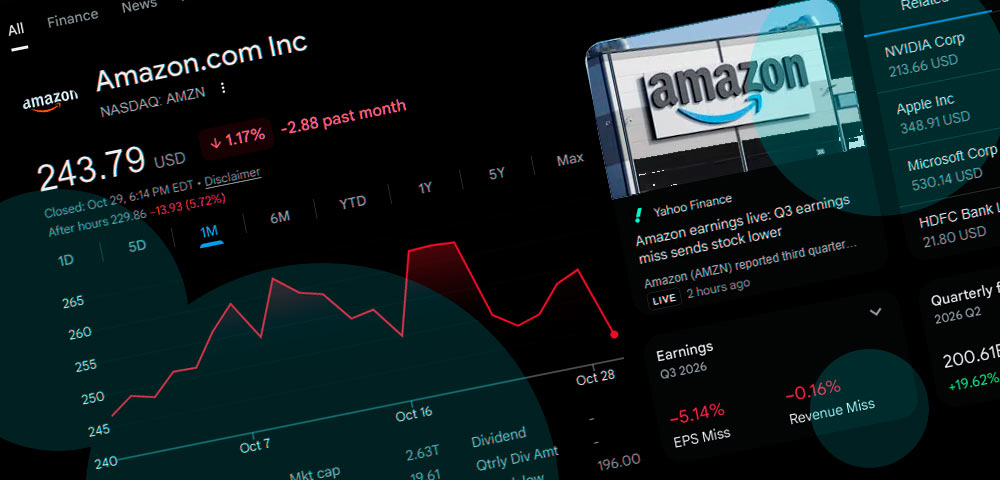
- Amazon stock price targets and analyst consensus
- Amazon Q3 earnings miss expectations despite record margins
- AWS revenue accelerates 39% as AI demand expands
- AI capital expenditure pushes free cash flow into negative territory
- Morgan Stanley and UBS expect stronger AWS profitability
- Retail sales and advertising growth fall short
- Fourth-quarter guidance raises concerns about holiday demand
- Amazon stock valuation and near-term outlook
Amazon (NASDAQ: AMZN) shares fell sharply on October 29, 2026, after the company reported weaker-than-expected third-quarter earnings and issued a cautious holiday-quarter outlook.
The stock closed regular trading at $243.79, down 4.25%, before falling to approximately $228.50 in extended trading, a further decline of 6.3%.
- Amazon shares fell sharply after third-quarter earnings missed expectations and fourth-quarter guidance disappointed, despite record operating profitability.
- AWS growth accelerated to its fastest pace in nearly five years, but exceptionally high AI infrastructure spending raised concerns about future cash generation.
- Wall Street remains overwhelmingly bullish on AMZN, although existing price targets largely predate the earnings release and could face revisions.
Amazon’s earnings revealed a widening gap between operating performance and cash generation. Its cloud division continued to accelerate, and consolidated operating margins reached a record high. However, the company’s investment in artificial intelligence infrastructure is expanding faster than operating cash flow.
That distinction is central to the latest Amazon stock price forecasts. Analysts remain optimistic about the long-term earnings potential of Amazon Web Services, but the selloff has increased scrutiny of capital expenditure, depreciation and the timing of returns on AI investment.
Amazon stock price targets and analyst consensus
Wall Street entered the third-quarter earnings release with a strongly positive outlook for Amazon.
According to S&P Global Market Intelligence data covering 60 analysts, the average 12-month AMZN price target stood at $332.41, representing approximately 36.4% upside from the October 29 regular-session close.
The consensus rating was Strong Buy, with 58 positive recommendations and two Hold ratings. Individual forecasts ranged from $230 to $405. Those estimates largely preceded the earnings announcement. Their implied upside therefore reflects expectations established before investors received the latest capital spending figures and fourth-quarter guidance.
Recent investment bank revisions show substantial confidence in Amazon’s cloud business.
Morgan Stanley analyst Brian Nowak upgraded Amazon to his top internet-sector pick on October 19, maintaining an Overweight rating and raising his target to $350 from $335.
Nowak identified AWS revenue growth, expanding cloud profitability, Bedrock adoption, AI-powered shopping and warehouse robotics as potential valuation catalysts.
KeyBanc Capital Markets also maintained a bullish outlook at the same target level, citing opportunities from enterprise cloud migration, AI applications and additional computing capacity.
UBS analyst Stephen Ju raised his target to $348 from $318 on October 26 while reiterating a Buy recommendation.
Bank of America maintained Buy with a $320 target ahead of earnings, arguing that new AWS capacity, enterprise contracts and AI demand could support stronger financial performance.
Other bullish forecasts included BMO Capital Markets at $380 and Evercore ISI at $355.
Wells Fargo reduced its target to $329 from $338, while Cantor Fitzgerald lowered its forecast to $310 from $320. Both retained positive ratings, but the reductions illustrated increasing caution about Amazon’s near-term risk-reward profile.
The latest results create a potential disconnect between these forecasts and the market’s assessment of AI investment costs. Post-earnings revisions will provide a more reliable indication of whether analysts consider the selloff excessive.
Amazon Q3 earnings miss expectations despite record margins
Amazon reported third-quarter revenue of $201.9 bn, an increase of 12% from $180.2 bn a year earlier but slightly below the Bloomberg analyst consensus of $202.25 bn.
Diluted earnings per share reached $1.89 against expectations of $1.97. Operating income increased 61% to $28.1 bn, exceeding estimates of approximately $26.2 bn. The consolidated operating margin reached 13.9%, compared with 9.7% in the prior-year quarter.
The apparent contradiction between higher operating profit and lower earnings per share reflects an important accounting factor.
Third-quarter 2025 results benefited from a $9.5 bn pre-tax investment gain associated with Anthropic. That gain was recorded in non-operating income and made the prior-year earnings comparison unusually demanding.
Consequently, the decline in reported net income does not indicate a corresponding deterioration in Amazon’s core operations.
Nevertheless, the operating profit improvement was insufficient to offset concerns about spending and the company’s near-term outlook.
AWS revenue accelerates 39% as AI demand expands
Amazon Web Services remained the strongest part of the quarterly report.
AWS generated $46 bn in revenue, increasing 39.3% year over year and exceeding Wall Street’s approximately $45.7 bn estimate. Growth accelerated from 37% in the second quarter, reaching its fastest rate in almost five years.
The division generated $17.8 bn in operating income, up from $11.4 bn a year earlier. Its operating margin reached 38.7%.
AWS accounted for approximately 63% of Amazon’s consolidated operating profit, emphasizing the cloud business’s importance to the company’s valuation.
CEO Andy Jassy said AWS exited the quarter at an annualized revenue run rate of approximately $184 bn and projected growth above 40% in both 2027 and 2028.
The company’s cloud backlog also expanded to $578 bn, compared with approximately $496 bn at the end of the preceding quarter.
These figures support the view that enterprise demand for cloud infrastructure and AI computing remains strong.
However, the result did not fully satisfy elevated market expectations. RBC Capital Markets analyst Brad Erickson noted that some institutional investors had anticipated AWS growth of approximately 42%. The reported acceleration was therefore encouraging but below the more aggressive expectations circulating ahead of earnings.
Amazon is also expanding its AI software business. Fortune 500 customers increased their spending on Amazon Bedrock’s inference services nearly sevenfold year over year, while total Bedrock token volume grew approximately 17 times.
Amazon Bedrock AgentCore serves tens of thousands of customers, with agent deployments during the third quarter doubling relative to the preceding three quarters combined.
These adoption indicators suggest that AWS is expanding beyond infrastructure rental into higher-value AI services. However, Amazon has not disclosed sufficient revenue and profitability figures to establish the financial contribution of each offering.
AI capital expenditure pushes free cash flow into negative territory
Capital spending was the most significant concern in the earnings release. Amazon purchased approximately $77.3 bn of property and equipment during the third quarter, substantially exceeding market expectations of around $57.5 bn.
Management maintained its forecast for approximately $220 bn in cash capital expenditure during 2026, primarily supporting data centers, computing infrastructure and AI capacity.
The company’s trailing 12-month free cash flow deteriorated to an outflow of $42.4 bn, compared with a positive $14.8 bn in the corresponding period a year earlier. This deterioration occurred despite a 29% increase in operating cash flow to $168.3 bn.
Amazon’s operations continue generating substantial cash, but infrastructure investment is consuming more than that business produces. The company attributed much of the deterioration to a $94.8 bn year-over-year increase in net property and equipment purchases.
Management also indicated that spending could rise further in 2027 as additional AWS capacity comes online.
The investment case therefore depends on whether incremental cloud revenue and operating profit can eventually outpace depreciation, energy costs and further infrastructure expansion.
If capital expenditure continues increasing at its current pace, Amazon could report strong accounting earnings while generating limited free cash flow for an extended period.
Morgan Stanley and UBS expect stronger AWS profitability
The principal disagreement among bullish analysts concerns how much AWS profitability can improve as revenue accelerates.
Morgan Stanley expects AWS sales to grow 47% in 2027 and 42% in 2028, with operating margins reaching 42% and 44%, respectively.
Nowak’s model implies Amazon could generate approximately $16.50 in earnings per share in 2028, around 7% above the previous Wall Street consensus.
His valuation framework focuses on the relationship between cloud revenue growth and operating profitability.
Under that approach, a combined growth and margin figure approaching 90% would support a premium valuation for AWS.
The model assumes that new computing capacity can be deployed quickly enough to generate substantial incremental revenue without a proportional increase in operating expenses.
UBS takes an even more optimistic view of margins. Ju forecasts a 46% AWS operating margin in 2027, compared with a consensus estimate of approximately 38%. His argument is that revenue generated by additional cloud capacity will increase considerably faster than the operating costs required to support it.
UBS estimates that AWS could add approximately $80 bn in revenue against roughly $20 bn in additional depreciation and amortization.
The bank nevertheless recognizes that 2027 capital expenditure could exceed $300 bn, potentially leaving free cash flow near zero or negative.
Morgan Stanley’s forecasts also incorporate exceptionally high future infrastructure investment, including approximately $355 bn in 2027 and $365 bn in 2028.
These projections explain why analysts can remain bullish on Amazon’s earnings trajectory while accepting substantial near-term pressure on cash generation.
The key uncertainty is whether demand and pricing remain strong enough to justify that spending before depreciation and replacement requirements begin absorbing a larger share of cloud profits.
Retail sales and advertising growth fall short
Outside AWS, Amazon’s consumer businesses produced mixed results. North American revenue increased 6% to $112.9 bn, while international sales rose 5% to $43.1 bn.
Online store revenue reached $68.47 bn, below analyst expectations of approximately $69.6 bn. Growth of roughly 2% marked a significant slowdown from the company’s recent performance.
The comparison was affected by the timing of Prime Day. In 2025, the event occurred during the third quarter, while most major markets held it during the second quarter of 2026.
Amazon estimated that reported consolidated revenue growth would have been approximately four percentage points higher without that shift.
Advertising services generated $19.6 bn, also missing forecasts of roughly $20.9 bn. Constant-currency growth slowed to 12%, compared with 26% in the preceding quarter.
Management attributed part of the slowdown to timing effects and expects advertising growth to recover to the high teens during the fourth quarter.
Amazon is simultaneously investing in AI tools designed to influence customer purchasing behavior. Its Alexa shopping assistant was used by more than 400 mn customers over the preceding 12 months, with interactions increasing 570% year over year.
The company also operates more than one million robots across its fulfillment network, supporting automation initiatives intended to improve productivity and reduce operating costs.
Prime Video has reached profitability as a standalone business, according to management, adding another potential source of advertising and subscription earnings.
These developments support the longer-term retail investment case, although their financial contribution remains less transparent than AWS operating performance.
Fourth-quarter guidance raises concerns about holiday demand
Amazon forecast fourth-quarter revenue between $240 bn and $247 bn, implying growth of 12% to 16% year over year. The midpoint of $243.5 bn fell below the approximately $244.5 bn expected by analysts.
Management also projected operating income between $28.5 bn and $33.5 bn. The midpoint of $31 bn was approximately 6% below the $33 bn consensus estimate.
Despite the miss, that forecast would still represent substantial growth from the $25 bn in operating profit recorded during the fourth quarter of 2025.
The guidance therefore signals weaker-than-expected profitability rather than an outright contraction in the business.
Investors will focus on whether AWS maintains its acceleration, advertising growth recovers and retail margins withstand holiday-season cost pressures.
Energy prices, transportation costs, labor expenses and the timing of infrastructure deployments could all influence the outcome.
Amazon stock valuation and near-term outlook
Amazon’s valuation increasingly depends on how investors assess future earnings against the costs required to produce them.
The company generated approximately $797.5 bn in revenue over the latest 12 months, reflecting sustained expansion across retail, cloud computing and services.
However, conventional trailing price-to-earnings comparisons are less useful when reported net income includes substantial gains and losses from equity investments.
Segment operating income, depreciation trends and normalized free cash flow provide a clearer basis for assessing Amazon’s underlying financial performance.
The latest after-hours decline also pushed the stock below the approximately $243 level that had served as a longer-term technical reference before earnings.
That move suggests weaker near-term momentum, although extended-hours trading does not establish where the shares will stabilize during the next regular session.
The next major test for AMZN is whether management can demonstrate that rapid AWS growth is translating into improved returns on invested capital.
Continued expansion in cloud backlog, higher operating margins and a moderation in capital spending growth would strengthen the case for a recovery toward analysts’ existing price targets.
Conversely, further increases in infrastructure expenditure without a corresponding improvement in cash generation could force analysts to revise their earnings assumptions and valuation multiples, even if demand for AWS services remains strong.