Follow Beinsure
- BT Group share price targets show limited consensus upside
- Openreach investment could support a recovery toward 240p
- BT Group’s FY2027 financial outlook
- TalkTalk acquisition introduces costs and regulatory uncertainty
- AI-RAN trials with Nvidia and Nokia offer longer-term potential
- BT Group share price forecast for 2026, 2027 and 2028
- November 5 earnings could determine the next move
BT Group (LSE: BT.A) shares are recovering after breaking above the 210p resistance level, supported by expectations of improving free cash flow and continued investment in the UK’s fibre infrastructure.
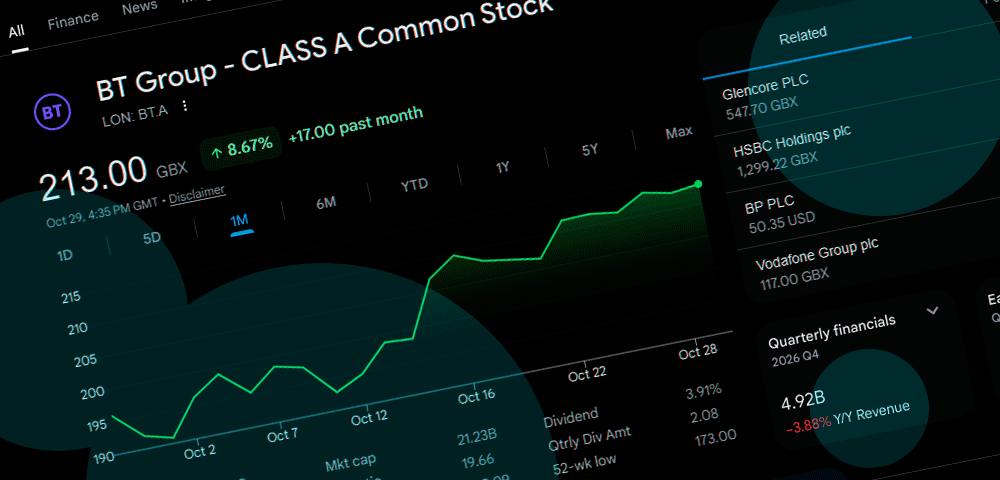
The stock closed at 213p on October 29, 2026, up 0.23% for the session. Its next technical test lies between 220p and 225p, although the company’s half-year results on November 5 could determine whether the recovery continues.
- BT Group shares closed at 213p on October 29, with the recovery above 210p putting the 220-225p resistance zone in focus ahead of November 5 earnings.
- Analysts remain divided: the average 12-month price target is approximately 224p, while individual forecasts range from 150p to 310p.
- BT expects normalised free cash flow of around £2 bn in FY2027 and £3 bn by the end of the decade, although the TalkTalk acquisition adds costs and regulatory uncertainty.
The longer-term investment case depends on Openreach’s ability to convert its extensive network investment into stronger cash generation, while managing broadband competition, debt and the newly acquired TalkTalk business.
BT Group share price targets show limited consensus upside
The average 12-month analyst price target for BT Group is approximately 224p, implying upside of about 5% from the latest closing price.
Individual broker forecasts differ substantially.
| Analyst | Rating | Price target | Potential return from 213p |
|---|---|---|---|
| JPMorgan | Overweight | 310p | +45.5% |
| Berenberg | Buy | 300p | +40.8% |
| Analyst consensus | Hold | 224p | +5.2% |
| Citi | Sell | 165p | -22.5% |
| Barclays | Underweight | 155p | -27.2% |
| Deutsche Bank | Sell | 150p | -29.6% |
Barclays lowered its target from 165p to 155p on October 20, maintaining its negative assessment.
The difference between bullish and bearish valuations reflects uncertainty over BT’s ability to increase cash flow while facing pressure on broadband customer numbers, pricing and operating costs.
The optimistic case assumes that declining capital expenditure and network efficiency gains will materially improve shareholder returns. More cautious analysts remain concerned about the group’s debt, competitive pressures and the cost of its transformation programme.
Openreach investment could support a recovery toward 240p
BT’s improving cash flow outlook is one of the strongest arguments for a higher share price.
The company invested £5.1 bn in capital expenditure during FY2026, largely reflecting the continued expansion of its full-fibre broadband network.
Management expects expenditure excluding spectrum to decline to £4.2-£4.3 bn in FY2027, helping normalised free cash flow increase from £1.5 bn in FY2026 to approximately £2 bn.
BT’s longer-term target is £3 bn in annual normalised free cash flow by the end of the decade.
Openreach had passed 23 mn premises with full-fibre infrastructure by the end of March 2026 and aims to reach 25 mn by December.
As network construction slows, higher customer adoption and lower investment requirements could improve returns on the infrastructure already built.
BT has also raised its transformation savings target from £3 bn to £3.7 bn, with the programme extending through FY2030. However, competition remains a significant risk. Openreach lost approximately 825,000 broadband lines during the last financial year as alternative network operators continued expanding.
BT also ended FY2026 with nearly £20 bn in net debt.
A recovery toward 240p, close to the stock’s 52-week high, would represent approximately 12.7% upside from 213p. Achieving that level would likely require evidence that improving cash generation can outweigh competitive pressures and financing costs.
BT Group’s FY2027 financial outlook
BT has updated its financial guidance following plans to combine its international operations with Verizon in a joint venture.
The revised outlook excludes BT International, which is treated as a discontinued operation.
| Financial metric | FY2027 guidance |
|---|---|
| Adjusted group revenue | £17.1-£17.6 bn |
| Adjusted UK service revenue | £15.1-£15.4 bn |
| Adjusted EBITDA | £8.1-£8.2 bn |
| Capital expenditure, excluding spectrum | £4.2-£4.3 bn |
| Normalised free cash flow | £2 bn |
These forecasts exclude the financial effects of the TalkTalk acquisition.
The expected improvement in free cash flow is especially important because BT plans to increase its dividend by a low- to mid-single-digit percentage annually while strengthening its financial position.
The FY2026 dividend totalled 8.32p per share, equivalent to a historical yield of approximately 3.9% at the latest share price.
TalkTalk acquisition introduces costs and regulatory uncertainty
BT acquired TalkTalk Telecommunications and PlatformX Communications from administration on October 5, protecting services for approximately 2.5 mn customers.
The company estimates a £400 mn cash impact in FY2027, covering acquisition consideration, transaction and administration costs, working capital requirements and trading losses.
Management has maintained its financial guidance excluding the acquisition, but the additional costs could weigh on reported cash flow. The deal also remains subject to regulatory scrutiny.
The Competition and Markets Authority delivered its assessment to the government on October 19, while the merger inquiry remains open.
Virgin Media O2 CEO Lutz Schüler has questioned the speed of the approval process and called for closer examination of the transaction’s competitive implications.
Successful integration could provide BT with additional customers and potential cost synergies. However, regulatory remedies, integration expenses and TalkTalk’s financial condition could reduce those benefits.
AI-RAN trials with Nvidia and Nokia offer longer-term potential
BT is also expanding its network technology strategy through a partnership with Nvidia and Nokia. The companies plan to begin live AI-RAN trials on BT’s EE mobile network in Birmingham in 2027.
AI-RAN uses artificial intelligence to improve radio network performance, potentially allowing operators to increase capacity and make more efficient use of existing spectrum.
Nokia has reported improvements exceeding 20% in spectral efficiency during laboratory testing. BT’s planned trials will assess whether similar results can be achieved on a live network.
Other telecom operators are advancing comparable projects. T-Mobile has completed an AI-RAN call on its commercial network using Nvidia and Nokia technology.
For BT, successful deployment could eventually support network efficiency and reduce the need for additional infrastructure investment.
However, AI-RAN remains an emerging technology and is unlikely to make a material contribution to BT’s near-term earnings.
BT Group share price forecast for 2026, 2027 and 2028
Short-term forecasting models suggest moderate gains through November, followed by a potential pullback in December.
One published algorithmic forecast projects the following prices:
| Period | Forecast price | Change from 213p |
|---|---|---|
| November 2026 | 231p | +8.5% |
| December 2026 | 216p | +1.4% |
| December 2027 | 389p | +82.6% |
| October 2028 | 541p | +154.0% |
The forecasts for 2027 and 2028 are particularly aggressive compared with current broker valuations. They would require substantial improvements in earnings expectations, cash generation or the valuation investors are willing to assign to BT.
Without clear assumptions supporting those increases, they should be treated as speculative scenarios rather than reliable estimates of future market prices.
The near-term outlook is more closely tied to whether BT can sustain trading above 210p and overcome resistance at 220–225p.
November 5 earnings could determine the next move
BT will publish its FY2027 half-year results on November 5.
Investors will focus on Openreach’s broadband connections, full-fibre adoption, capital expenditure and progress toward the £2 bn normalised free cash flow target.
Updates on TalkTalk’s financial impact, regulatory review and potential integration costs will also be important.
The near-term outlook is cautiously positive while BT shares remain above 207-210p. A breakout beyond 225p could support a move toward 240p, although that scenario depends on earnings and guidance reinforcing confidence in the recovery.
Over the next 12 months, the analyst consensus of approximately 224p suggests limited upside. More substantial gains would require BT to demonstrate that lower infrastructure spending and cost savings can translate into sustained free cash flow growth despite continued competition in the UK telecom market.