Follow Beinsure
- Tesla stock price targets suggest limited near-term upside
- Morgan Stanley and Goldman Sachs remain cautious on valuation
- Tesla’s Q3 earnings beat masks a 56% decline in operating profit
- Robotaxi expansion becomes Tesla’s central growth catalyst
- Full Self-Driving adoption strengthens Tesla’s software business
- A SpaceX merger could change Tesla’s valuation
- ARK Invest’s $4,400 Tesla forecast depends on Robotaxi economics
- Tesla’s valuation leaves little room for execution delays
- Tesla stock outlook after the October rebound
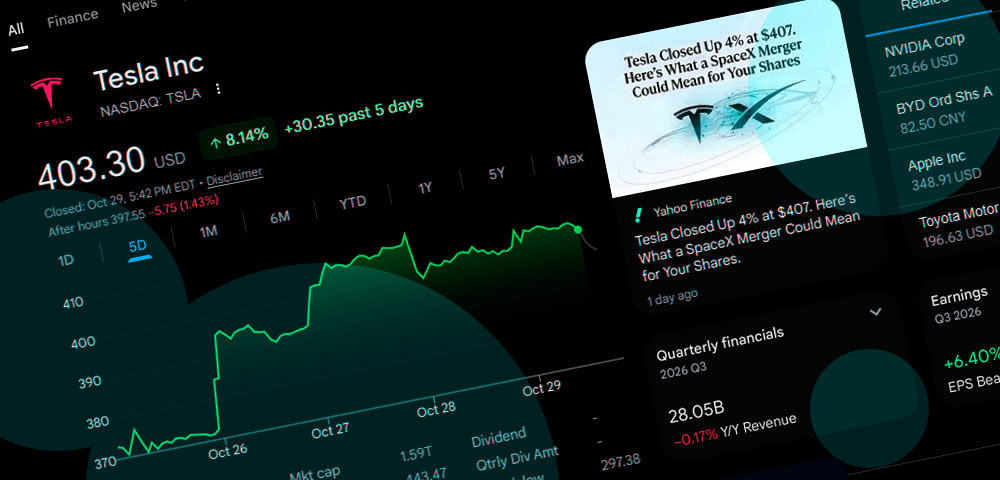
Tesla (NASDAQ: TSLA) shares closed October 29, 2026, at $403.30, down 0.23% for the session, before slipping toward $397 in after-hours trading.
The stock has recovered from its October lows, supported by improving sentiment toward autonomous driving and speculation about a possible combination with SpaceX.
- Wall Street’s outlook remains divided despite recent upgrades, with Tesla trading close to the average analyst price target.
- Robotaxi mileage and Full Self-Driving adoption are accelerating, but autonomous transportation has yet to demonstrate meaningful profitability.
- A potential SpaceX merger could materially change Tesla’s valuation, although no agreement has been reached and shareholder approval presents a significant obstacle.
The rebound follows a third-quarter report that exceeded adjusted earnings expectations but showed another substantial decline in operating profit.
Tesla’s valuation increasingly depends on businesses that contribute relatively little to current earnings: autonomous transportation, Full Self-Driving software and humanoid robotics.
The latest investment-bank forecasts reflect that uncertainty. Several analysts have become more optimistic about Tesla’s autonomous technology and corporate strategy, while others remain concerned that its valuation has moved far ahead of demonstrated profitability.
Tesla stock price targets suggest limited near-term upside
According to S&P Global Market Intelligence, 43 analysts covering Tesla have an average 12-month price target of $410.68, implying approximately 1.8% upside from the latest closing price.
The median forecast stands at $430, with published estimates ranging from $128.11 to $600. The ratings distribution includes 19 Buy recommendations, 22 Holds and two Sells.
The average target has increased from approximately $397.83 before the third-quarter earnings announcement, indicating that recent upgrades have improved sentiment without producing a substantially higher consensus valuation.
Barclays delivered the most significant recent rating change.On October 26, analyst Dan Levy upgraded Tesla to Overweight from Equal Weight and increased his target to $450 from $370. The bank identified three potential catalysts: improving automotive performance, accelerating Robotaxi deployment and the possibility of a takeover premium from a SpaceX combination.
Barclays expects Tesla’s automotive business to return to annual growth in 2026 following two years of declining sales. It also sees opportunities from Full Self-Driving adoption, Shanghai exports and energy storage expansion.
The merger scenario adds a potential source of value that is not directly dependent on near-term vehicle earnings.
Other bullish investment banks emphasize Tesla’s software and autonomous driving opportunities.
Bank of America maintained a Buy rating and $460 target on October 29, citing autonomy prospects and potential benefits from closer integration with SpaceX.
Mizuho raised its target from $450 to $460 while retaining an Outperform recommendation. RBC Capital Markets maintained a $480 objective, Cantor Fitzgerald stood at $485 and Piper Sandler increased its forecast to $475.
These analysts generally expect Tesla to benefit from a larger contribution from software, autonomous transportation and new products as commercialization advances.
Morgan Stanley and Goldman Sachs remain cautious on valuation
Several major banks take a more restrained view despite acknowledging progress in Tesla’s technology programs.
- Morgan Stanley increased its price target to $410 from $400 after earnings but maintained an Equal Weight rating.
- UBS raised its objective from $391 to $425 while retaining Neutral.
- JPMorgan lifted its target to $430 from $415, also maintaining Neutral, while Deutsche Bank’s latest forecast stands at $420 with a Buy recommendation.
- Goldman Sachs reiterated Neutral and a $360 target following the third-quarter results.
The bank noted stronger gross margins and adjusted earnings but highlighted the divergence between Tesla’s operating performance and the valuation attached to its future businesses.
Evercore ISI remained more cautious with a $300 target and Hold rating.
Phillip Securities maintained a Sell recommendation with a $230 objective, reflecting a substantially more negative assessment of Tesla’s valuation.
The disagreement is unusually wide because analysts are valuing different combinations of existing earnings and potential future businesses.
Traditional automotive models place greater weight on deliveries, margins and capital requirements. More optimistic approaches assign significant value to Robotaxi networks, software subscriptions and robotics.
Separately, an updated October 29 quantitative forecast from 24/7 Wall St. placed Tesla’s 12-month value at $423.60 with a Hold recommendation.
That estimate represents a proprietary valuation model rather than an investment-bank consensus. Its projected upside is modest and broadly consistent with the view that Tesla’s near-term share price already incorporates substantial expectations for future growth.
Tesla’s Q3 earnings beat masks a 56% decline in operating profit
Tesla reported third-quarter revenue of $28.05 bn, narrowly above the $28.02 bn estimate cited in pre-earnings market forecasts.
Revenue was essentially unchanged from a year earlier. Adjusted diluted earnings reached $0.48 per share, beating expectations of approximately $0.45. However, GAAP diluted EPS fell to $0.22 from $0.39, while net income attributable to common shareholders declined 43% to $787 mn. Operating income dropped 55.8% to $718 mn from $1.62 bn.
The deterioration reflected higher operating expenses, particularly research and development spending associated with autonomous driving, artificial intelligence infrastructure and new products.
Tesla’s R&D expenses increased 69% year over year to $2.76 bn. The company is investing in software, proprietary chips, battery technology and Optimus robots while its principal revenue-generating business remains under pressure.
Automotive revenue totaled $20.56 bn, accounting for approximately 73% of consolidated sales.
Tesla delivered 486,532 vehicles during the quarter, exceeding its company-compiled analyst consensus of 461,974 by approximately 5.3%. Nevertheless, deliveries declined 2% from the corresponding period in 2025.
Management attributed part of the production constraint to limited battery availability, despite reporting its largest passenger vehicle order backlog in four years.
Gross margin excluding regulatory credit sales increased to 18.1% from 15.4% a year earlier, indicating better profitability on vehicle operations despite competitive pricing pressure.
However, regulatory credit revenue declined 73%, removing a historically important source of high-margin automotive earnings.
Competition from lower-priced manufacturers, particularly BYD and Geely, continues to constrain Tesla’s ability to increase vehicle prices in major international markets.
The latest results therefore present a mixed operating picture: stronger vehicle margins and better-than-expected deliveries alongside declining earnings and considerable investment requirements.
Robotaxi expansion becomes Tesla’s central growth catalyst
Tesla’s most important prospective earnings driver is its autonomous transportation business. The company introduced Cybercab vehicles into its Austin Robotaxi service on September 3, 2026.
By the end of the third quarter, cumulative unsupervised Robotaxi mileage had increased eightfold from the preceding quarter to nearly 2 mn miles.
Tesla subsequently reported approximately 3.1 million autonomous miles as of October 18, including operations across several cities in Texas and Florida.
The increase demonstrates operational expansion, but mileage alone does not establish commercial profitability.
Tesla has not provided sufficient financial detail to determine the Robotaxi business’s contribution to consolidated revenue or operating income.
Chief Financial Officer Vaibhav Taneja acknowledged during the latest earnings call that the company had not yet achieved its target operating cost of $0.30 per paid Robotaxi mile.
Management expects higher utilization, improved fleet coordination and lower servicing costs to move the business closer to that objective.
Tesla also plans to expand Cybercab deployment beyond Austin and expects some privately owned vehicles could begin participating in the Robotaxi network around the second quarter of 2027.
A successful transition would allow Tesla to expand network capacity without owning every participating vehicle. However, the economic implications depend on the division of revenue between Tesla and vehicle owners, fleet utilization, insurance costs, maintenance requirements and pricing.
These financial assumptions remain more important to long-term valuation than the number of miles driven during early deployment.
Full Self-Driving adoption strengthens Tesla’s software business
Tesla reported 1.74 million active Full Self-Driving subscriptions at the end of September, compared with 1.04 million a year earlier. That represents growth of approximately 67%.
The reported figure includes customers who purchased FSD upfront as well as those paying monthly subscription fees. It should therefore not be interpreted entirely as recurring subscription revenue.
Management said FSD adoption has continued increasing across new vehicle deliveries, particularly in North America.
Software monetization offers an attractive potential source of additional revenue because incremental software sales can carry higher margins than vehicle manufacturing.
Tesla has also expanded regulatory approvals for its supervised driving system across several European markets.
Nevertheless, Full Self-Driving (Supervised) remains a driver-assistance product requiring human supervision. Its adoption should not be equated with approval for fully autonomous consumer vehicles.
Tesla must also demonstrate that greater software penetration produces sustained growth in recognized revenue and operating profit.
The relationship between software adoption and vehicle demand remains important, particularly as the company faces competition from manufacturers offering increasingly sophisticated driver-assistance features.
A SpaceX merger could change Tesla’s valuation
Speculation surrounding a possible Tesla-SpaceX combination has become an additional driver of the stock.
Tesla disclosed in its latest quarterly SEC filing that its board established a special committee of independent directors to examine closer integration with SpaceX, potentially including a business combination.
SpaceX has also formed a committee to evaluate a transaction.
Elon Musk has publicly supported the idea but confirmed that the committees have not agreed on any terms. No definitive agreement, exchange ratio or acquisition premium has been announced.
JPMorgan has outlined a possible SpaceX-led, all-stock transaction offering Tesla shareholders a premium of approximately 30% to 35%. That scenario reflects the bank’s assessment of potential transaction economics, not an announced offer or a formal share-price guarantee.
The proposed strategic rationale includes shared engineering resources, semiconductor development, AI infrastructure and existing commercial relationships.
Musk has said a transaction would require approval from holders representing at least 50% of all outstanding Tesla shares, rather than merely a majority of votes cast.
With approximately 3.95 billion shares outstanding, that would require roughly 1.98 billion affirmative votes.
At turnout comparable to Tesla’s 2025 annual meeting, the proposal would need support from approximately two-thirds of participating shares. Retail shareholder participation could therefore materially affect the outcome.
A transaction would also raise questions about the valuation of each company, minority shareholder protections, Musk’s control of the combined business and potential regulatory scrutiny.
A merger could create operational synergies, but it could also expose Tesla shareholders to additional capital spending and financing obligations.
Until transaction terms become available, assigning a specific takeover premium to Tesla’s intrinsic value remains speculative.
ARK Invest’s $4,400 Tesla forecast depends on Robotaxi economics
ARK Invest offers a substantially more optimistic long-term valuation than conventional Wall Street forecasts. In its October 19 research update, ARK projected a Tesla share price of approximately $4,400 by 2031.
The firm’s model assigns about 80% of Tesla’s projected enterprise value to its autonomous ride-hailing business.
Its base case assumes roughly 8 million Robotaxi vehicles operating by 2031, generating hundreds of billions of dollars in annual transportation revenue.
The forecast also incorporates substantial contributions from Optimus robotics and energy storage.
ARK’s projected valuation would imply a market capitalization of approximately $17.5 tn, compared with Tesla’s current value near $1.6 tn.
The difference illustrates the scale of the assumptions separating the company’s existing business from its most optimistic future scenarios.
ARK’s projection is not a conventional 12-month investment-bank price target.
It is a highly speculative multiyear model dependent on widespread autonomous driving adoption, substantial fleet utilization, favorable operating costs and the successful commercialization of products that have yet to reach meaningful scale.
Tesla’s current Robotaxi activity provides some operational evidence supporting the technology’s development, but not the revenue or profitability required to substantiate that long-term valuation.
Tesla’s valuation leaves little room for execution delays
Tesla’s financial valuation remains demanding even after its share price correction.
Trailing GAAP earnings are approximately $0.91 per share, implying a price-to-earnings ratio above 440 times. That multiple reflects the sharp decline in automotive profitability over the preceding two years.
Consensus estimates currently project adjusted EPS of $1.74 for 2026 and $2.16 for 2027.
Even using the higher forward estimate, Tesla trades at approximately 187 times expected earnings. Revenue forecasts call for $107.79 bn this year and $122.32 bn next year, representing annual growth of roughly 14%. Those expectations are positive but insufficient on their own to explain Tesla’s valuation relative to conventional automotive manufacturers.
Investors are effectively paying for future software, fleet-based transportation and robotics profits that remain largely outside current financial results.
Third-quarter free cash flow fell approximately 62% to $1.53 bn from $3.99 bn a year earlier. Capital expenditures increased to $4.73 bn, and Tesla now expects spending to exceed $20 bn in 2026 as it expands computing infrastructure, manufacturing capabilities and autonomous vehicle operations.
The company ended September with approximately $45.45 bn in cash, cash equivalents and short-term investments, providing substantial liquidity. It also entered credit agreements providing aggregate commitments of $30 bn to support its investment plans.
The balance sheet offers flexibility, but sustained capital spending without corresponding increases in operating cash generation would reduce financial returns.
Tesla stock outlook after the October rebound
Tesla’s recent recovery has improved its short-term technical position, although the shares remain below the 52-week high of $498.83.
The stock is trading near its 20-day moving average and above its 50-day and 200-day averages, which stood near $391 and $375, respectively, in the latest technical data.
A sustained move above the recent $406 to $410 area would indicate stronger buying momentum.
Failure to hold the $400 level could shift attention toward the longer-term moving averages. These levels provide trading reference points rather than independently verified probabilities of future price movements.
The fundamental outlook depends on several developments that can materially change earnings expectations.
- First, Robotaxi deployment must begin producing measurable commercial returns, particularly through higher fleet utilization and lower operating costs.
- Second, Tesla needs to stabilize automotive profitability while expanding battery production and managing intense international competition.
- Third, the energy storage business must convert its substantial order backlog into profitable revenue growth.
- Finally, the SpaceX special committees must determine whether a transaction is feasible and, if so, establish terms that shareholders can evaluate.
For the near term, the prevailing analyst consensus indicates that Tesla is trading close to fair value under existing forecasts.
Substantial appreciation beyond those estimates would require stronger evidence of autonomous transportation profitability, a material improvement in operating earnings or a confirmed corporate transaction that changes the company’s financial prospects.