Follow Beinsure
- Western Digital stock price targets show substantial upside
- Why several banks cut their WDC forecasts despite stronger earnings
- Fiscal Q1 2027 earnings confirm exceptional HDD pricing power
- AI cloud storage accounts for 88% of Western Digital revenue
- Strong Q2 guidance raises expectations for 2027
- Western Digital valuation: the low P/E requires closer examination
- Analysts expect earnings to rise sharply through fiscal 2028
- Higher capital spending and storage competition remain key risks
- WDC stock outlook after a 50% correction
Western Digital (NASDAQ: WDC) has become one of the strongest-performing AI infrastructure stocks, but its latest earnings report has exposed a growing disagreement between investors and Wall Street analysts over the durability of the storage industry’s profit expansion.
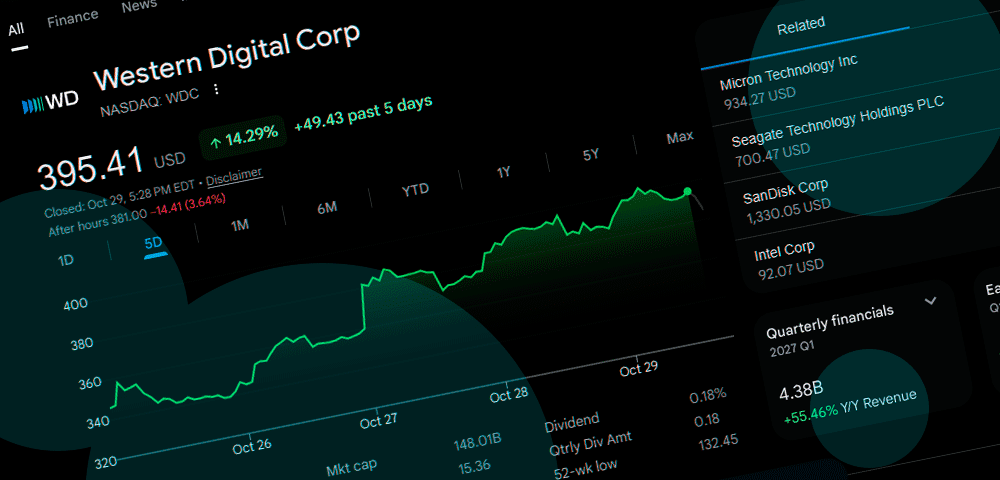
Shares closed October 29, 2026, at $395.41, down 0.25% for the session, before weakening further in after-hours trading. The stock remains approximately 51% below its June intraday high of $799.87, despite gaining more than 200% over the preceding year.
- Western Digital’s fiscal Q1 2027 revenue surged 55%, supported by higher HDD shipments, stronger pricing and expanding cloud storage demand.
- Wall Street’s average 12-month price target is $613.38, but major banks disagree sharply on valuation despite stronger earnings forecasts.
- The stock’s low reported P/E partly reflects nonrecurring Sandisk investment gains. Future returns depend on sustainable operating profits and storage pricing.
The company reported stronger-than-expected fiscal first-quarter results on October 22 and issued guidance substantially above analysts’ forecasts. Nevertheless, several investment banks reduced their price targets, primarily because of lower valuation multiples and concerns about capital expenditure.
The central issue for Western Digital’s stock forecast is whether favorable hard disk drive pricing represents a sustainable improvement in industry economics or an unusually profitable phase of the storage cycle.
Western Digital stock price targets show substantial upside
Wall Street’s consensus remains positive following the latest earnings announcement.
According to S&P Global Market Intelligence, 26 analysts covering Western Digital have an average 12-month price target of $613.38, implying approximately 55% upside from the latest regular-session close. The median target stands at $622.50, with forecasts ranging from $405 to $900.
Of the covering analysts, 21 recommend buying the stock and five maintain Hold ratings. None currently has a Sell recommendation.
The consensus has nevertheless weakened. The average target stood near $654 before the earnings release, indicating that stronger operating results have not prevented analysts from reducing valuation assumptions.
Robert W. Baird has the most aggressive forecast among the major firms.
On October 23, analyst Tristan Gerra raised the bank’s price target to $900 from $630, maintaining an Outperform rating.
Baird expects Western Digital’s exabyte shipment growth to accelerate through fiscal 2027 and 2028 as higher-capacity ePMR drives ramp and heat-assisted magnetic recording, or HAMR, technology enters volume production.
The bank also sees opportunities for further gross margin expansion through long-term customer agreements, improving product mix and higher storage output without equivalent growth in drive unit shipments.
Bank of America maintains another bullish forecast at $800, following an increase from $720 ahead of the results.
Morgan Stanley raised its target to $668 from $643 after earnings, retaining an Overweight rating. Analyst Erik Woodring highlighted stronger enterprise demand and pricing, alongside December-quarter guidance that exceeded the bank’s already optimistic expectations.
JPMorgan also increased its objective to $650 from $600.
These forecasts assume that the current supply-demand imbalance will support higher earnings for longer than investors have historically expected from the HDD industry.
Why several banks cut their WDC forecasts despite stronger earnings
The more cautious analyst revisions reveal a different interpretation of the same operating performance.
Cantor Fitzgerald reduced its target from $900 to $625 while maintaining an Overweight rating.
Analyst C.J. Muse increased the firm’s earnings forecasts to approximately $30 per share for calendar 2027 and $41.50 for 2028.
The lower price objective therefore reflected valuation compression rather than deteriorating earnings expectations.
Cantor’s revised target represents approximately 15 times its projected calendar 2028 earnings.
Citi made a similar adjustment, reducing its target to $660 from $740 while retaining a Buy rating. The bank cited lower peer valuation multiples despite continued confidence in the HDD cycle.
Rosenblatt Securities cut its objective to $650 from $800, while Bernstein’s latest forecast stands at $600, down from $770.
Evercore ISI maintained an Outperform rating and $575 target, emphasizing the company’s pricing strength.
The most conservative revisions came from analysts concerned about capital intensity and the risk of assigning a premium valuation to cyclical earnings.
TD Cowen lowered its target to $430 from $540, retaining a Buy rating.
Analyst Krish Sankar reduced the earnings multiple applied to Western Digital from approximately 20 times to 15 times, reflecting concerns about higher investment requirements.
Wells Fargo previously cut its target from $730 to $450.
Susquehanna maintained a Neutral rating while reducing its objective to $405 from $460. UBS also retained a cautious Neutral assessment, with a target near $435.
The differences are substantial. While Baird expects more than 125% upside, the lowest published forecasts imply little appreciation from current levels.
The disagreement is principally about how long Western Digital can sustain elevated pricing and margins, rather than whether demand is currently strong.
Fiscal Q1 2027 earnings confirm exceptional HDD pricing power
Western Digital reported revenue of $4.38 bn for the quarter ended October 2, an increase of 55% from $2.82 bn a year earlier. The result exceeded Wall Street’s approximately $4.14 bn estimate.
Adjusted diluted earnings reached $4.64 per share, compared with expectations near $4.11 and $1.78 in the corresponding quarter of fiscal 2026.
GAAP diluted EPS was $4.63, while basic EPS totaled $4.86. These measures should not be confused when comparing results with analyst forecasts. Revenue growth reflected both increased storage shipments and substantial pricing improvements.
Western Digital shipped 248 exabytes of storage capacity, up 22% year over year and 8% sequentially.
Average selling prices per terabyte increased 28%, accelerating from growth in the high teens during the preceding quarter. This combination produced significant operating leverage.
Non-GAAP gross margin reached 58.1%, compared with 43.9% a year earlier, while adjusted operating margin expanded to 49.1%. On a GAAP basis, operating income increased 158% to $2.05 bn, with an operating margin of 46.7%.
Chief Financial Officer Kris Sennesael said incremental year-over-year gross margins remained above 80%, demonstrating the profitability of additional revenue under current market conditions.
Operating cash flow reached $1.60 bn, while free cash flow totaled $1.38 bn. Western Digital repurchased approximately $1 bn in shares during the quarter and increased its quarterly dividend by 17% to $0.175 per share.
Unlike some of the company’s historical reported earnings gains, the latest quarter’s profitability was supported by substantial operating cash generation.
AI cloud storage accounts for 88% of Western Digital revenue
Western Digital completed the separation of its flash memory business into Sandisk in 2025, leaving the company focused on hard disk drives. That structure has increased its exposure to large cloud providers and the economics of storing rapidly expanding datasets.
Cloud revenue reached approximately $3.87 bn in fiscal Q1, representing 88% of consolidated sales. The segment grew 54% year over year, supported by higher shipments of nearline HDDs and stronger average selling prices.
AI infrastructure investment contributes to this demand because training datasets, inference records and enterprise information must be stored economically at scale.
Although flash storage offers performance advantages, HDDs generally remain substantially cheaper per terabyte for large-capacity applications.
That cost difference supports continued demand from hyperscale data centers even as solid-state storage technology advances.
Management also reported expanding visibility into future purchases. CEO Irving Tan said Western Digital has demand visibility extending into 2030 and 2031 across its seven largest customers.
Long-term agreements covering shipments in 2027 and 2028 provide additional support for production planning.
However, long-range customer forecasts should not be interpreted as fully contracted revenue at fixed prices.
Management acknowledged that some existing agreements will expire and require renewal, while other shipments remain outside long-term contracts.
The pricing achieved on those renewals will determine how much of the current margin expansion can be sustained.
Strong Q2 guidance raises expectations for 2027
Western Digital expects fiscal second-quarter 2027 revenue of $5.1 bn, plus or minus $100 mn. At the midpoint, that represents approximately 69% year-over-year growth and exceeds the roughly $4.57 bn Wall Street forecast ahead of the announcement.
Management expects adjusted gross margin between 60% and 61%, with non-GAAP diluted earnings of $5.80 per share, plus or minus $0.20.
The earnings midpoint is approximately 20% above the pre-report consensus estimate of $4.84. These projections indicate that management expects both shipment growth and pricing to strengthen further in the December quarter.
The next phase depends partly on Western Digital’s transition toward higher-capacity drives. Its latest energy-assisted perpendicular magnetic recording, or ePMR, platform supports capacities of up to 40 terabytes.
Management expects the platform to account for approximately 30% of nearline shipments in fiscal Q2 and 50% in fiscal Q3.
Higher-capacity drives allow cloud operators to store more information within existing infrastructure, improving storage density and reducing energy consumption per terabyte.
Western Digital also expects to complete qualification of its first-generation HAMR products with two hyperscale customers during the first quarter of calendar 2027.
Volume shipments are scheduled to begin in the first half of the year, with additional customer qualifications planned. The transition provides a route to increasing exabyte shipments without proportionate growth in the number of drives manufactured.
Execution risk remains significant, however. Delays in customer qualification, production yields or component availability could affect the expected profitability of the technology transition.
Western Digital valuation: the low P/E requires closer examination
Western Digital’s valuation appears relatively inexpensive when measured against reported earnings. At the latest closing price, the stock traded at approximately 15.3 times trailing GAAP earnings, below several commonly cited technology sector and hardware peer averages. However, that multiple does not provide a clean measure of recurring profitability.
Trailing net income is approximately $9.9 bn, substantially above operating income of roughly $5.9 bn.
A major reason is the company’s accounting gains related to its retained investment in Sandisk. Western Digital recorded approximately $6.5 bn in gains on that investment during fiscal 2026.
Those gains were recognized outside operating income and materially increased reported net profit. They do not represent recurring earnings from HDD manufacturing and sales.
Consequently, valuing Western Digital solely on trailing GAAP EPS understates the multiple investors are paying for its operating business.
Using the company’s adjusted earnings disclosures, trailing normalized EPS is approximately $13.08. That implies a price-to-earnings multiple near 30 times, substantially higher than the headline GAAP figure. The difference is particularly relevant after the stock’s substantial appreciation.
Western Digital’s price-to-sales multiple increased from approximately 4.1 times in September 2025 to 11.5 times in September 2026.
The expansion reflected greater profitability per dollar of revenue, but it also increased the stock’s sensitivity to any deterioration in storage pricing.
At the October 29 closing price, the market capitalization was approximately $148 bn, equivalent to roughly 10 times trailing sales. The valuation therefore depends on sustained margin strength rather than revenue expansion alone.
Analysts expect earnings to rise sharply through fiscal 2028
Forward earnings forecasts present a more favorable valuation picture.
Current consensus estimates call for approximately $21.32 bn in fiscal 2027 revenue, representing growth of about 65% from fiscal 2026.
Adjusted EPS is projected to reach $24.72, increasing to approximately $40.40 in fiscal 2028.
At the current share price, those estimates imply forward earnings multiples of approximately 16 times and 10 times, respectively.
The sharp difference between trailing and forward multiples illustrates how much earnings growth analysts expect over the next two years.
Fiscal 2028 earnings forecasts have risen substantially over the past three months, from roughly $27 per share to around $40. If those estimates materialize, Western Digital’s current valuation would look considerably less demanding. But the forecasts incorporate assumptions about sustained HDD pricing increases, successful product transitions and continued hyperscaler investment.
They also imply unusually high profitability for a business historically exposed to pronounced storage industry cycles.
The main valuation risk is that investors apply lower earnings multiples if pricing growth normalizes before the expected profit expansion is fully realized.
Higher capital spending and storage competition remain key risks
Western Digital’s investment plans introduce another source of uncertainty.
Management expects capital expenditures to average 4% to 6% of revenue over a five-year period, with spending modestly above that range during the next two years.
The additional investment is directed primarily toward recording heads, media technology and factory automation rather than expanding HDD unit manufacturing capacity.
By increasing storage density per drive, Western Digital aims to deliver more terabytes without creating the same degree of additional unit supply that could weaken industry pricing.
However, HAMR production requires more complex manufacturing processes, creating execution risks and potentially higher costs during the transition.
Seagate Technology is pursuing its own high-capacity HDD roadmap, while Chinese flash manufacturers, including YMTC, continue expanding NAND capabilities.
Lower flash storage costs could gradually increase substitution pressure in selected applications, although the economics of large-scale cloud storage currently favor HDDs.
A more immediate risk is that strong profitability encourages industry participants to increase available storage capacity faster than demand grows.
Western Digital’s margins are particularly sensitive to this balance because recent earnings gains have been driven heavily by higher average selling prices.
WDC stock outlook after a 50% correction
Western Digital shares gained approximately 218% in the year through October 28, substantially outperforming the S&P 500’s 13.7% advance.
Seagate’s comparable gain of roughly 215% suggests that investors have repriced the HDD industry broadly, reflecting stronger storage economics rather than developments unique to Western Digital.
The subsequent correction has also affected both companies. Western Digital fell sharply from its June peak, including periods of selling after earnings releases that exceeded expectations. Its October results initially failed to arrest that decline, with shares losing approximately 3% in the first full session following the announcement.
The stock subsequently recovered, demonstrating continued investor interest but also substantial volatility.
Near-term price action now centers on whether WDC can maintain its recovery above the $380 area.
A sustained move above $400 would strengthen the short-term rebound, while renewed weakness could bring the October trading lows around $332 to $340 back into focus.
The fundamental forecast remains tied to three measurable developments: continued increases in exabytes shipped, the sustainability of average selling prices and successful commercialization of higher-capacity drives.
The bullish scenario underlying the highest bank targets assumes these factors will support further margin expansion and sharply higher earnings through fiscal 2028.
The more conservative forecasts assume that even strong operating results deserve a lower valuation multiple because storage pricing and capital expenditure remain cyclical.
Western Digital’s latest earnings strengthen the case for higher future operating profits. They do not eliminate the risk that peak margins, investment requirements or changing storage economics could limit the stock’s recovery.
The company’s next quarterly results, expected in January 2027, will provide a clearer test of whether the current pricing cycle can support the substantial earnings growth already embedded in Wall Street’s forecasts.