Follow Beinsure
- AST SpaceMobile stock price targets and analyst ratings
- Satellite launch delays threaten the commercial rollout
- Revenue forecasts depend on a stronger second half
- ASTS valuation still assumes substantial future growth
- Cash reserves support expansion but debt raises financial risks
- Operator partnerships strengthen the growth case
- SpaceX and Amazon increase competitive pressure
- Lawsuit and technical signals add near-term uncertainty
- November earnings will test the satellite deployment outlook
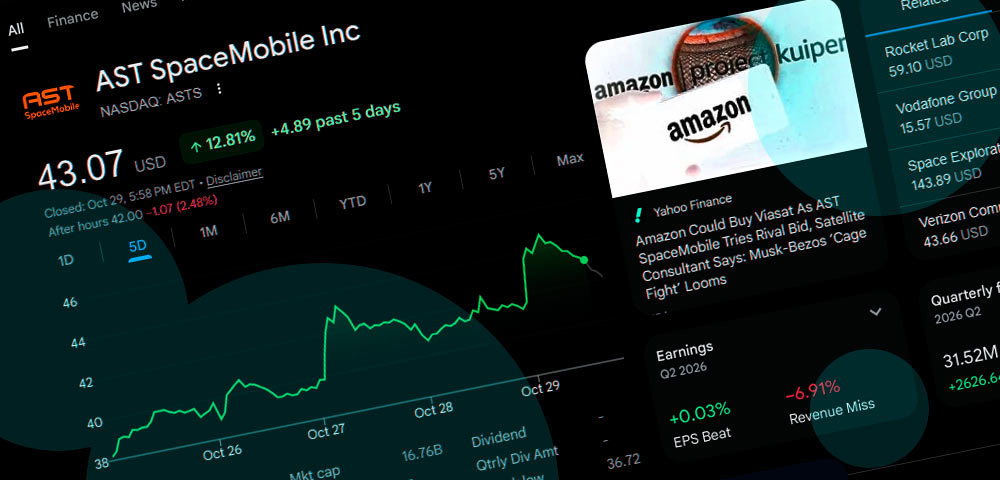
AST SpaceMobile (NASDAQ: ASTS) closed at $43.07 on October 29, 2026, gaining 1.82% as investors assessed progress toward commercial satellite broadband services and renewed optimism among some Wall Street analysts.
The rebound follows a sharp decline in the company’s valuation. Shares remain approximately 68% below their 52-week high of $133.86, reflecting concerns about satellite launch delays, rising financing requirements and intensifying competition in the direct-to-device communications market.
- Wall Street remains divided on AST SpaceMobile, with bullish analysts emphasizing spectrum assets and operator partnerships while others question satellite deployment timelines and commercial pricing.
- The company is preparing to launch initial cellular broadband services, but its planned constellation expansion faces manufacturing, launch availability and execution risks.
- ASTS trades at a substantial premium to current revenue despite heavy infrastructure spending, continued losses and increasing competition from SpaceX and Amazon.
Wall Street’s 12-month price forecasts indicate considerable potential upside, but the consensus rating remains Hold. The difference reflects a fundamental disagreement over how quickly AST SpaceMobile can convert its satellite technology, spectrum rights and telecommunications partnerships into recurring revenue.
AST SpaceMobile stock price targets and analyst ratings
According to S&P Global Market Intelligence data covering 13 analysts, AST SpaceMobile has an average 12-month price target of $74.68, implying approximately 73.4% upside from its latest closing price.
The consensus consists of five Buy, six Hold and two Sell recommendations. Individual forecasts range from $42.50 to $108, illustrating the uncertainty surrounding the company’s commercialization timetable and eventual profitability.
Recent rating changes show sharply different interpretations of the stock’s decline.
On October 23, Scotiabank analyst Andres Coello upgraded AST SpaceMobile to Sector Outperform from Sector Perform and raised his target to $55.70 from $50.80.
Coello acknowledged that SpaceX’s expansion into mobile spectrum justified some of the selloff. However, he argued that Starlink’s ambitions to compete directly with traditional wireless carriers could strengthen AST SpaceMobile’s position as a wholesale satellite connectivity partner.
Deutsche Bank analyst Bryan Kraft reached a similar conclusion on October 12, upgrading the shares to Buy from Hold while maintaining a $93 target.
Kraft argued that the decline had left AST SpaceMobile’s spectrum holdings accounting for nearly all its estimated enterprise value, with little value attributed to the operating satellite network. He also viewed a potential expansion of partnerships with major U.S. wireless carriers as an overlooked catalyst.
Other bullish forecasts include Roth MKM’s $108 target, Berenberg’s $92 and Cantor Fitzgerald’s $90.
The more cautious analysts are concerned about the economics and timing of commercial deployment.
Piper Sandler’s Alexander Potter downgraded ASTS to Neutral from Overweight on October 13, cutting his target to $54 from $98. Potter cited weaker confidence in the company’s ability to execute its planned satellite launches during 2026 and 2027. He also warned that SpaceX could increase competitive pressure through its own spectrum holdings, potentially lower service pricing and its influence over commercial launch capacity.
B. Riley Securities downgraded AST SpaceMobile to Neutral earlier in October, reducing its target to $65 from $85. Analyst Mike Crawford identified unresolved questions about customer adoption, subscription pricing and competition from alternative satellite networks.
Barclays also maintains an Underweight rating at $65, while Bank of America and UBS retain neutral positions with targets of $80 and $78, respectively.
The distinction matters: even several analysts with Hold ratings have targets substantially above the current share price. Their recommendations suggest that execution uncertainty and financial risk remain significant despite the potential valuation upside.
Satellite launch delays threaten the commercial rollout
AST SpaceMobile is developing a low Earth orbit satellite network designed to deliver 4G and 5G broadband directly to ordinary smartphones without specialized hardware. The company’s network had reached 13 satellites in orbit following the August 5 launch of BlueBirds 11, 12 and 13.
Management has targeted approximately 45 satellites by early 2027, a level intended to support substantially more continuous U.S. coverage.
BlueBirds 14, 15 and 16 were shipped to Cape Canaveral in September, while additional spacecraft remain in various stages of production and assembly. However, the absence of further orbital launches since August has raised questions about manufacturing readiness and launch scheduling.
The concerns are not limited to satellite production. AST SpaceMobile relies on external launch providers, including SpaceX and Blue Origin, creating exposure to rocket availability, launchpad infrastructure and operational delays.
Blue Origin’s New Glenn program could provide additional launch capacity in 2027 if operations recover as expected. Nevertheless, an improved launch schedule remains an assumption rather than a demonstrated result.
The company is separately targeting initial intermittent cellular broadband coverage before the end of 2026 in the United States, Canada, Japan, the United Kingdom and Saudi Arabia.
That service represents an important operational milestone, but it should not be confused with uninterrupted nationwide commercial coverage.
The initial rollout is expected to involve selected partners and limited availability as AST SpaceMobile expands its satellite constellation and terrestrial infrastructure.
Revenue forecasts depend on a stronger second half
AST SpaceMobile continues to target 2026 revenue of $150 mn to $200 mn, supported by telecommunications infrastructure sales and U.S. government contracts.
The company generated $31.5 mn in second-quarter revenue, compared with $14.7 mn in the preceding quarter. First-half revenue reached $46.3 mn.
Most reported sales currently come from gateway equipment deliveries and government contract milestones rather than recurring subscriptions for satellite cellular broadband.
This distinction is important because equipment sales and milestone payments can fluctuate substantially between quarters.
For the third quarter, analysts expect approximately $45.7 mn in revenue and a loss of $0.42 per share ahead of the company’s November 9 earnings release. If that revenue estimate proves accurate, AST SpaceMobile would need roughly $58 mn to $108 mn in fourth-quarter sales to achieve its full-year guidance.
The company’s existing commercial and government agreements provide some visibility. Its contracted revenue backlog reached approximately $1.3 bn in August, including U.S. government awards worth more than $125 mn.
However, backlog does not represent immediately recognizable revenue. Actual sales depend on delivery schedules, contract conditions and completed milestones.
Analyst consensus forecasts revenue of approximately $167.2 mn for 2026 and $609.1 mn in 2027, implying a significant acceleration as commercial services expand.
Management has also discussed approaching $1 bn in revenue during its first year of commercial service. That remains an operational ambition rather than formal guidance for a specific fiscal year.
ASTS valuation still assumes substantial future growth
Despite the decline in its stock price, AST SpaceMobile remains expensive relative to its current business.
At approximately $16.8 bn in equity market value, the company trades at roughly 145 times its trailing 12-month revenue of $115.3 mn. Even against the projected 2027 sales base, the valuation represents approximately 27.5 times revenue.
Those multiples indicate that investors are paying primarily for anticipated network expansion and future cash generation rather than current operating performance.
In the second quarter, AST SpaceMobile reported a $230.9 mn net loss attributable to common shareholders, compared with $99.4 mn a year earlier. The latest result included a $125.9 mn loss associated with the BlueBird 7 satellite.
The company also reported negative operating cash flow, reflecting the costs of building its network before recurring commercial revenue reaches scale.
An independent bullish valuation published in October illustrates the assumptions required to justify a materially higher share price.
Seeking Alpha contributor Melissa Tucker estimated a 2030 base-case value of $275 per share, equivalent to approximately $140 in present value using a 15% discount rate.
Her model assumes substantial long-term expansion in commercial and government revenue. She reduced projected business-to-business and Internet of Things revenue by $1 bn in response to SpaceX’s spectrum acquisition, while retaining a Strong Buy view following the selloff.
That estimate is a scenario-based valuation, not a 12-month institutional price target. Its outcome depends on assumptions about satellite deployment, customer adoption, pricing and operating margins that have yet to be demonstrated.
Cash reserves support expansion but debt raises financial risks
AST SpaceMobile ended June with approximately $2.7 bn in cash, cash equivalents and restricted cash, against nearly $3 bn in debt.
A subsequent $1.15 bn convertible senior notes offering in July increased pro forma liquidity to more than $3.7 bn while adding to the company’s debt obligations.
The financing provides resources for satellite manufacturing, launches and ground infrastructure, but it also highlights the capital intensity of the business.
During the first six months of 2026, AST SpaceMobile used $145.2 mn in operating cash flow and spent $859.2 mn on property and equipment.
Those figures demonstrate how rapidly cash requirements can accumulate before the network becomes commercially mature.
Convertible financing also introduces potential shareholder dilution, while additional borrowing could increase interest costs.
The central financial challenge is therefore not simply whether AST SpaceMobile has enough liquidity to continue launching satellites. It is whether the resulting network can generate sufficient revenue and cash flow to support its expanding capital base.
Operator partnerships strengthen the growth case
AST SpaceMobile’s wholesale business model remains a major differentiator. Rather than building a conventional consumer wireless business, the company intends to distribute satellite connectivity through existing mobile network operators. It has agreements with more than 60 operators whose combined customer bases exceed 3 bn subscribers. Those figures establish potential distribution reach, not the number of paying AST SpaceMobile customers.
Recent regulatory progress in Brazil has expanded the company’s potential market access.
On October 26, AST SpaceMobile announced authorization from Brazil’s telecommunications regulator for 30 MHz of S-band spectrum, alongside approval for secondary use of up to 20 MHz in the 700 MHz band through agreements with four regional operators.
It also plans to establish four ground gateways in Brazil. These developments strengthen the company’s spectrum position, but service availability still requires satellite capacity, network integration and commercial arrangements.
A separate potential growth opportunity involves government-backed satellite infrastructure in Japan. AST SpaceMobile and Rakuten have received preliminary selection for a program with an expected value of up to approximately $1 bn in non-debt government capital.
That figure is subject to further approvals and agreements and should not be treated as secured funding.
SpaceX and Amazon increase competitive pressure
SpaceX’s expanding Starlink Mobile strategy represents one of AST SpaceMobile’s most consequential competitive risks.
The company’s acquisition of additional U.S. low-band spectrum has strengthened its ability to pursue direct-to-device services, potentially reducing the technological and commercial advantages AST SpaceMobile expects from its own spectrum strategy.
One view holds that SpaceX’s move toward becoming a standalone mobile provider makes AST SpaceMobile more attractive to established carriers seeking an independent satellite partner.
The opposing argument is that a vertically integrated competitor with substantial launch capacity could exert pressure on satellite service pricing and accelerate customer acquisition.
Amazon is also expanding into direct-to-device connectivity.
The Federal Communications Commission recently approved Amazon’s proposed $11.5 bn acquisition of Globalstar, which would add satellite spectrum and infrastructure to its communications ambitions.
Satellite industry consultant Tim Farrar has additionally suggested that Amazon could pursue Viasat and that AST SpaceMobile has explored a competing proposal.
Neither transaction has been announced as a definitive acquisition agreement. In AST SpaceMobile’s case, such a deal would introduce additional financing and integration questions at a time when the company is already funding an expensive network rollout.
Lawsuit and technical signals add near-term uncertainty
AST SpaceMobile also faces securities litigation concerning its financing disclosures and competitive position.
A federal class action filed in the Western District of Texas covers investors who acquired shares between March 4, 2025 and July 15, 2026.
The complaint alleges that the company overstated the sufficiency of its capital resources, the durability of its competitive advantages and the pace of customer adoption in the United States and Japan.
These are allegations, not established findings of wrongdoing. The deadline for investors seeking appointment as lead plaintiff is November 13, 2026.
November earnings will test the satellite deployment outlook
AST SpaceMobile’s November 9 business update will be important because investors need evidence that manufacturing progress is translating into launches and revenue.
The most consequential disclosures will be the status of BlueBirds 14 through 16, an updated deployment schedule, the timing of initial service availability and the company’s ability to maintain its revenue forecast.
Management’s discussion of subscriber economics will also matter. The market still lacks a reliable basis for estimating revenue per user, operator revenue-sharing arrangements and the profitability of commercial satellite coverage at scale.
A credible launch timetable and stronger commercial revenue visibility could help narrow the gap between the current share price and bullish analyst valuations.
Further deployment delays, weaker contract conversion or additional financing requirements would instead reinforce the market’s concerns that AST SpaceMobile’s long-term opportunity remains substantially ahead of its operating results.