Follow Beinsure
- IBM Stock Price Forecast: Wall Street Consensus
- Latest Investment Bank Price Targets and Revisions
- IBM Q3 Earnings Beat Wall Street Expectations
- Software Growth Faces a Sustainability Test
- Infrastructure Growth Masks Mainframe Weakness
- Free Cash Flow Supports IBM’s Valuation
- IBM Stock Valuation: Limited Upside at Current Multiples
- IBM Stock Outlook for 2027
International Business Machines Corporation (NYSE: IBM) has recovered sharply from its July lows, supported by stronger software revenue, improved cash generation and a series of upward revisions to Wall Street price targets.
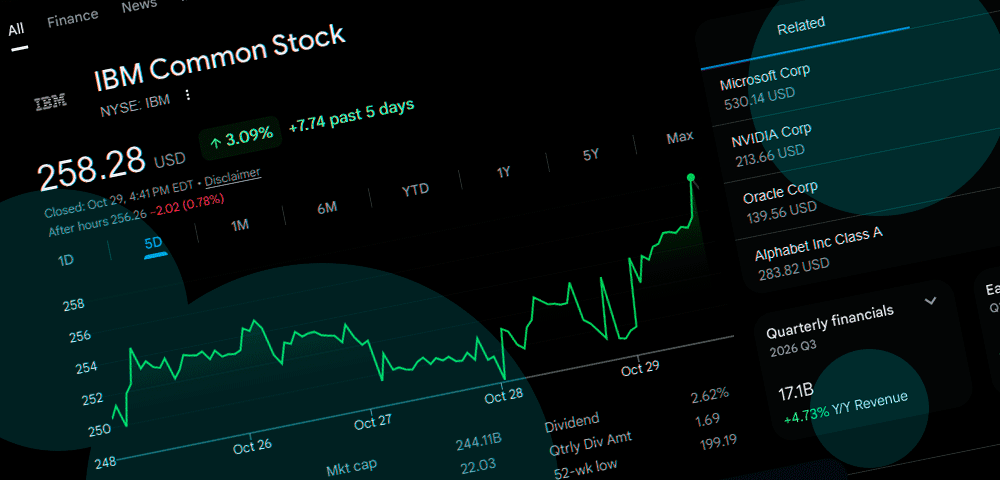
IBM closed October 28, 2026, at $253.22, gaining 1.19% for the session and 15.14% over the preceding month. Shares traded near $258 late in the October 29 session, moving above their previous three-month high.
- Wall Street remains moderately bullish on IBM, but the average analyst price target offers limited upside after the stock’s recent recovery.
- Goldman Sachs, Jefferies, Citigroup and several other banks raised their forecasts following third-quarter earnings. Analysts remain divided over the sustainability of software growth and IBM’s valuation.
- A bullish moving-average crossover supports the near-term technical outlook, although overbought momentum readings and relatively weak trading volume raise the risk of consolidation.
The recovery has narrowed the gap between IBM’s share price and analysts’ valuations. Although third-quarter results exceeded expectations, investors are increasingly focused on whether recent software growth can continue into 2027 without relying heavily on acquisitions and previously delayed contracts.
IBM Stock Price Forecast: Wall Street Consensus
According to S&P Global Market Intelligence, 25 analysts covering IBM have an average 12-month price target of $257.22 and a median forecast of $260.
The estimates range from $174 to $300, reflecting considerable differences in expectations for revenue growth, profitability and the valuation investors should assign to IBM’s software business.
The consensus rating is Buy, comprising 12 positive recommendations, 11 Holds and two negative ratings.
MarketBeat’s broader compilation of 34 analyst ratings produces a Moderate Buy consensus and an average target of $266.12. The difference reflects the services’ coverage universes and calculation methodologies.
Unlike some technology stocks whose analyst targets imply substantial potential appreciation, IBM now trades close to the average forecast. At prices reached during October 29 trading, the S&P Global consensus indicated essentially no remaining upside.
That does not establish that IBM is overvalued. It indicates that investors seeking further appreciation increasingly depend on earnings growth, favorable estimate revisions or a higher valuation multiple rather than a large existing discount to Wall Street targets.
Latest Investment Bank Price Targets and Revisions
IBM received widespread target increases following its third-quarter earnings announcement on October 21.
Goldman Sachs analyst James Schneider raised the firm’s price target from $270 to $300 while maintaining a Buy rating.
Goldman highlighted stronger software performance and improving consulting trends as evidence of better execution. However, the bank indicated that a sustained valuation increase would require additional confirmation that the operational improvement can continue.
Citigroup made another substantial upward revision, lifting its target from $245 to $280 and retaining a Buy recommendation.
Jefferies analyst Brent Thill reached the same objective after increasing the firm’s previous target by $10. The bank remains constructive on IBM’s software business but has identified the durability of organic growth in automation and data applications as an important consideration for 2027.
Barclays maintained an Overweight rating and raised its target from $262 to $277, while JPMorgan analyst Brian Essex increased the firm’s objective from $250 to $269. RBC Capital Markets reaffirmed its Outperform recommendation with a $270 target.
These positive assessments generally reflect confidence in IBM’s transition toward a software-led business, supported by hybrid cloud demand, enterprise applications and improving operating efficiency.
More cautious firms also increased their targets without upgrading their recommendations.
BMO Capital Markets analyst Keith Bachman raised the firm’s objective from $230 to $265 while retaining Market Perform.
Stifel increased its target from $235 to $260 and maintained Buy, while Robert W. Baird reached the same price with a Neutral recommendation.
At the lower end of recent forecasts, UBS analyst David Vogt increased the firm’s target from $236 to $243, maintaining Neutral. Morgan Stanley analyst Erik Woodring raised its objective from $238 to $240 while retaining Equal-Weight.
The distinction between these recommendations is significant. Several banks recognize improving near-term financial performance but remain unconvinced that IBM’s current valuation adequately compensates investors for slower underlying growth and execution risks.
IBM Q3 Earnings Beat Wall Street Expectations
IBM reported third-quarter 2026 earnings on October 21, exceeding consensus estimates for revenue and adjusted profit.
Revenue increased 5% year over year to $17.1 bn, compared with approximately $16.33 bn in the corresponding 2025 period. Growth reached 6% at constant currency, while analysts had expected around $16.82 bn.
Operating earnings per share, IBM’s non-GAAP measure, rose to $2.95 from $2.65 a year earlier, exceeding the approximately $2.86 consensus estimate.
GAAP diluted earnings per share from continuing operations were $2.31. The distinction matters because acquisition-related and other adjustments account for part of the difference between reported and operating profitability.
Software remained the principal contributor to growth. Segment revenue increased 8.3% to $7.8 bn, exceeding market expectations of approximately $7.6 bn.
Red Hat-related hybrid cloud revenue grew 11%, while Data software expanded 19%. Transaction Processing software increased 9%, recovering from weakness during the preceding quarter.
Automation revenue declined 3%, demonstrating that growth was not uniform across IBM’s software portfolio.
The Software segment’s profit margin improved to 35% from 32.9% a year earlier, providing evidence that a greater contribution from higher-margin products is benefiting profitability.
However, the quality and sustainability of the revenue improvement remain important points of disagreement among analysts.
Software Growth Faces a Sustainability Test
Part of IBM’s third-quarter software recovery came from contracts that had slipped out of the second quarter.
Chief Financial Officer James Kavanaugh indicated that approximately two-thirds of the previously delayed agreements had subsequently closed. That helped improve reported growth, but it also means some of the quarter’s strength represented recovered business rather than entirely new demand.
UBS estimated that organic software growth was approximately 1% after excluding the contribution from delayed transactions and acquisitions.
This is an analyst estimate rather than IBM’s reported segment growth rate. Nevertheless, it illustrates why UBS remains cautious despite the headline earnings beat.
The distinction matters for valuation. A temporary recovery in contract timing can improve one quarter’s results without necessarily establishing a higher sustainable growth rate.
IBM raised the lower end of its 2026 software revenue growth outlook to 7%, from 6% previously, while maintaining the upper end at 8%.
Achieving comparable growth in 2027 would require continued demand for Red Hat, broader adoption of enterprise data and automation products, and successful integration of acquired businesses.
These assumptions underpin the more optimistic investment bank forecasts.
Infrastructure Growth Masks Mainframe Weakness
IBM’s Infrastructure division generated $3.7 bn in third-quarter revenue, an increase of approximately 4% year over year.
Growth was driven primarily by Distributed Infrastructure, which expanded 31%, reflecting stronger demand for servers and storage systems.
IBM Z mainframe revenue, by contrast, declined 20%. Although the broader Infrastructure segment improved, the figures do not establish a recovery in mainframe hardware sales.
The decline reflects the cyclical nature of IBM’s enterprise hardware business following the earlier strength associated with the z17 product cycle.
Infrastructure Support revenue also fell 3%, further limiting the segment’s overall expansion.
Revenue was approximately $5.3 bn, essentially unchanged year over year. Growth reached 2% at constant currency, but the segment’s profit margin declined to 12.2% from 12.9%.
Enterprise customers continue investing in artificial intelligence, cloud modernization and infrastructure, but consulting demand remains sensitive to project timing, technology budgets and clients’ expectations of investment returns.
These trends help explain why some analysts have raised their IBM targets while retaining neutral recommendations.
Free Cash Flow Supports IBM’s Valuation
IBM’s cash generation remains an important distinction between the company and higher-growth technology businesses that have yet to establish sustainable profitability.
Third-quarter free cash flow reached $3.0 bn, increasing by $0.7 bn year over year.
For the first nine months of 2026, IBM generated $7.8 bn in free cash flow, compared with approximately $7.2 bn during the corresponding period of 2025.
Management increased its full-year outlook and now expects free cash flow to grow by more than $1 bn from the previous year’s $14.7 bn. That implies annual cash generation exceeding $15.7 bn if the revised forecast is achieved.
Against an equity market capitalization of approximately $246 bn, the implied free cash flow yield is above 6%. This provides support for the company’s valuation, although free cash flow yield alone does not establish whether the shares are attractively priced.
IBM also returned $1.6 bn to shareholders through dividends during the third quarter.
The board approved a quarterly dividend of $1.69 per share, equivalent to an annualized payment of $6.76 and a yield of approximately 2.6% at recent share prices.
The company ended September with $11.1 bn in cash, restricted cash and marketable securities. Total debt reached $63.8 bn, including $12.7 bn associated with IBM Financing.
Acquisitions represented another substantial use of capital, with IBM investing $11.4 bn in corporate purchases during the first nine months.
The strategy expands its software and data capabilities, but integration expenses, acquisition-related amortization and higher financing requirements remain relevant to future earnings and cash flow.
IBM Stock Valuation: Limited Upside at Current Multiples
IBM’s forward valuation reflects expectations of continued software expansion and relatively stable cash generation.
Analyst consensus estimates indicate approximately $70.4 bn in revenue and $12.31 in earnings per share for 2026.
For 2027, projections rise to roughly $73.1 bn in revenue and $13.15 in earnings per share. At a share price near $258, IBM trades at approximately 21 times expected 2026 earnings and 20 times projected 2027 earnings.
These multiples are not exceptionally high for a profitable enterprise technology company, but they require IBM to maintain earnings growth despite a relatively modest expected increase in revenue.
The forecasts suggest that operating efficiency, business mix and financial discipline will remain important contributors to profit expansion.
A higher proportion of software revenue could support stronger margins. Conversely, weaker consulting demand, acquisition costs or a slowdown in enterprise software spending could reduce expected earnings growth.
The valuation gap among investment banks reflects these competing assumptions.
Bullish firms place greater weight on IBM’s recurring software revenue, cash generation and potential for improved profitability.
More conservative analysts emphasize the risk that recent growth reflects delayed deals, acquisitions and product-cycle effects rather than a lasting acceleration in organic demand.
IBM Stock Outlook for 2027
IBM’s next major financial test will be its fourth-quarter earnings report and management’s outlook for 2027.
Current market estimates indicate fourth-quarter revenue of approximately $20.47 bn and operating earnings per share near $4.62.
The results will help determine whether the software recovery recorded in the September quarter continued into year-end.
Investors will be watching the contribution from previously delayed transactions, the performance of Red Hat and Data software, consulting demand and the progression of the mainframe product cycle.
Cash generation will remain equally important. IBM’s revised annual outlook implies that the final quarter must support another year of free cash flow growth despite substantial acquisition activity.
Management’s 2027 guidance could prove particularly consequential because analysts disagree over how much of the recent software improvement represents sustainable organic expansion.
A stronger outlook supported by recurring software demand and margin improvement would provide additional justification for the higher investment bank targets.
Conversely, slower software growth or disappointing consulting performance would make further valuation expansion harder to sustain.
With IBM shares trading near the current analyst consensus, future returns depend increasingly on the company exceeding financial expectations rather than merely recovering toward existing Wall Street valuations.