Follow Beinsure
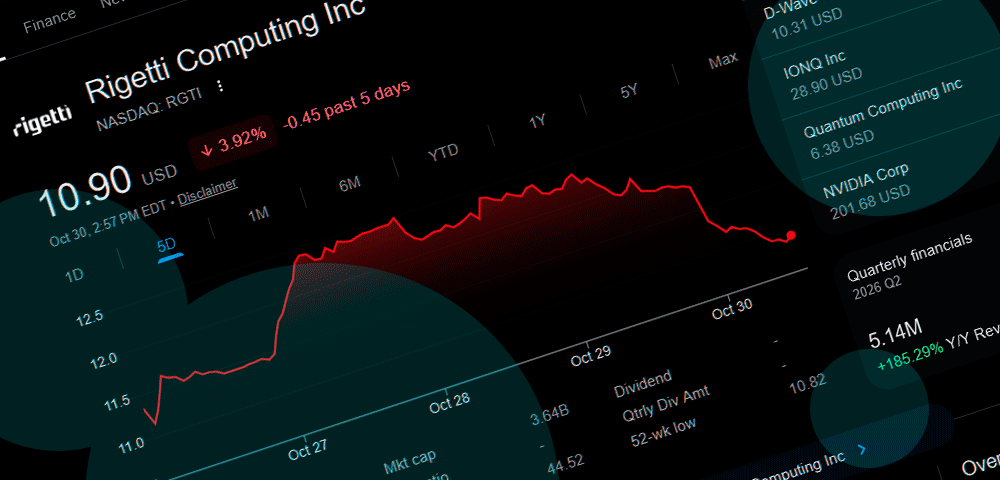
Rigetti Computing (NASDAQ: RGTI) shares extended their decline on October 30, 2026, falling approximately 10% during Friday’s session to $10.86 and touching an intraday low of $10.82.
The stock has lost more than 75% of its value from the 52-week high of $44.52, reflecting a sharp reversal in investor sentiment toward speculative quantum computing companies.
- Rigetti Computing shares fell to approximately $10.86 on October 30, trading more than 75% below their 52-week high of $44.52.
- Q2 2026 revenue increased 185% to $5.14 mn, but the company reported an operating loss of $28.1 mn and remains far from profitability.
- Rigetti secured an agreement for up to $100 mn in CHIPS Act funding, supporting quantum computing research, although high valuation multiples and competition remain significant risks.
Although Rigetti has delivered substantial revenue growth and secured government funding, its financial losses and demanding valuation continue to raise questions about the stock’s recovery potential.
Rigetti stock valuation remains high despite the selloff
Rigetti shares have undergone a significant valuation correction over the past year.
At the end of September 2025, the company traded at approximately 1,292 times trailing annual revenue. By October 22, 2026, that multiple had declined to 286.5 times sales.
The reduction reflects falling investor expectations rather than a contraction in the company’s business.
Rigetti generated $13.4 mn in revenue over the twelve months ended June 2026, representing growth of 68.5%. However, even after the share price decline, the valuation remains exceptionally high relative to current revenue. For comparison, the S&P 500 trades at approximately 3.1 times sales.
The difference highlights how much of Rigetti’s valuation depends on expectations of future quantum computing adoption rather than its existing financial performance.
Rigetti Q2 2026 earnings show growth but widening losses
Rigetti reported second-quarter revenue of approximately $5.14 mn, up 185% from the previous year.
Growth was primarily driven by sales of its Novera quantum processing units, including systems installed directly at customers’ facilities.
Despite the revenue increase, operating losses remained substantial.
| Financial metric | Q2 2026 |
|---|---|
| Revenue | $5.14 mn |
| Revenue growth | +185% |
| Operating loss | $28.1 mn |
| Net loss | $52.6 mn |
| Adjusted EPS | -$0.05 |
Over the twelve months ended June 2026, Rigetti recorded an operating loss of $97.2 mn, compared with $77.4 mn a year earlier.
The company held approximately $394 mn in cash and short-term investments at the end of June, against $7.7 mn in debt.
While this provides funding for continued research and development, the company’s share count has increased, creating dilution concerns for existing investors.
$100 mn CHIPS Act agreement supports quantum development
Rigetti has reached an agreement with the US Department of Commerce for up to $100 mn in funding under the CHIPS Act.
The financing is intended to support three research projects focused on advancing superconducting quantum computing technology.
The agreement follows a May 2026 announcement that initially lifted Rigetti shares by more than 30% in a single session.
However, the funding is structured over several years and does not represent an immediate $100 mn cash payment. The arrangement also includes potential securities issuance, which could dilute existing shareholders.
Rigetti separately holds an $8.4 mn order from India’s Centre for Development of Advanced Computing for a 108-qubit system, with revenue recognition expected in Q4 2026.
That order alone exceeds the company’s entire second-quarter revenue, illustrating how individual contracts can significantly influence quarterly financial results.
Rigetti faces increasing competition from IonQ and IBM
Rigetti specialises in superconducting quantum processors, an approach also being developed by IBM and Alphabet’s Google. Its technology uses modular chiplets to connect quantum processors and increase computing capacity. However, improving computational accuracy remains a major challenge.
Rigetti’s 108-qubit system has reported two-qubit gate fidelity of approximately 99.1%. Competing quantum computing developers, including IonQ, are targeting higher fidelity levels, although performance measurements across different quantum architectures are not always directly comparable.
IonQ uses trapped-ion technology, while Rigetti relies on superconducting circuits.
The competition also includes D-Wave Quantum, IBM and Google, which are investing in different quantum computing approaches.
Rigetti’s long-term prospects depend on improving gate fidelity, scaling its systems and demonstrating commercially useful applications.
Rigetti Computing stock price outlook for 2027–2030
The quantum computing industry offers significant long-term growth potential.
McKinsey estimates that the global quantum computing market could reach between $43 bn and $71 bn by 2035.
Some industry participants expect commercially useful quantum computing systems to emerge around 2029–2030. However, that opportunity does not guarantee that Rigetti will capture a substantial share of the market.
The company’s stock outlook depends on three developments:
- Improving quantum processor accuracy and scaling beyond its current systems.
- Converting government agreements and commercial orders into sustained sales growth.
- Reducing operating losses while managing research expenditure and potential shareholder dilution.
In the near term, the decline below $11.11 and the subsequent intraday low of $10.82 signal continued selling pressure. A recovery would require improving investor confidence in Rigetti’s technology roadmap and commercial prospects.
Rigetti remains a high-risk quantum computing investment. Government funding and growing revenue provide support for its development strategy, but substantial operating losses and an elevated price-to-sales multiple leave the shares vulnerable to further declines.
The company’s next earnings report, expected in November 2026, will provide an important update on its operating losses, system deliveries and progress toward commercialising larger quantum processors.