- The property reinsurance market is expected to remain soft
- Fitch Ratings’ Global Reinsurance Forecast
- Rating Outlooks: Strong Credit Quality
- Global reinsurance outlook for 2027
- 2027 pricing, underwriting and investment outlook
- Inflationary effects of the US–Iran war
- More flexible terms, moderating reinsurance pricing
Fitch Ratings has maintained its deteriorating outlook for the global reinsurance sector in 2027 as pricing weakens and claims costs rise. Operating and business conditions are expected to soften from still-sound levels, although reinsurers should retain strong capital positions.
Analysts expect reinsurance prices to decline further in 2027, though at a slower pace than in 2026. Abundant capacity remains the main source of pressure as capital supply continues to exceed demand across the market.
Competition between reinsurers should therefore remain intense, keeping conditions favorable for buyers. Softer pricing and renewed claims inflation are expected to reduce both underwriting margins and revenue, according to Fitch Rating.
Key highlights
- Fitch keeps its global reinsurance sector outlook at deteriorating for 2027 as softer pricing and rising claims costs pressure margins.
- Global reinsurance capital reached new highs in 1H 2026, with retained earnings, catastrophe bonds and sidecars keeping capacity ahead of cedant demand.
- Property and specialty reinsurance remain the softest areas, while US casualty pricing should hold up better because of social inflation, reserve uncertainty and higher loss costs.
- Fitch estimates an unexpected industry loss of around $100 bn might be needed to remove enough excess capital to materially change buyer-friendly market conditions.
- Credit quality remains strong: 88% of Fitch-rated global reinsurance groups carry Stable Outlooks, with most IFS ratings in the AA and A categories.
The effect shouldn’t materially weaken sector capital, which Fitch continues to view as very strong. Investment income and reserve releases from prior underwriting years should also offset part of the pressure on profitability.
The property reinsurance market is expected to remain soft
The property reinsurance market is expected to remain soft through 2027 unless the industry absorbs a very large loss event. Fitch also expects selective loosening of terms and conditions to add to rate pressure as reinsurers compete for business.
Casualty pricing should prove more resistant because carriers continue to face reserve uncertainty and rising loss costs. Excess capacity still presents a risk, though, and Fitch warned that competition could eventually push some casualty rates below adequate levels.
Claims costs continue to rise through economic and medical inflation, along with social inflation. Climate-related losses and emerging liabilities connected with geopolitics and AI add further uncertainty to future claims development.
Reinsurers are also expected to retain a larger proportion of industry losses as primary insurers reduce retention levels from the highs reached during the hard market. That change would transfer more claims back into reinsurance programs and increase earnings volatility.
Excess reinsurance capital to persist
These pressures should limit how far the market softens compared with previous cycles. Fitch believes a material unexpected loss could quickly change pricing conditions and produce a sharper market correction.
Moderately softer pricing and rising claims inflation in 2027 will increasingly weigh on underwriting margins. Supportive investment returns and prior-year reserve releases are likely to mitigate the decline in sector profitability. Intelligent cycle management and disciplined capital allocation will differentiate individual reinsurer performance
Manuel Arrivé, CFA, Director at Fitch Ratings
Reinsurer performance will increasingly depend on cycle management and disciplined capital allocation. Companies will have less support from broad market pricing as competitive conditions become more difficult.
Reinvestment yields remain elevated and should continue supporting earnings. Fitch also sees profitable growth opportunities in selected specialty insurance lines, alongside longevity risk and financial solutions.
Those businesses give reinsurers alternatives as pricing pressure increases in traditional property and casualty markets. Strong capital positions also leave the sector with enough financial capacity to absorb weaker margins without creating material pressure on credit quality.
Fitch Ratings’ Global Reinsurance Forecast
| (USDbn) | 2025 | 2026F | 2027F |
| Net premiums written | 175.1 | 164.6 | 159.6 |
| Catastrophe losses | 14.6 | 7.7 | 14.2 |
| Net prior-year favorable reserve development | 3.9 | 4.0 | 2.4 |
| Calendar-year combined ratio (%) | 88.2 | 88.1 | 94.2 |
| Accident-year combined ratio (%) | 90.5 | 90.6 | 95.7 |
| Accident-year combined ratio (excluding catastrophes, %) | 83.2 | 85.9 | 86.7 |
| Shareholders’ equity (excluding Berkshire Hathaway) | 290.8 | 296.6 | 311.5 |
| Net income return on equity (excluding Berkshire Hathaway) (%) | 19.6 | 17.3 | 13.8 |
Lower insured catastrophe losses
Rating Outlooks: Strong Credit Quality
Among Fitch-rated global reinsurance groups, 88% are on Stable Outlooks, reflecting Fitch’s expectation that the projected mild deterioration in financial metrics will remain within rating sensitivities.
Insurer Financial Strength (IFS) ratings are generally split between the ‘AA’ and ‘A’ categories.
Record profits in the past three years, coupled with enhanced balance-sheet resilience through rising capitalization buffers and strengthened reserve adequacy, provide a solid base for the sector to maintain its strong credit fundamentals in deteriorating business conditions.
Global reinsurance outlook for 2027
| Indicator | 2027 outlook | Main driver |
| Sector outlook | Deteriorating | Softer pricing and higher claims costs |
| Reinsurance pricing | Further decline | Abundant capacity and intense competition |
| Underwriting margins | Moderate pressure | Price erosion and claims inflation |
| Revenue | Lower | Softer rates and underwriting discipline |
| Capital position | Very strong | Retained earnings and capital buffers |
| Investment income | Supportive | Elevated reinvestment yields |
| Buyer conditions | Favorable | Capital supply exceeds cedant demand |
Global reinsurance capital hits new highs as pricing softens
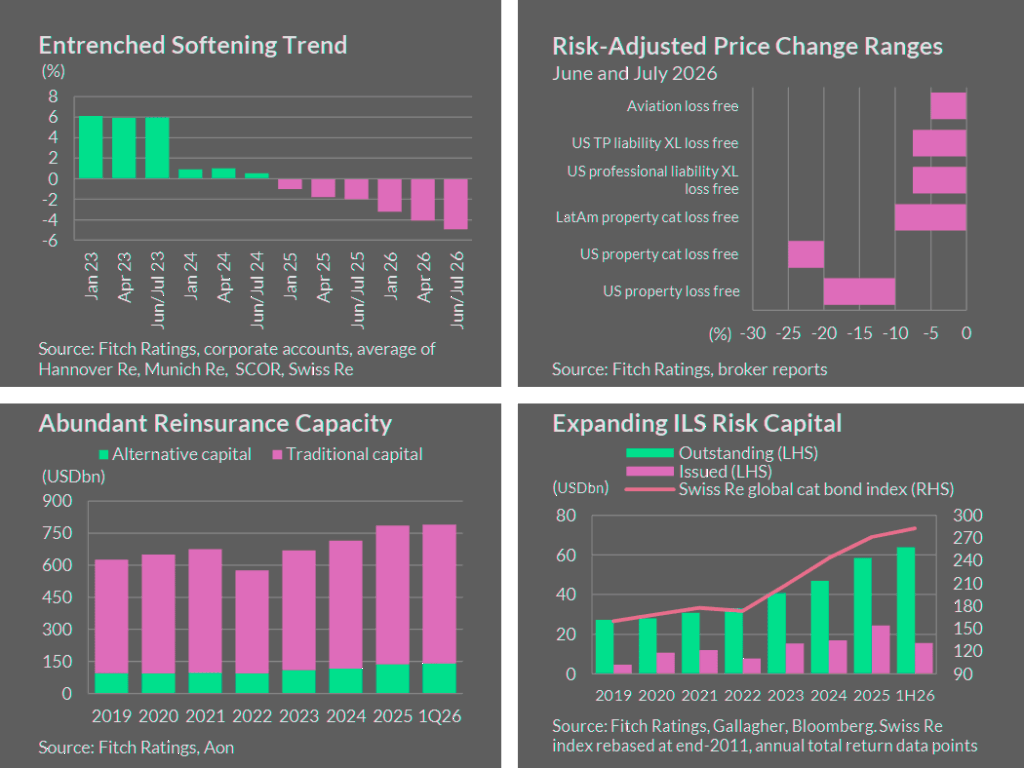
Global reinsurance capacity remains abundant after sector capital reached new highs in 1H 2026, according to Fitch Ratings. Strong retained earnings on reinsurers’ balance sheets supported the increase, alongside faster growth in alternative capital.
Catastrophe bonds and sidecars accounted for much of the expansion outside traditional reinsurance capital. Investor demand for insurance-linked securities also remains strong, adding capacity as reinsurers continue generating solid earnings.
Fitch expects capital supply to remain ahead of additional demand from cedants over the next 12 months. That imbalance should keep competitive pressure on reinsurers and give buyers greater negotiating power during renewals.
Global reinsurance capital and capacity
| Capital factor | Fitch assessment |
| Global reinsurance capital | Reached new highs in 1H 2026 |
| Traditional capital | Supported by strong retained earnings |
| Alternative capital | Expanding faster |
| Catastrophe bonds | Major source of alternative capacity growth |
| Sidecars | Adding capacity across selected markets |
| ILS investor demand | Remains strong |
| Capital vs. demand | Supply expected to exceed incremental demand over the next 12 months |
| Potential market-reset loss | Around $100 bn of unexpected industry losses |
The effect is already more visible across property and specialty reinsurance
Pricing has moved lower in several segments, while contract structures and terms have become more flexible as reinsurers compete for available business.
Casualty conditions remain more balanced because loss-cost pressure and reserve uncertainty limit aggressive pricing moves. Property business faces stronger pressure from excess capacity, especially on loss-free programs.
Fitch’s June and July 2026 pricing data showed an established softening trend across several reinsurance segments. The analysis covered loss-free US property catastrophe and property business, Latin American property catastrophe, US professional liability excess-of-loss and aviation business.
Property and casualty reinsurance demand is still supported by rising insured values and exposures; higher risk awareness reinforced by geopolitical risk, climate-related exposures and AI-driven transformation (e.g. data centers); and demand for tailored and structured solutions to manage earnings volatility.
Reinsurance market conditions by business line
| Reinsurance segment | Pricing outlook | Market conditions | Main pressure |
| Property | Softer | Buyer-friendly | Excess capacity |
| Property catastrophe | Softer | Highly competitive | Loss-free programs attracting capacity |
| Specialty | Softer | Increasingly flexible | Capacity exceeds incremental demand |
| US casualty | More stable | Relatively balanced | Social inflation and reserve uncertainty |
| Life & health | Growth expected | Favorable | Biometric and financial solutions demand |
| Longevity and financial solutions | Growth opportunities | Supportive | Pension risk transfer and capital optimization |
However, policy uncertainty, muted economic growth and lower pricing are likely to curb near-term premium growth, particularly in specialty lines tied to economic activity.
Growth in life and health reinsurance is likely to outpace that in P&C. This will be supported by demand for biometric cover and financially motivated transactions, including pension risk transfers and capital optimization through asset-intensive structures.
2027 pricing, underwriting and investment outlook
| Area | Fitch expectation |
| Combined ratios | Slight deterioration |
| Property pricing | Continued softening |
| Specialty pricing | Continued softening |
| Terms and conditions | Greater flexibility |
| US casualty rates | Gradual deceleration |
| Casualty sidecar capacity | Increasing |
| Underwriting discipline | Expected to remain intact |
| Reinvestment rates | Converging with portfolio yields |
| Investment upside | More limited |
| Main investment risk | Rising defaults in a slow economy |
US third-party liability excess-of-loss also formed part of the pricing review
Risk-adjusted rate changes across these lines generally moved into negative territory as available capacity exceeded demand.
The supply-demand gap isn’t fixed. Cedants are purchasing broader products and additional protection as pricing becomes more attractive, which increases demand for reinsurance capital.
Capital growth itself could also slow through higher shareholder distributions and narrower ILS spreads. Even with those changes, Fitch doesn’t expect the current balance to shift materially without substantial unexpected industry losses.
Fitch estimates losses of around $100 bn might be required to remove enough excess capital to materially change current market conditions. Without an event of that scale, buyers should retain considerable negotiating power across property and selected specialty lines.
The result is a reinsurance market where strong balance sheets increasingly compete for limited incremental demand. Continued inflows into catastrophe bonds and sidecars add further pressure, leaving pricing and contract structures favorable for cedants heading into the next renewal cycle.
Claims pressures facing reinsurers in 2027
| Claims driver | Expected effect |
| Economic inflation | Higher repair and replacement costs |
| Medical inflation | Higher casualty and health-related claims costs |
| Social inflation | Greater US casualty severity and reserve pressure |
| Climate change | Structural increase in catastrophe loss exposure |
| US-Iran war | Inflation pressure on property repair and rebuilding costs |
| Trade policy volatility | Higher replacement and supply costs |
| AI exposure | Additional uncertainty around silent AI losses |
| Lower primary insurer retentions | Greater share of losses transferred to reinsurers |
Inflationary effects of the US–Iran war
Inflationary effects of the US–Iran war and volatile global trade policy are likely to increase property claims costs through higher repair, rebuilding and replacement costs.
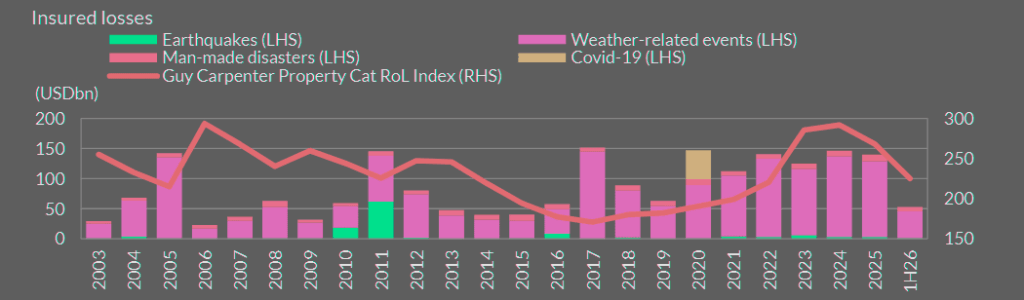
Emerging risks, including uncertainty over silent AI exposure, could add to loss costs. Global insured natural catastrophe losses in 1H 2026 were below long-term averages, but we expect them to rise structurally over time, driven by exposure growth and climate change.
Reinsurers are also likely to bear a higher share of losses as primary insurers’ retentions normalize from hard-market highs.
In US casualty lines, persistent social inflation will remain a significant pressure on claims severity and reserve adequacy, while recent tort reform measures are unlikely to materially alter broader market trends in the near term.
Eroding but still-strong underwriting profits
Assuming major losses remain within budgeted levels, Fitch forecasts a slight deterioration in combined ratios in 2027. This will be driven by continued price erosion, while easing policy terms could increase earnings volatility. Nevertheless, we expect most reinsurers to maintain underwriting discipline, resulting in lower sector revenue.
Margin pressure is likely to be partly offset by overall price adequacy, improved retrocession conditions, better diversification beyond
More flexible terms, moderating reinsurance pricing
Fitch expects highly competitive market conditions in most property and specialty lines to drive further market softening in 2027.
However, following substantial price declines over the past two years, competition is likely to become less price-led and increasingly centered on T&C, which have remained resilient through most of 2026.
US casualty pricing is likely to decelerate only gradually in light of adverse loss-cost trends, although growing capacity, particularly from casualty sidecars, will reduce rate adequacy.
Reinsurance demand and growth drivers
| Driver | Expected market effect |
| Rising insured values | Supports P&C reinsurance demand |
| Higher insured exposures | Increases protection requirements |
| Geopolitical risk | Supports demand for additional protection |
| Climate exposure | Increases demand for catastrophe capacity |
| AI-related infrastructure | Creates new exposures, including data centers |
| Structured reinsurance solutions | Helps cedants manage earnings volatility |
| Weak economic growth | Limits premium expansion |
| Lower pricing | Restrains near-term revenue growth |
| Pension risk transfers | Supports L&H reinsurance growth |
| Asset-intensive transactions | Supports capital optimization demand |
Fitch expects reinvestment rates and recurring portfolio yields to converge in 2027, limiting potential upside to investment results. Rising defaults in a slow economy, rather than market risk, are the main risk as most reinsurers hold assets to maturity.
Earnings and capital have limited sensitivity to market volatility, although vulnerability could be revealed if a protracted AI or private credit correction has wider market, macro and credit effects.
FAQ
What is Fitch’s global reinsurance outlook for 2027?
Fitch Ratings maintains a deteriorating outlook for global reinsurance in 2027. The agency expects further price declines, rising claims inflation and weaker underwriting margins, although sector capital should remain very strong.
Why are reinsurance prices falling in 2027?
Reinsurance capacity continues to exceed incremental demand from cedants. Strong retained earnings and growing alternative capital, including catastrophe bonds and sidecars, are increasing competition and giving buyers more negotiating power.
Will property reinsurance rates fall in 2027?
Fitch expects property reinsurance pricing to soften further in 2027. Competition is also shifting toward more flexible terms and conditions after substantial rate declines during the previous two years.
What is the outlook for casualty reinsurance pricing?
US casualty pricing should remain more resistant than property pricing because of social inflation, reserve pressure and higher loss severity. Growing capacity, including casualty sidecars, could still reduce rate adequacy.
How strong is global reinsurance capital in 2026?
Global reinsurance capital reached new highs in the first half of 2026. Growth came from retained earnings on traditional reinsurer balance sheets and continued expansion of alternative capital.
What could cause reinsurance prices to rise again?
Fitch estimates an unexpected industry loss of roughly $100 bn might remove enough excess capital to materially alter current market conditions. A large loss event could produce faster repricing, especially in property catastrophe reinsurance.
What are the main risks for reinsurers in 2027?
The main pressures include economic, medical and social inflation, climate-related losses, geopolitical risks and emerging AI liabilities. Reinsurers may also absorb a larger share of losses as primary insurers reduce retention levels from hard-market highs.
……………………….
AUTHORS: Manuel Arrivé – CFA, Director at Fitch Ratings, Brian Schneider – CPA, CPCU, Senior Director in Fitch Ratings’ North American insurance rating group
Edited by Yana Keller – Lead Re/Insurance Editor at Beinsure