Overview
Germany’s startup ecosystem in 2026 is consolidating its role as Europe’s second-largest innovation hub after the UK, driven by a combination of fintech, deep tech, AI, and climate-focused ventures.
Germany hosts 32 unicorns, collectively valued at more than $85 bn, underscoring the maturing of its venture-backed economy, according to Beinsure’s data.
While Berlin remains the epicenter, Munich, Hamburg, and Cologne have also attracted significant deal flow, reflecting the decentralization of Germany’s entrepreneurial energy.
The Scale of German Unicorns Value Creation
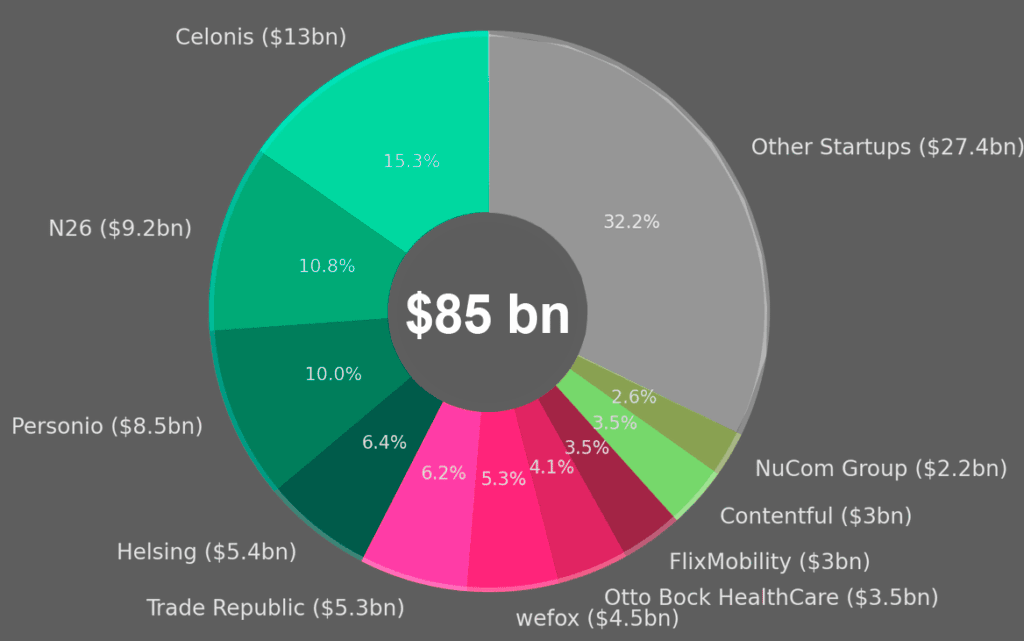
The standout German unicorn is Celonis (valuation $13bn), a process-mining software leader backed by Accel and 83North. Its scale alone accounts for over 15% of total German unicorn value, illustrating how enterprise software continues to deliver Germany’s most global success stories.
Following closely are fintech pioneers N26 ($9.2bn) and Personio ($8.5bn), both of which demonstrate the enduring strength of Berlin’s financial services cluster, according to Beinsure. Together, the top three startups represent more than 35% of Germany’s unicorn capital base.
Defense AI is also entering the spotlight with Helsing ($5.4bn), supported by an unusually diverse investor syndicate ranging from Prima Materia to defense contractor Saab. This reflects the new geopolitical environment in Europe where dual-use AI technology is becoming both commercially and strategically attractive.
Other consumer-facing scale-ups such as Trade Republic ($5.3bn) and wefox ($4.5bn) confirm that neobrokerage and insurtech remain powerful growth engines, even in a high-interest rate environment. Meanwhile, more traditional industries are represented by Otto Bock HealthCare ($3.5bn), a prosthetics manufacturer that blends advanced medtech with venture-style growth.
Sectoral Shifts: 3 Dominant Startups’ Clusters
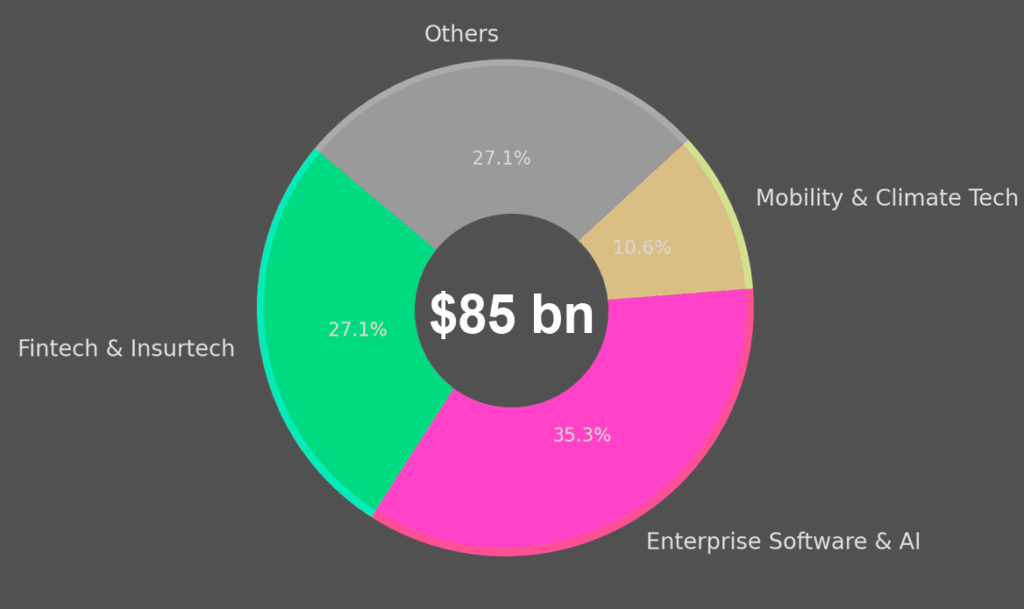
The unicorn landscape highlights three clusters:
- Fintech & Insurtech: N26, Trade Republic, wefox, Solaris, Scalable Capital, and Taxfix together represent over $23bn in valuation, confirming financial services as Germany’s single strongest vertical.
- Enterprise Software & AI: Celonis, Personio, Contentful, commercetools, DeepL, Staffbase, and Quantum Systems combine into a formidable software layer valued at more than $30bn, positioning Germany as Europe’s enterprise tech powerhouse.
- Mobility & Climate Tech: FlixMobility, Enpal, 1Komma5, Omio, Agile Robots, and InFarm illustrate a rising green and mobility wave, collectively worth around $9bn, as investors shift toward sustainability-driven growth.
A cluster of unicorns at the $1bn mark, such as Parloa, 1Komma5, SellerX, and Taxfix, indicates a steady pipeline of scale-ups graduating into the unicorn bracket.
This $1bn “entry point” for recognition in Germany reflects both the resilience of local founders and the broadening pool of capital available to later-stage ventures.
Biggest 30+ Unicorn Startups in Germany by Valuation
| Rank | Unicorn | Valuation, bn | Investors |
| 1 | Celonis | $13 bn | Accel, 83North |
| 2 | N26 | $9.2 bn | Redalpine Venture Partners, Earlybird Venture Capital, Valar Ventures |
| 3 | Personio | $8.5 bn | Global Founders Capital, Nortzone Ventures, Picus Capital |
| 4 | Helsing | $5.4 bn | Prima Materia, Lightspeed Ventures, Accel, Plural, General Catalyst, Saab, BDT, MSD Partners |
| 5 | Trade Republic | $5.3 bn | Founders Fund. Accel, Creandum |
| 6 | wefox | $4.5 bn | Salesforce Ventures, Seedcamp, OMERS Ventures |
| 7 | Otto Bock HealthCare | $3.5 bn | EQT Partners |
| 8 | FlixMobility | $3 bn | Holtzbrinck Ventures, Unternehmertum Venture Capital, General Atlantic |
| 9 | Contentful | $3 bn | Balderton Capital, General Catalyst, Tiger Global Management |
| 10 | NuCom Group | $2.2 bn | General Atlantic |
| 11 | Forto | $2.1 bn | Cherry Ventures, Northzone Ventures, Global Founders Capital |
| 12 | DeepL | $2 bn | Benchmark, btov Partners, Bessemer Venture Partners |
| 13 | commercetools | $1.9 bn | High-Tech Grunderfonds, Bayern Kapital, Accel |
| 14 | Razor | $1.7 bn | Global Founders Capital, 468 Capital, Redalpine Venture Partners |
| 15 | Solaris | $1.6 | Yabeo Capital, SBI Investment, Vulcan Capital |
| 16 | Scalable Capital | $1.4 bn | BlackRock, Tengelmann Ventures, Holtzbrinck Ventures |
| 17 | Choco | $1.2 bn | Bessemer Venture Partners, G Squared, Insight Partners |
| 18 | Flink | $1.1 bn | Mubadala Capital, Bond, Prosus Ventures |
| 19 | GetYourGuide | $2 bn | Spark Capital, Highland Europe, Sunstone Capital |
| 20 | Sennder | $1.1 bn | Accelm Scania Growth Capital, Lakestar |
| 21 | Enpal | $1.1 bn | HV Capital, Softbank Group, BlackRock |
| 22 | Staffbase | $1.1 bn | Insight Partners, e.ventures, General Atlantic |
| 23 | Quantum Systems | $1 bn | Notion Capital, Bayern Kapital |
| 24 | Parloa | $1 bn | Altimeter Capital |
| 25 | 1Komma5 | $1 bn | Porsche Ventures, G2VP, b2venture |
| 26 | Omio | $1 bn | Lakestar, Battery Ventures, New Enterprise Associates |
| 27 | Berlin Brands Group | $1 bn | Ardian, Bain Capital |
| 28 | Agile Robots | $1 bn | Hillhouse Capital Management, Sequoia Capital China, Linear Venture |
| 29 | SellerX | $1 bn | Cherry Ventures, Felix Capital, 83North |
| 30 | InFarm | $1 bn | Atomico, Hanaco Venture Capital, TriplePoint Capital |
| 31 | Grover | $1 bn | Varengold Bank, Circularity Capital, Coparion |
| 32 | Taxfix | $1 bn | Valar Ventures, Index Ventures, Creandum |
Valuation share of Top Unicorns in Germany
Top FinTech Unicorn Startups in Germany
| № | FinTech | Valuation, $ bn | VC raised, $ mn |
| 1 | N26 | 9,2 bn | 1 900 |
| 2 | Trade Republic | 5,3 bn | 1 200 |
| 3 | Solaris | 1,6 bn | 546 |
| 4 | Scalable Capital | 1.4 bn | 365 |
| 5 | Moonfare | 1,1 bn | 212 |
| 6 | Deposit Solutions | 1,1 bn | 204 |
| 7 | Vivid Money | 1 bn | 219 |
| 8 | Taxfix | 1 bn | 329 |
VC Investors in German Startups
Germany’s unicorn set illustrates the increasing globalization of capital. For instance, DeepL ($2bn), one of Europe’s leading AI translation companies, attracted backing from Benchmark and Bessemer, signifying deep tech’s move into the venture mainstream, Beinsure stated.
Traditional domestic funds like Earlybird, Holtzbrinck Ventures, and Global Founders Capital remain prominent, but they now co-invest alongside global heavyweights such as Accel, General Atlantic, SoftBank, BlackRock, and Benchmark.
Global late-stage investors such as General Catalyst, Tiger Global, and Insight Partners are heavily involved in the German scene, making Germany an increasingly contested market for cross-border VC capital.
Notably, Accel has exposure across multiple German champions including Celonis, Helsing, Trade Republic, and commercetools, consolidating its role as one of the most influential foreign VCs in the country.
Consolidation and Selective Growth
As of 2025, Germany’s startup ecosystem is defined by capital concentration in category leaders and a sharp increase in strategic investors (e.g., Saab, Porsche Ventures, and BlackRock) joining traditional VC players.
The German’s unicorns are not just software disruptors but also energy transition enablers, mobility providers, and industrial tech companies, reflecting Germany’s unique economic fabric.
While valuations have cooled globally compared to the 2021–2022 funding boom, Germany’s unicorn roster demonstrates resilience.
According to Beinsure, with over $85bn in private market value spread across a diversified set of sectors, the country stands as Europe’s most balanced startup ecosystem, combining consumer innovation, industrial deep tech, and green technology at scale.
Global Unicorns Ranked by Country
- Unicorn Startups in the US
- Unicorn Startups in the UK
- Unicorn Startups in China
- Unicorn Startups in France
- Unicorn Startups in Canada
- Unicorn Startups in Singapore
- Unicorn Startups in Israel
- Unicorn Startups in Sweden
- Unicorn Startups in Finland
- Unicorn Startups in Norway
- Unicorn Startups in India
- Unicorn Startups in Brazil
- Unicorn Startups in Australia
- Unicorn Startups in South Korea
- Unicorn Startups in UAE
Methodology
The ranking of the top 10 unicorns in Germany is based on publicly available data from venture capital databases, company announcements, and reliable industry sources. A unicorn is defined here as a privately held, venture-backed company with a valuation of $1 bn or more, measured at the most recent funding round (post-money valuation).
We first identified all active unicorns headquartered in Germany. Companies that had gone public, been acquired, or fallen below the $1 bn threshold were excluded.
From this list, we selected the 10 highest-valued firms. Valuations were cross-checked against multiple sources, including CB Insights, PitchBook, and press releases from investors and companies.
Investor information was included to illustrate the breadth of global capital supporting these startups. The ranking is presented in descending order by valuation, with data rounded to the nearest $10 mn where necessary.
This methodology ensures transparency, consistency, and comparability across companies. While valuations can fluctuate with market conditions, this ranking reflects the latest available figures at the time of publication.
It provides a snapshot of the most influential and highly valued startups shaping the innovation landscape in Germany.
FAQ
Germany counts 32 unicorns in 2026, collectively valued at more than $85bn, spanning fintech, enterprise software, AI, mobility, and climate tech.
Celonis, valued at $13bn, is the leading German unicorn, specializing in process-mining software with global enterprise clients.
Fintech and insurtech are the largest clusters, representing over $23bn in combined valuation. Key players include N26, Trade Republic, wefox, Solaris, Scalable Capital, and Taxfix.
International investors such as Accel, General Atlantic, Insight Partners, and Benchmark are highly active, alongside German funds like Earlybird, Holtzbrinck Ventures, and Global Founders Capital.
Yes. Beyond traditional VCs, strategic investors like Saab, Porsche Ventures, and Salesforce Ventures are funding German startups, reflecting interest from industry leaders in AI, mobility, and green tech.
Germany is Europe’s second-largest startup hub after the UK, ahead of France in total unicorn valuations. Its ecosystem is also more diversified, spanning fintech, deep tech, and climate technology.
Three major trends dominate: 1) Fintech strength despite global headwinds, 2) Enterprise AI expansion with companies like DeepL and Helsing, 3) Sustainability-driven growth through energy, mobility, and robotics scale-ups.
……………..
AUTHORS: Peter Sonner — Lead Tech Editor of Beinsure Media, Oleg Parashchak — CEO & Founder of Finance Media Holding