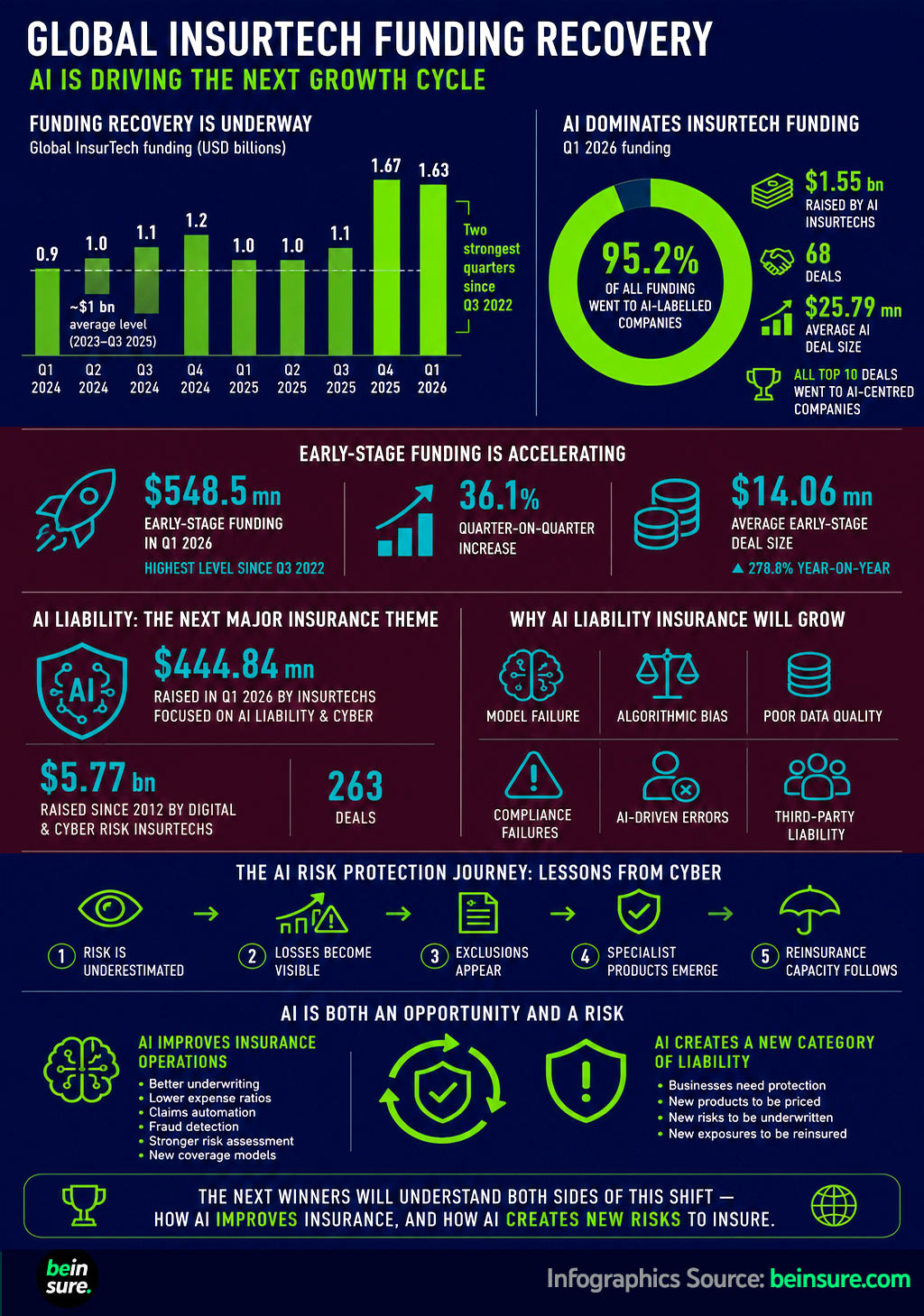
Global InsurTech funding is recovering, but the rebound is narrow. According to Beinsure, artificial intelligence now dominates the flow of capital into insurance technology.
Gallagher Re data shows global InsurTech funding reached $1.63 bn in Q1 2026. That sits slightly below the $1.67 bn raised in Q4 2025.
Together, those two quarters became the strongest for InsurTech funding since Q3 2022. Capital is returning after several years of weaker quarterly activity near the $1 bn mark. The stronger signal sits in the allocation.
AI-labeled InsurTechs captured 95.2% of all Q1 2026 funding. They raised $1.55 bn across 68 deals.
The average AI deal size reached $25.79 mn. Every top 10 InsurTech deal in the quarter went to an AI-centered company.
This doesn’t look like another loose hype cycle. Investors appear to be repricing InsurTech around measurable gains in insurance economics.
The market is moving away from pure digital distribution stories. It is shifting toward companies improving underwriting accuracy, expense ratios, claims automation, fraud detection, cyber risk assessment and coverage design for emerging risks.
Early-stage funding also recovered. It rose 36.1% quarter-on-quarter to $548.5 mn, the highest level since Q3 2022.
Average early-stage deal size jumped 278.8% year-on-year to $14.06 mn. Investors are again funding new insurance technology platforms, but the AI value proposition needs to be plain. No fog.
AI liability insurance is becoming one of the main emerging themes. In Q1 2026, InsurTechs linked to AI liability and cyber insurance raised $444.84 mn.
Since 2012, digital and cyber risk InsurTechs have raised $5.77 bn across 263 deals. According to Beinsure, that history matters because AI risk is starting to follow a familiar insurance pattern.
AI is moving into healthcare, finance, mobility, hiring, credit, claims handling and regulated decision-making. Businesses now face exposures tied to model failure, algorithmic bias, poor data quality, AI-driven errors, compliance breaches and third-party liability.
The pattern looks close to early cyber insurance. First, companies underestimate the risk. Then losses become visible. Exclusions appear. Specialist products follow. Reinsurance capacity enters later, once the market learns how to price the exposure.
……………….
AUTHOR: Oleg Parashchak – CEO & Founder of Finance Media Holding