Artificial Intelligence may be the most transformative technology of our generation. But what fascinates me most is not AI itself, it is the number of paradoxes it creates.
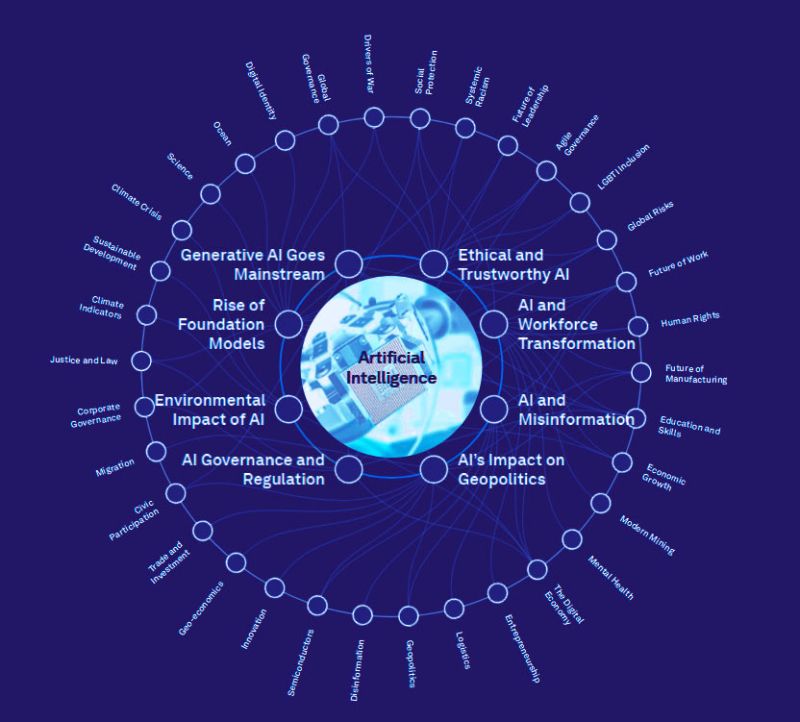
The World Economic Forum’s AI landscape map perfectly illustrates how AI is no longer just a technology topic. It now intersects with almost every major issue shaping our future: economic growth, education, healthcare, geopolitics, misinformation, climate challenges, regulation, labor markets, entrepreneurship, security, and human rights.
AI sits at the center of a rapidly expanding ecosystem of opportunities and risks.
On one hand, AI is driving unprecedented innovation. Generative AI is becoming mainstream. Foundation models continue to improve at remarkable speed. Organizations are using AI to increase productivity, automate processes, improve decision-making, and unlock new business models.
On the other hand, many of the questions society faces today are becoming more complex because of AI.
- Will AI create more jobs than it eliminates?
- Will it reduce inequality through broader access to knowledge and services, or concentrate wealth and power even further?
- Will AI strengthen democracy through better information access, or accelerate misinformation and social polarization?
- Will AI help solve global challenges such as healthcare, climate change, and education, or create new risks that regulators struggle to manage?
These are economic, social, political, ethical, and human questions. Our view is that one of the biggest misconceptions about AI is that it is primarily a software challenge.
The technology is advancing faster than institutions, regulations, education systems, labor markets, and corporate governance frameworks can adapt.
That is why discussions around:
- AI governance
- trustworthy AI
- regulation
- workforce transformation
- digital identity
- cybersecurity
- global risk management
- are becoming just as important as advances in algorithms and computing power.
Another important reality is that AI remains far from perfect. Despite impressive capabilities, AI still struggles with reasoning, hallucinations, context, accountability, bias, and explainability. The more influential AI becomes, the more important human judgment becomes.
The future is unlikely to be shaped by AI replacing people. It will be shaped by how effectively people learn to work with AI.
……………….
AUTHOR: Oleg Parashchak – CEO & Founder of Finance Media Holding