The US individual life insurance market delivered another growth quarter in Q2 2026, as total new annualized with excess premium, or AWEP, reached $4.7 bn. That marked a 3% increase from the same quarter in 2025.
LIMRA data shows whole life and variable universal life drove much of the gain. Policy count rose 8% year over year, which gives advisors a broader signal than premium volume alone.
Demand isn’t only coming through larger checks. More buyers entered the market, and wealth managers assessing protection planning for clients will read the data that way.
Life insurance plays an important role in protecting households from financial uncertainty and is distributed through multiple channels, most notably the workplace and retail markets, where offerings and access have expanded over time. Yet despite an increase in access to coverage, it is not always visible or fully understood by those it is designed to protect.
LIMRA stated U.S. retail annuity sales to finish above $460 bn in 2025, marking the fourth consecutive year of record sales. Quarterly results tell the same story: eight straight quarters have exceeded $115 bn, with the third quarter of 2025 surpassing $120 bn.
Life insurance ownership over time
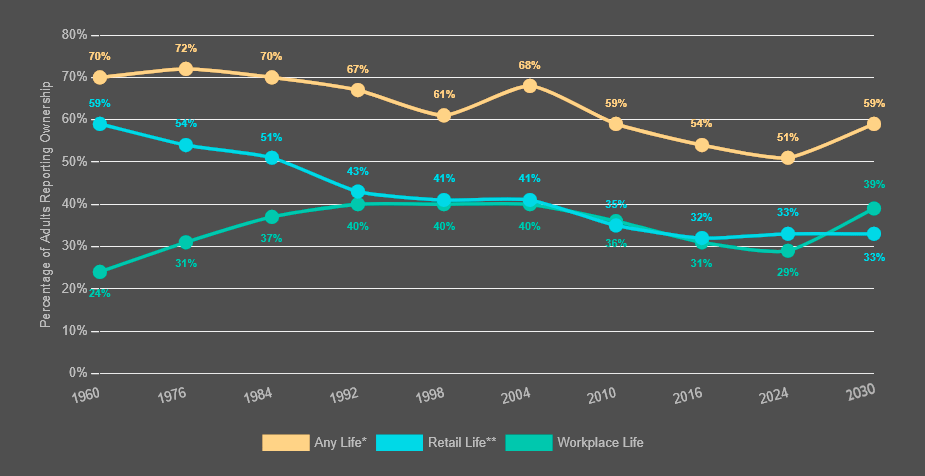
In many cases, these disconnects reflect how life insurance is delivered. Workplace coverage is often provided automatically through a passive enrollment process, which explains many, though not all, of these gaps.
Retail coverage, by contrast, typically involves an active purchase, making it more visible to policyholders. Regardless of how coverage is obtained, gaps in awareness, understanding and adequacy persist across channels, despite increased industry education and communication efforts.
More Americans have life insurance today than they may realize. LIMRA estimates that at least 59% of U.S. adults have some form of coverage, yet only 51% report having it. Even among those who recognize they are covered, understanding is often limited.
Many cannot clearly explain how much coverage they have, what risks it is intended to address, or whether it is sufficient for their needs.
This dynamic is most pronounced with workplace life insurance. Because the benefit is often provided automatically and requires little ongoing interaction after enrollment, it may not be top of mind (see US Life Insurers Face Rising Investment Risks Outlook).
LIMRA research suggests this awareness gap has been widening for more than two decades, with employee-reported coverage levels increasingly falling below estimated participation. Today, approximately 1 in 6 employees (and 1 in 4 insured employees) appear to be unaware of the life insurance they have through work.
Whole life leads premium and policy growth

Whole life insurance posted the strongest quarter across the market. New AWEP reached $1.78 bn, up 9% from Q2 2025. Policy sales rose 11%, and whole life now accounts for 37% of total new AWEP, making it the largest product category in US individual life insurance.
The gains also spread across carriers. 6 in 10 whole life writers increased premium sales during the quarter, while roughly half expanded policy count.
That distribution suggests the product line gained ground across a meaningful part of the market, rather than through one outsized carrier result.
“The individual life insurance market extended its growth in the second quarter, powered by whole life and variable universal life,” said Bryan Hodgens, head of research at LIMRA.
Beyond the favorable economic conditions and demographics, product innovation has been a major driver of the annuity market growth over the past five years.
The rise of registered index-linked annuities (RILAs) has dramatically reshaped the product landscape. RILA sales have surged more than 270% in just a few years, from $24 bn in 2020 to $65 bn in 2024. LIMRA projects RILA sales to exceed $75 bn in 2025 and 2026.
Term Life insurance
Term life insurance also held steady. New AWEP reached $829 mn, up 7%, while policy count increased 6%. Term remains an entry product for many younger and middle-market clients building basic coverage, especially when advisors start with income protection before moving into more complex planning.
Variable universal life insurance
Variable universal life, or VUL, recorded the sharpest premium growth among product lines. New AWEP reached $800 mn, up 11% year over year.
VUL now represents about 17% of total new AWEP. Policy count stayed almost flat against Q2 2025, which points to a different growth pattern. Larger face amounts, affluent purchasers and higher premiums appear to be doing more of the work than a broad rise in new policyholders. It’s a richer-ticket story, not a mass-market one.
Indexed universal life insurance
Indexed universal life (IUL) new annualized with excess premium was almost $1.1 bn in the second quarter of 2026, down 11% from the prior year, its first decline since the second quarter of 2023. The number of IUL policies sold rose 5% year over year.
The premium drop reflects an exceptionally strong comparison quarter: IUL premium had surged 31% in the second quarter of 2025, and the carriers posting the steepest declines this quarter were largely those that recorded outsized gains a year ago.
About half of IUL writers, including half of the top 10 carriers, reported premium growth. IUL represented 23% of total new annualized with excess premium in the second quarter.
Fixed universal life insurance
After declining since the fourth quarter of 2024, fixed universal life insurance (fixed UL) new premium stabilized in the second quarter.
Fixed UL new annualized with excess premium was $240 mn, even with the prior year, and the number of policies sold edged up 1%.
At least half of fixed UL writers, including eight of the top 10, reported premium growth. Expectations that interest rates will remain relatively elevated may be lending support to fixed UL. Fixed UL held a 5% share of new premium.
Fixed indexed annuities (FIAs) have nearly doubled during that same window, reaching $126 bn in 2024 with similar results expected for 2025. Total U.S. annuity sales were $223 bn in H1 2025, 3% above prior year results.
At the same time, fee‑based annuities have opened the door to greater adoption among RIAs. These products (now supported by enhanced technology platforms) have doubled in sales since 2020. As more RIAs integrate annuities into holistic planning conversations, this channel is poised for continued expansion.
The 2026 Annuity Sales Forecast
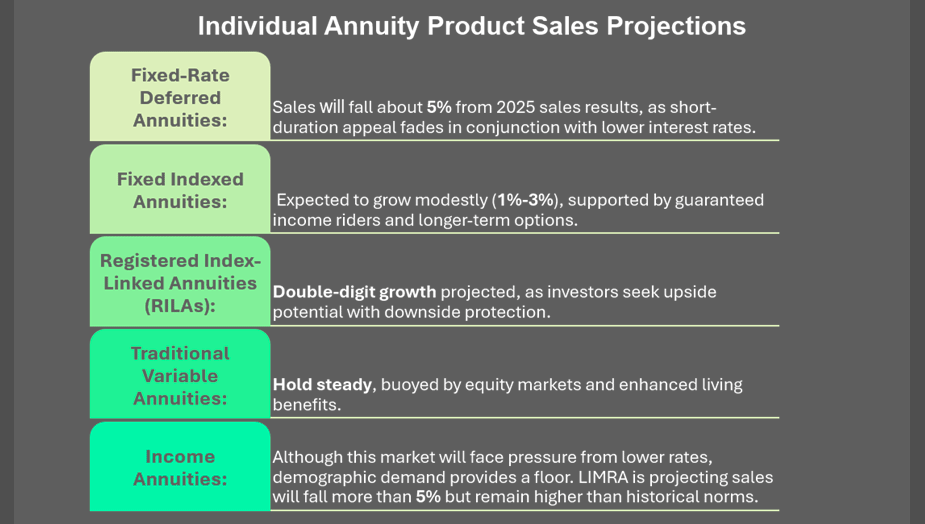
Despite expectations of gradual interest‑rate cuts, LIMRA projects that 2026 annuity sales will remain above $450 bn, supported by strong demographic demand, maturing contracts (“money in motion”), new product development, and technology-driven efficiencies.
While cuts in interest rates will dampen the fixed annuity market a bit, interest rates will remain historically high, allowing carriers to offer competitive solutions.
According to LIMRA’s 2026 forecast, indexed-linked product sales will continue to grow as investors seek downside protections coupled with investment growth potential.
“The continued growth of the U.S. annuity market also will depend on robust engagement with financial professionals,” noted Sean Grindall, chief member relations and solutions officer, LIMRA and LOMA.
This year, LIMRA expanded its mission to educate the financial professionals about the value of annuities and the greater options to address the spectrum of their clients’ risk concerns, and about changing landscape that makes annuities a more important component to a holistic retirement plan.
With millions entering retirement each year and fewer guaranteed lifetime income sources available, the demand for solutions that offer security has never been stronger. LIMRA’s forecast reflects not only a moment of growth, but a shift toward a more resilient, consumer-centered retirement landscape.
What the data means for advisors
LIMRA’s survey covers about 85% of the US life insurance market. According to Beinsure analysts, the results point to a market gaining in both premium volume and policy count, a mix which suggests demand goes beyond inflation-driven premium expansion.
Advisors should watch the product split closely. Whole life growth shows continued appetite for permanent protection and cash-value features.
VUL’s premium gains point toward affluent buyers, market-linked accumulation and larger policy designs. Term growth signals healthy entry-level demand. IUL’s premium decline, despite higher policy count, looks more like repricing, smaller cases or buyer caution than a collapse in interest.
One methodological change matters for comparisons. Starting in Q1 2026, LIMRA moved from its traditional annualized premium, or AP, metric to annualized with excess premium, AWEP. The newer measure includes total premium, including excess payments above the base amount.
For many, the challenge begins with awareness, or a lack thereof. A meaningful share of Americans is best described as “insured but unaware,” meaning they have coverage but do not fully recognize it.
How much did the US individual life insurance market grow in Q2 2026?
The US individual life insurance market grew 3% year over year in Q2 2026. Total new annualized with excess premium, or AWEP, reached $4.7 bn. Policy count rose 8%, which points to broader buyer activity, not only higher premium payments.
Which life insurance product led market growth?
Whole life insurance led the market. New AWEP reached $1.78 bn, up 9% from Q2 2025, while policy sales increased 11%. Whole life accounted for 37% of total new AWEP, making it the largest product category in US individual life insurance.
Why did VUL premium grow faster than other product lines?
Variable universal life posted an 11% rise in new AWEP to $800 mn. Policy count stayed almost flat, so growth appears tied to larger face amounts, affluent purchasers and higher premium cases rather than a wider pool of new buyers.
What happened to indexed universal life sales?
Indexed universal life new AWEP fell 11% year over year to almost $1.1 bn in Q2 2026. It marked the first premium decline since Q2 2023. Policy count still rose 5%, which suggests smaller cases, repricing or more price-sensitive demand rather than a broad retreat from the product.
How did term life insurance perform?
Term life insurance remained stable. New AWEP reached $829 mn, up 7%, and policy count rose 6%. The product continues to work as an entry point for younger and middle-market clients seeking basic income protection.
Why does life insurance awareness matter?
Life insurance ownership remains underreported. LIMRA estimates at least 59% of US adults have some form of coverage, yet only 51% say they do. Workplace coverage explains part of the gap, since employees often receive coverage through passive enrollment and do not always track the benefit after enrollment.
What should advisors take from LIMRA’s Q2 2026 data?
Advisors should read the quarter as a mixed but constructive signal. Whole life growth points to demand for permanent protection and cash-value features. VUL growth reflects larger affluent-market cases. Term remains healthy at the entry level. IUL’s premium decline needs closer review, since policy count still grew and roughly half of writers reported premium gains.