AcuityMD raised $80 mn in new funding as the Boston-based company pushes deeper into AI tools for the medical device industry. The Series C round was led by StepStone Group, with participation from Benchmark, Redpoint Ventures, ICONIQ, and Atreides Management.
The deal pushes AcuityMD close to unicorn territory. The company now carries a $955mn valuation after raising more than $160mn to date.
AcuityMD says 16 of the top 20 MedTech companies already use its platform. According to the company, customers have identified more than $34bn in pipeline opportunities through its system.
The new capital goes toward three areas. AcuityMD plans to expand agentic AI capabilities for sales, leadership, and marketing teams, deepen the MedTech ontology behind its data model, and move the platform beyond commercial operations into broader product lifecycle workflows.
Healthcare markets move fast, and MedTech companies often struggle to keep pace with shifting reimbursement policies, hospital consolidation, portfolio changes, and regulatory updates.
Sales teams end up chasing fragmented information spread across claims databases, FDA filings, government records, and market data.
The company aggregates healthcare datasets into what it describes as a proprietary MedTech ontology, a continuously updated knowledge graph mapping physicians, hospitals, networks, procedures, reimbursement trends, and relationships between them. It then layers customer-specific information on top, including CRM activity, territory structures, contracting details, and product indications.
The result gives MedTech companies a live commercial view of the healthcare market instead of scattered spreadsheets and disconnected systems.
According to AcuityMD, the platform helps commercial teams move faster and make sharper decisions in the field.
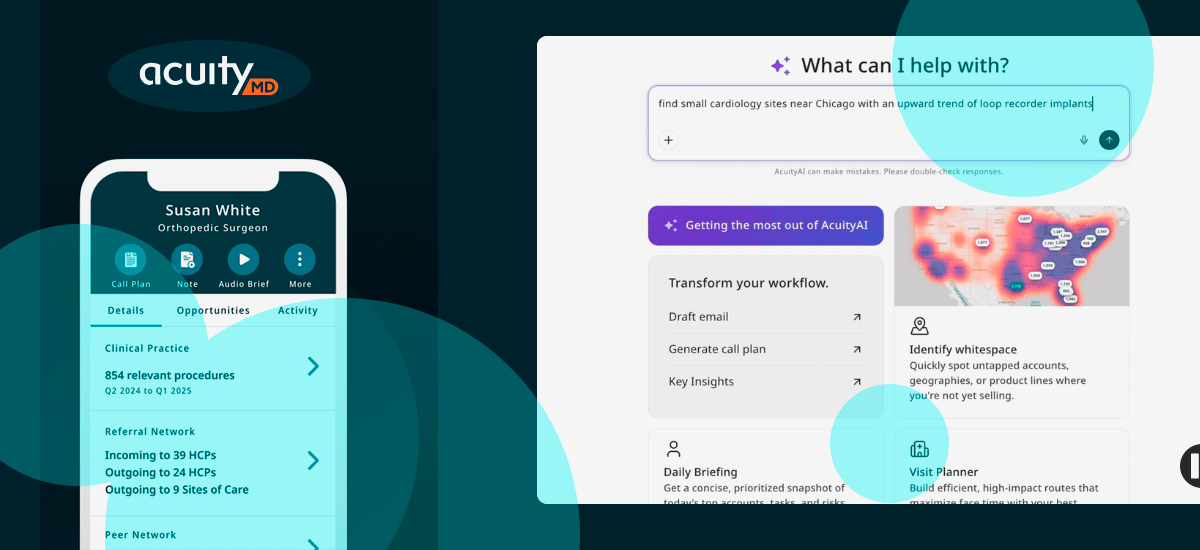
Its newest product, AcuityAI, entered open beta and sits at the center of the company’s next growth phase. The tool connects AcuityMD’s ontology with a customer’s business context and individual sales rep workflows to surface commercial insights horizontal AI systems struggle to replicate.
Sales reps spend less time searching for targets and more time meeting physicians with relevant context already in hand. That’s the pitch, anyway.
Mark Edwards, senior director of sales operations at Kuros Biosciences, said AcuityAI shortened research workflows that previously consumed hours.
According to Edwards, one sales leader used the system to analyze a new national contract tied to a large health system and quickly built a business plan identifying surgeon targets, geographic priorities, and opportunity areas without spending hours searching online.
Hunter Somerville, partner at StepStone Group, said AcuityMD’s data depth gives the company an edge as AI capabilities mature. He added that StepStone sees room for AcuityMD to expand well beyond commercial teams into wider MedTech operations, which drove the firm’s decision to increase its investment.
AcuityMD’s leadership argues AI alone isn’t enough in healthcare markets. According to CEO and co-founder Mike Monovoukas, AI systems need deep workflow context tied directly to how MedTech organizations operate day to day.
Monovoukas said AcuityMD aims to serve field reps, territory planners, and product launch teams through a shared intelligence layer built around real-world healthcare data and AI-generated insights.
The company now supports more than 400 MedTech businesses across different growth stages, from pre-commercial startups to enterprise-scale manufacturers.
According to Beinsure analysts, the bigger opportunity sits in workflow-specific AI systems trained on proprietary industry data rather than generic AI copilots dropped into healthcare environments with little operational context.
Commercial execution in MedTech has always depended on fragmented market intelligence and relationship-heavy sales motions.