CVS Health has released a real-world analysis showing that GLP-1 medications are associated with lower hospitalization rates, improved clinical outcomes and reduced medical spending, but the savings do not fully compensate for higher prescription drug costs at current prices.
Using anonymized claims from commercially insured Aetna members, researchers compared patients taking GLP-1 medications with matched non-users over follow-up periods of up to three years.
- CVS Health found that GLP-1 users had 34-42% fewer hospitalizations and 10-12% fewer emergency department visits, with generally better cardiovascular and kidney outcomes.
- After three years, medical spending was $9,400 lower per GLP-1 user, but pharmacy spending increased by $13,300, leaving a $3,900 net cost increase.
- CVS Health estimates that a net GLP-1 price of approximately $350 per month over three years would balance observed medical savings and additional pharmacy costs across the study population.
The findings indicate that the medications provide measurable clinical benefits, particularly among patients who remain on treatment. Their higher pharmacy costs nevertheless increase total health care spending.
CVS Health estimates that an average net price of approximately $350 per month over three years would allow the observed medical savings to offset additional pharmacy expenditures across the population studied.
GLP-1s are remarkably effective medicines, and the health benefits are real. The challenge is making those benefits affordable at scale.
Amy Compton-Phillips, MD, a co-author of the research
The company argues that broader access depends on identifying patients with the greatest clinical need, supporting treatment adherence and reducing drug prices.
GLP-1 users show lower hospitalization and cardiovascular risks
The study examined Aetna members who initiated GLP-1 treatment during 2023-2025, using a 12-month baseline period and up to three years of follow-up.
Researchers matched treated patients with comparable individuals who had not used GLP-1 medications, accounting for age, underlying health conditions, previous health care utilization and medical and pharmacy spending.
Among all patients initiating treatment, hospitalization rates were 34-42% lower than among matched non-users across the three follow-up periods.
Emergency department visit rates were 10-12% lower in the first two years. The analysis also identified more favorable cardiovascular and kidney outcomes.
GLP-1 users had 14% lower odds of major adverse cardiovascular events, 18-24% lower odds of heart attack, 15-19% lower odds of heart failure and 17-18% lower odds of a composite renal failure outcome in the earlier follow-up analyses. The differences generally became more pronounced among patients who maintained treatment.
Obesity Rates in the United States May Be Turning a Corner
For adherent users, hospitalization rates were 53-66% lower, while emergency department visits were 27-33% lower than among matched non-users. Their odds of major adverse cardiovascular events were 18-33% lower.
In the third-year analysis, adherent patients had 55% lower odds of heart attack and 59% lower odds of heart failure, although the smaller sample limits the certainty of these comparisons.
Adherence was defined as prescriptions covering at least 80% of days during follow-up, using the standard proportion of days covered measure.
The researchers cautioned that the observational findings establish associations rather than causation. Differences in patient characteristics, including factors associated with consistent medication use, may have influenced the results.
The first-, second- and third-year populations were also matched separately rather than followed as one continuous cohort.
GLP-1 medical savings remain below higher pharmacy spending
The study’s central economic finding is that GLP-1 treatment was associated with lower medical costs, but additional prescription spending exceeded those savings.
In the first-year analysis, medical spending was approximately $1,300 lower per treated member than among matched non-users. By the third-year comparison, the difference had increased to $9,400 per member.
Incremental net pharmacy spending, including rebates and discounts, was $13,300 higher for GLP-1 users.
That left an estimated $3,900 increase in total cost of care per member. The difference was larger among patients who remained adherent to treatment. In the third-year analysis, adherent patients had $13,000 lower medical spending than matched non-users. Their incremental pharmacy spending, however, reached $20,300, producing a net cost increase of approximately $7,300.
| Third-year cost comparison | All GLP-1 initiators | Adherent users |
|---|---|---|
| Medical spending reduction | $9,400 | $13,000 |
| Additional net pharmacy spending | $13,300 | $20,300 |
| Net increase in total cost | $3,900 | $7,300 |
The results demonstrate a financial trade-off associated with sustained treatment.
Patients who consistently used GLP-1 medications generally experienced larger reductions in hospital utilization and medical spending, but their continued prescription use also generated higher pharmacy costs.
CVS Health said treatment effectiveness should not be judged solely by whether medications produce immediate net savings.
The analysis nevertheless provides a pricing benchmark for insurers and employers seeking to expand coverage while controlling total health care expenditures.
CVS Health estimates $350 monthly GLP-1 break-even price
Based on observed medical spending reductions, CVS Health modeled the net medication price at which additional pharmacy expenditure would be fully offset by medical savings. Its estimate was approximately $350 per month over three years for the overall study population.
The calculation is an average rather than a universally applicable price for every patient or treatment indication. The economic value of GLP-1 therapy varies according to underlying medical risks, treatment duration and medication adherence.
Patients with diabetes and elevated cardiovascular risk, for example, may have greater opportunities for near-term medical cost reductions than younger individuals with obesity but relatively low immediate health risks.
The modeled estimate also reflects the products, prices and follow-up periods included in the analysis. It should not be interpreted as a general price recommendation or a guaranteed financial break-even point.
CVS Health emphasized that the objective is to align medication prices with clinical benefits and the associated savings elsewhere in the health care system.
More than 137 mn US adults may qualify for semaglutide
GLP-1 therapies were initially developed to treat type 2 diabetes but now have approved indications covering a broader range of metabolic and cardiovascular conditions. These include obesity, cardiovascular risk reduction, kidney disease progression in adults with type 2 diabetes and chronic kidney disease, metabolic dysfunction-associated steatohepatitis and obstructive sleep apnea in adults with obesity.
Semaglutide and tirzepatide are among the newer medications developed from earlier incretin-based treatments.
GLP-1 receptor agonists support glucose regulation by stimulating insulin release when blood sugar is elevated, slowing gastric emptying and reducing appetite. Tirzepatide also acts on the glucose-dependent insulinotropic polypeptide receptor.
CVS Health cited research estimating that more than 137 mn US adults qualify medically for semaglutide under at least one approved indication.
That includes approximately 35 mn adults with diabetes, 129 mn with obesity and 9 mn eligible for secondary cardiovascular prevention, with substantial overlap between the groups.
Despite the size of the eligible population, high medication prices, inconsistent insurance coverage and out-of-pocket costs restrict access.
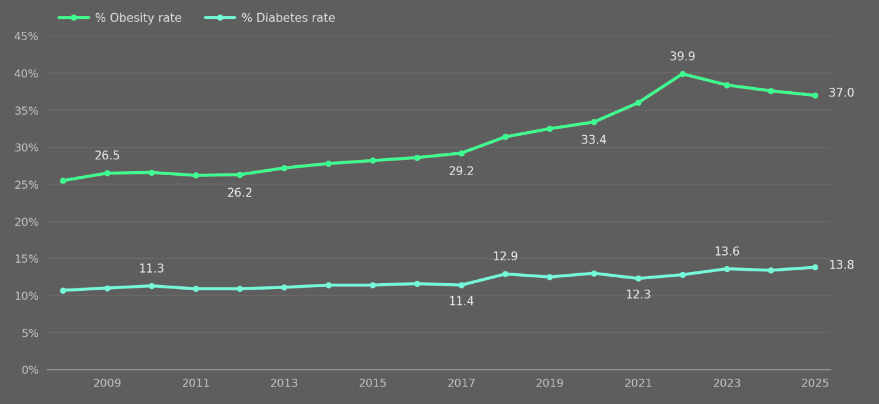
The report also noted that US adult obesity prevalence declined from 39.9% in 2022 to 37.0% in 2025, following decades of increases.
That decline coincided with expanding GLP-1 use, although the figures do not establish that the medications caused the population-level change.
GLP-1 spending increases pressure on employers and health plans
CVS Health estimates that GLP-1 medications account for roughly half of prescription drug spending growth.
Approximately eight in ten employers identify the medications as a major contributor to rising health care costs, according to the report. The affordability challenge comes as employer-sponsored health insurance premiums continue increasing.
Average annual family coverage premiums reached $28,303 in 2026, up 5% from 2025. The growing number of patients eligible for GLP-1 treatment creates a substantial financial challenge for employers and health plans deciding which treatments to cover and how to structure access.
CVS Health recommends prioritizing patients whose medical conditions and individual risk profiles indicate the greatest potential benefit.
Lower cash prices could improve GLP-1 affordability
The report examined recent changes in the direct-to-consumer market, where manufacturers have reduced cash prices for patients purchasing medications without insurance.
Novo Nordisk and Eli Lilly have worked with the US government on lower out-of-pocket prices for GLP-1 treatments available through the TrumpRx platform.
CVS Health said lower cash prices can improve access for people without insurance coverage, although affordability for commercially insured patients depends on the net prices negotiated by employers and health plans.
The company recommends that manufacturers offer insured patients with approved clinical indications net prices at least comparable to cash-pay prices for the same medication and dosage. It also argues that discounted access should not require health plans to abandon evidence-based medical eligibility requirements.
The report distinguishes medically indicated treatment from cosmetic weight loss among individuals without relevant clinical conditions.
CVS Health compared that distinction with Botox, which may be covered for chronic migraines or other medical conditions but is generally purchased out of pocket for cosmetic purposes.
The company maintains that GLP-1 coverage decisions should similarly reflect established clinical evidence and patient need. Eligibility verification, however, should remain straightforward and avoid unnecessary administrative barriers.
CVS Health also expects additional oral treatments and new GLP-1-based therapies to create opportunities for pricing competition.
Clinical benefits depend on sustained treatment and affordable access
The research identifies three conditions for improving the economic and clinical value of GLP-1 treatment: appropriate patient selection, sustained adherence and lower net prices.
The findings suggest that greater adherence is associated with better clinical outcomes and larger medical savings, although higher cumulative medication spending can increase total health care costs.
The analysis also has limitations. Claims records establish prescription availability rather than confirmed medication use, while propensity-score matching cannot eliminate differences caused by unmeasured patient characteristics.