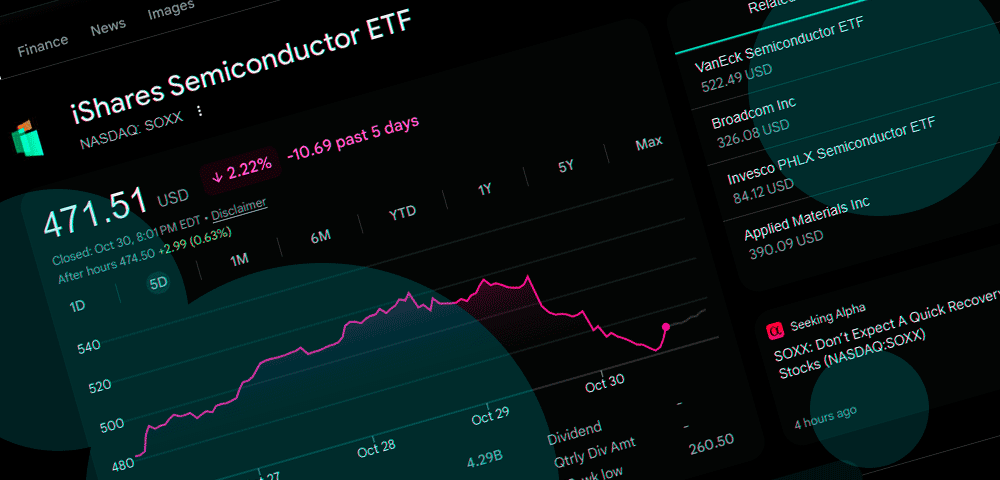
US stock markets opened November with a recovery after October’s technology-led selloff, supported by a sharp decline in oil prices and renewed demand for industrial, consumer and technology stocks.
The Dow Jones Industrial Average rose approximately 1.2% to 52,380.83 during Monday morning trading. The S&P 500 and Nasdaq Composite also advanced as investors assessed whether last week’s losses created opportunities to increase equity exposure.
- Dow Jones futures recovered on November 2 as falling oil prices and renewed demand for equities supported a rebound. The Dow Industrial Average gained more than 600 points in early trading, reaching approximately 52,380.
- Morgan Stanley expects the US stock market correction to approach its final stages, while JPMorgan sees improving market breadth and Goldman Sachs maintains a constructive 12-month equity outlook.
- The Dow’s next move depends on oil prices, interest rates and economic data. The November 3 midterm elections, corporate earnings and November 6 employment report could determine whether the rebound continues.
December E-mini Dow futures had traded around 52,200 during the earlier premarket session, reversing part of Friday’s decline. Futures and the cash Dow are separate instruments, so their prices are not directly interchangeable. Investing.com
The rebound followed a difficult October for US equities. Semiconductor and technology stocks faced substantial selling as investors questioned the sustainability of AI infrastructure spending and the ability of major technology companies to generate sufficient cash flow.
However, investment bank research increasingly points to a more differentiated market, with industrials, healthcare and selected cyclical companies demonstrating greater resilience than technology stocks.
Morgan Stanley expects the stock market correction to end
Morgan Stanley’s latest assessment, published November 2, suggests that the US equity correction may be entering its final phase.
Chief US equity strategist Michael Wilson argues that deteriorating performance among large technology companies has obscured improving conditions across other parts of the market.
According to Morgan Stanley, approximately 60% of Russell 3000 constituents have experienced corrections exceeding 20% since June.
This indicates that much of the selling has already occurred outside the major stock indexes.
The bank expects the November 3 midterm elections to remove an important source of uncertainty and potentially encourage investors to increase exposure to cyclical companies.
Morgan Stanley remains constructive on the medium-term outlook but acknowledges that further short-term volatility is possible. Its strategists have identified the S&P 500 range of 7,100-7,300 as a potential area where market conditions could become more attractive if selling resumes. The bank has maintained an 8,000 year-end S&P 500 target.
For Dow futures, Morgan Stanley’s analysis supports a potential rotation toward industrial and economically sensitive stocks, particularly if earnings expectations stabilize and oil prices decline further.
However, the bank identifies renewed military escalation involving Iran and additional US tariffs as risks to the recovery. Reuters
JPMorgan sees stronger market breadth and potential post-election gains
JPMorgan Private Bank has identified improving market breadth as an encouraging development for US equities.
Strategists Kriti Gupta and Nick Roberts noted that more than half of S&P 500 companies recently reached new 20-day highs.
The development is significant because earlier market gains depended heavily on a relatively small number of large technology companies. A broader recovery reduces the market’s dependence on AI-related stocks.
JPMorgan expects the period following the midterm elections to provide an opportunity for stronger equity performance, although historical post-election returns do not guarantee future gains.
The bank previously raised its year-end S&P 500 target to 8,000.
For the Dow, improving market breadth is particularly relevant because the index includes companies across industrials, financial services, healthcare, energy and consumer sectors.
A recovery extending beyond technology could support Dow futures even if Nasdaq performance remains volatile. Business Insider
Goldman Sachs maintains a bullish stock market forecast
Goldman Sachs Research remains constructive on US equities over the next 12 months, although its analysts expect earnings growth to become less dependent on AI infrastructure investment.
In its September outlook, Goldman Sachs projected that the S&P 500 could reach 8,700 over 12 months. The forecast was based primarily on corporate earnings growth rather than additional expansion in valuation multiples.
The bank estimates that S&P 500 earnings per share could reach $415 in 2027 and $460 in 2028.
Goldman Sachs expects earnings growth to moderate as the contribution from AI infrastructure spending gradually declines. Its research indicates that hyperscaler capital expenditure could reach $1.2 tn in 2027 and $1.4 tn in 2028.
However, the bank also warns that an unexpected $250 bn change in AI spending could alter S&P 500 earnings growth by approximately 6 percentage points.
For Dow futures, the implication is that earnings growth outside technology could become increasingly important.
Goldman Sachs expects AI-related productivity improvements to support corporate profitability over time, but the transition from infrastructure spending to realized economic benefits could be uneven.
Why falling oil prices are supporting Dow futures
The sharp decline in oil prices was one of the main drivers of Monday’s recovery.
Brent crude fell approximately 6% toward $106 per barrel following reports that the US and Iran could resume negotiations and work toward reopening the Strait of Hormuz.
Lower energy prices could reduce transportation costs, ease inflation pressures and improve corporate profit margins.
Airlines, cruise operators and other companies with substantial fuel expenses advanced following the decline.
The Dow’s response is more complicated because it also includes energy companies such as Chevron.
Lower oil prices can reduce earnings expectations for energy producers while supporting industrial and consumer businesses.
Goldman Sachs has identified substantial uncertainty in the oil market. Its latest outlook places Brent crude around $88 per barrel in its 2027 base case but acknowledges that prices could average approximately $130 if Middle Eastern supply disruptions persist.
For Dow futures, sustained oil-price stabilization would reduce an important source of market volatility. Renewed disruptions could reverse much of Monday’s improvement.
US manufacturing growth supports the Dow’s industrial companies
Fresh US manufacturing data provided another positive signal. The Institute for Supply Management’s manufacturing PMI increased to 55.5 in October from 54.5 in September, exceeding market expectations.
The production index reached 59.0, its strongest reading since November 2021.
New orders also continued expanding, indicating that demand remained relatively resilient despite elevated borrowing costs and energy prices. However, the prices-paid index remained high at 75.2, compared with 77.9 in September.
The combination suggests that manufacturing activity is improving while inflationary pressures remain substantial.
For the Dow, stronger production and capital expenditure could support companies such as Caterpillar and other industrial manufacturers. However, high input costs could limit margin expansion.
If industrial companies can maintain pricing power while production volumes increase, their earnings may support a broader stock market recovery.
S&P Global sees potential upside for Dow Jones companies
A separate analysis from S&P Global Market Intelligence, published October 13, provides a more direct assessment of the Dow’s constituents.
Using Visible Alpha analyst consensus estimates, the research identified an approximately 18.7% weighted potential price return for the 30 companies comprising the Dow Jones Industrial Average over a medium-term horizon.
The estimate reflects individual constituent valuations and earnings expectations. It is not a formal Dow futures target or a forecast for a specific month.
S&P Global identified industrial, energy and healthcare companies as important contributors to recent Dow performance.
Caterpillar and Chevron benefited from stronger earnings expectations, while healthcare companies including Johnson & Johnson, Amgen and Merck contributed to the index’s resilience.
The research also highlighted potential recovery opportunities among consumer companies that have underperformed.
However, S&P Global warned that elevated interest rates, geopolitical uncertainty and persistent inflation could continue affecting valuations.
The analysis suggests that the Dow futures has potential sources of earnings growth beyond the AI investment cycle, although the strength of those sources will vary by sector.
Federal Reserve interest rates remain a risk for Dow futures
The Federal Reserve’s policy outlook represents another important variable. The federal funds target range stands at 3.75%-4.00% following the October meeting.
While declining oil prices could eventually ease inflation pressures, strong manufacturing activity and resilient economic growth may reduce the urgency for lower interest rates.
Higher borrowing costs affect the Dow through several channels. Industrial companies face more expensive financing for investment and equipment purchases.
Consumer companies can experience weaker demand as households confront higher borrowing costs.
Financial institutions may benefit from some aspects of elevated interest rates, although tighter credit conditions can increase loan losses.
Investors will therefore focus on both job creation and wage inflation in the November 6 employment report.
Dow Jones futures forecast for November and year-end 2026
Based on current market conditions, institutional equity research and macroeconomic risks, Beinsure identifies three conditional scenarios for Dow Jones futures.
These scenarios are independent analytical estimates, not price targets issued by Morgan Stanley, Goldman Sachs or JPMorgan.
Bearish forecast: 49,000-51,000
The bearish scenario assumes renewed selling following the midterm elections, weaker corporate earnings or another escalation in the Middle East.
A rebound in oil prices toward $120-$130 could strengthen inflation expectations and reinforce concerns about prolonged restrictive monetary policy.
Technology-related earnings downgrades could also spread to industrial and financial companies.
Under these conditions, Dow futures could decline below 51,000 and potentially test the 49,000-50,000 area.
Base forecast: 51,500-54,000
The base scenario assumes that oil prices stabilize, corporate earnings remain resilient and the election results do not produce a major negative market surprise.
Manufacturing activity continues expanding, although inflation prevents an immediate shift toward easier monetary policy.
The Dow consolidates after October’s volatility, supported by healthcare, industrials and selected financial companies.
In this environment, futures could fluctuate within the 51,500-54,000 range through year-end.
Bullish forecast: 54,500-56,000
The bullish scenario assumes meaningful progress toward a US-Iran agreement, further declines in energy prices and stronger-than-expected corporate earnings.
Improving market breadth would allow industrial and consumer stocks to participate more fully in the recovery.
A reduction in geopolitical uncertainty could also encourage institutional investors to increase equity exposure following the elections.
Under these conditions, Dow futures could advance toward 54,500-56,000 before year-end.
Dow futures outlook: Can the market rally continue?
The November 2 rebound suggests that investors remain willing to increase equity exposure following sharp corrections.
Morgan Stanley sees evidence that the broader market’s decline is approaching its final stages. JPMorgan identifies improving market breadth, while Goldman Sachs continues to project substantial earnings growth through 2027.
However, these institutions’ bullish equity forecasts are not direct predictions for Dow futures.
For the Dow, the strongest near-term support comes from resilient manufacturing activity, falling energy prices and the possibility that investors continue reallocating capital toward industrial, healthcare and consumer companies.
The principal risks are persistent inflation, restrictive Federal Reserve policy and renewed geopolitical instability.
The base case is for continued volatility around 52,000-54,000, with a sustained move above 53,000 needed to strengthen the recovery outlook.
The next several trading sessions will be critical in determining whether Monday’s rebound develops into a broader year-end rally or remains a temporary recovery within the market correction.