The iShares Semiconductor ETF (NASDAQ: SOXX) has entered a bear market as investors reassess semiconductor valuations, AI infrastructure spending and earnings growth.
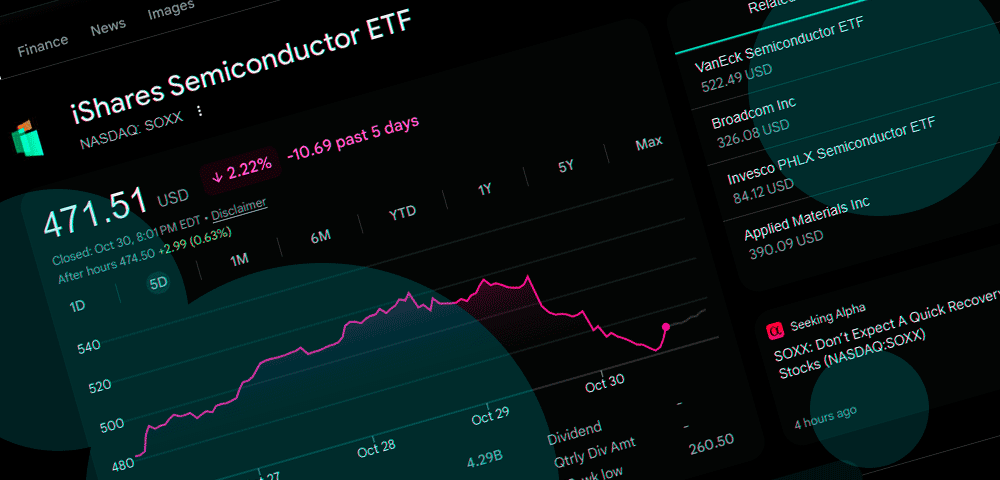
SOXX closed at $471.51 on October 30, down 28.1% from its June record of $656. The ETF plunged 8.24% on Friday following weak Intel guidance and renewed concerns about the financing of AI investments.
- The iShares Semiconductor ETF (NASDAQ: SOXX) has fallen 28.1% from its June peak of $656 to $471.51, entering a technical bear market. The fund lost 8.24% on October 30.
- Morgan Stanley expects semiconductor stocks to face another 10%-15% decline before the correction ends. Goldman Sachs warns that slowing AI investment growth could weaken chipmakers’ earnings.
- Beinsure’s SOXX forecast identifies $400-$425 as a bearish scenario, $460-$500 as the base case and $520-$540 as a potential recovery range.
The fund’s five largest holdings, AMD, Nvidia, Micron, Broadcom and Intel, account for approximately 39% of its portfolio. Their earnings expectations and capital spending outlooks have a substantial influence on SOXX performance.
Why are semiconductor stocks falling?
The selloff reflects concerns about the gap between rising AI infrastructure costs and the revenue generated by those investments.
Amazon reported negative trailing 12-month free cash flow of $42.4 bn, while Alphabet recorded approximately $9 bn in negative quarterly free cash flow. Both companies continue investing heavily in AI infrastructure.
Negative free cash flow does not necessarily indicate declining operating profitability, but sustained investment above internally generated cash raises questions about financing costs and returns on capital.
For semiconductor suppliers, the risk is that hyperscalers eventually reduce orders to protect cash flow.
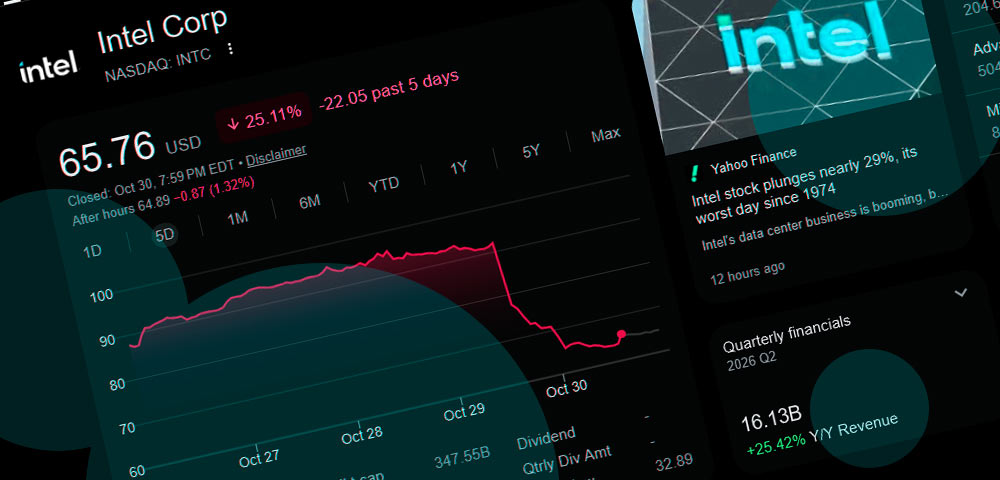
Intel added pressure after forecasting Q4 revenue of $15 bn-$16 bn, below analysts’ expectations of approximately $17.1 bn. Its shares fell 28.6% on October 30, despite data center revenue growing 78% to $7.3 bn in Q3.
The results exposed a divergence between AI-related server demand and the weaker PC market.
Morgan Stanley forecasts another 10%-15% semiconductor decline
Morgan Stanley chief US equity strategist Mike Wilson expects the semiconductor correction to approach its final stages around mid-November.
Wilson identified potential downside of 10%-15% for the Philadelphia Semiconductor Index, with support possibly emerging near 9,500 points.
The forecast was issued before the October 30 selloff and applies to the semiconductor index rather than SOXX directly.
Morgan Stanley attributes the correction to tightening financial conditions, AI financing requirements and weaker investor positioning.
The bank also notes that semiconductor earnings depend heavily on spending commitments from a relatively small group of large technology companies. A reduction in hyperscaler capital expenditure could therefore affect multiple manufacturers simultaneously.
Despite these risks, Morgan Stanley maintains its year-end S&P 500 target of 8,000, suggesting the broader equity correction may be approaching its final phase.
Goldman Sachs warns about semiconductor profit margins
Goldman Sachs Research expects hyperscaler capital expenditure to reach $1.2 tn in 2027 and $1.4 tn in 2028.
However, the bank warns that semiconductor earnings growth has benefited from strong pricing and unusually high margins.
Memory manufacturers have achieved gross margins of approximately 80%, more than twice historical levels. Goldman Sachs expects this profitability boost to moderate as supply constraints ease.
The bank also estimates that a $250 bn change in hyperscaler capital spending during 2027 could shift S&P 500 earnings growth by approximately 6 percentage points.
This illustrates how semiconductor manufacturers’ earnings have become increasingly sensitive to AI investment forecasts.
Bank of America has adopted a more cautious position on Intel, downgrading the stock from Buy to Neutral and reducing its price target from $145 to $100.
Analyst Vivek Arya expects Intel’s PC shipments to decline 25%-30% quarter over quarter in Q4, with further inventory adjustments possible in the first half of 2027.
The bank also estimates that weaker PC demand could create a revenue headwind of up to $750 mn for AMD, partly offset by stronger server processor sales.
DBS sees opportunities in memory and networking chips
DBS expects the semiconductor upcycle to continue through 2027-2028 but believes future performance will depend increasingly on AI economics rather than capital expenditure growth alone.
The bank identifies high-bandwidth memory, networking semiconductors and optical connectivity as potential beneficiaries of expanding AI infrastructure.
Growing AI computing clusters require faster connections between processors and greater memory bandwidth.
However, DBS warns that falling AI inference costs could eventually reduce infrastructure spending requirements unless higher usage offsets lower prices.
The bank therefore favors selective semiconductor exposure, particularly companies benefiting from supply constraints, sustainable earnings growth and reasonable valuations.
SOXX ETF price forecast for November and year-end 2026
Based on semiconductor valuations, earnings expectations and investment bank research, Beinsure identifies three conditional scenarios.
- Bearish forecast: $400-$425. Further earnings downgrades, weaker AI infrastructure investment and tighter credit conditions extend the correction.
- Base forecast: $460-$500. SOXX consolidates following October’s decline as investors assess updated semiconductor earnings and capital spending guidance.
- Bullish forecast: $520-$540. Stronger AI infrastructure orders, improving cash flow and renewed institutional demand support a recovery.
These are Beinsure’s analytical scenarios, not investment bank price targets.
BlackRock has also announced a 3-for-1 SOXX share split effective November 5, 2026.
Following the split, the October 30 closing price of $471.51 would be equivalent to approximately $157.17. The bearish forecast would correspond to roughly $133-$142, the base case to $153-$167 and the bullish range to $173-$180.
The split does not change the fund’s underlying value.
AMD’s earnings on November 3, subsequent semiconductor guidance and hyperscaler capital expenditure forecasts will be important for the near-term outlook.
Beinsure expects continued volatility in November, with the direction of SOXX increasingly determined by earnings revisions, financing costs and the ability of AI infrastructure customers to sustain investment.