Follow Beinsure
- Bristol’s Pero’s Bridge suffers further structural damage
- Engineers identified structural problems before the collapse
- Pero’s Bridge repair costs and potential insurance exposure
- Baltimore’s Francis Scott Key Bridge collapse led to billions in claims
- Baltimore bridge insurance payments and settlements reach billions
- Bristol and Baltimore bridge collapses differ in damage and insurance costs
A landmark pedestrian bridge in Bristol has partially collapsed into the city’s harbour, less than three months after a mechanical failure left its central lifting section stuck in a raised position.
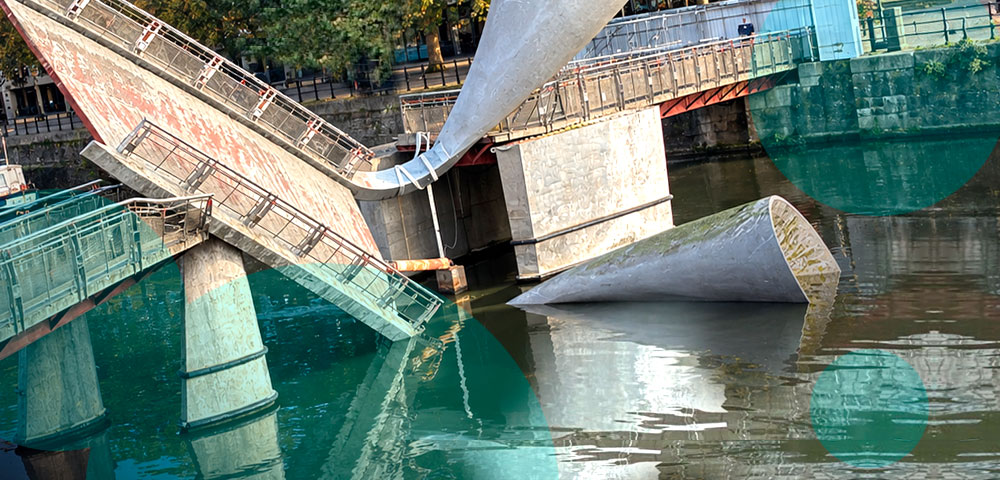
Pero’s Bridge, which connects two sides of Bristol’s Floating Harbour, suffered further structural damage shortly before 23:00 GMT on Saturday, October 31, 2026. Part of the crossing fell into the water, leaving one of its distinctive horn-shaped sculptures partially submerged.
- Pero’s Bridge partially collapsed into Bristol Harbour on October 31, 2026, damaging its hydraulic mechanism and causing an oil leak. No injuries were reported.
- Bristol City Council has allocated approximately £1.5 mn for repairs, with engineers assessing whether the latest damage will affect the planned 2027 reopening.
- The incident contrasts with Baltimore’s Francis Scott Key Bridge collapse, which resulted in $350 mn in initial insurance proceeds, a $102 mn federal settlement and a separate $2.25 bn state settlement.
Bristol City Council confirmed that the bridge’s central span slipped from its previous position, damaging a hydraulic ram used to operate the lifting mechanism.
No injuries were reported. A small quantity of hydraulic oil leaked into the harbour near the Arnolfini arts centre, prompting an environmental cleanup operation.
The incident occurred as the council was preparing to remove the damaged bridge sections for repairs, with previously announced refurbishment costs exceeding £1.5 mn.
Bristol’s Pero’s Bridge suffers further structural damage
Andrew Brown, chair of Bristol City Council’s Harbour Committee, confirmed that the central section had shifted and caused additional damage to the bridge’s hydraulic system.
Engineers and environmental specialists were deployed to assess the structure and remove oil from the water.
The council said there was no confirmed effect on the existing maintenance and refurbishment programme, although the schedule would remain under review pending further engineering assessments.
The bridge had been closed since August 13, 2026, when a routine lifting test resulted in a significant mechanical failure.
Its central bascule section became distorted and jammed in a partially elevated position, making the crossing unsafe for pedestrians and preventing vessels from passing underneath.
Photographs taken after the latest incident show the central span twisted towards the harbour, with one of the bridge’s prominent horn-shaped counterweights extending into the water.
The council had planned to remove all three bridge spans using specialist lifting equipment and transport them by barge to Albion Dry Dock for repair and refurbishment.
Its published repair programme scheduled the removal operation for the week beginning November 2, 2026.
Earlier council statements referred to reopening in spring 2027, while the latest published project information targets summer 2027. Officials have not confirmed whether the partial collapse will require a further revision.
Engineers identified structural problems before the collapse
Pero’s Bridge opened in 1999 and was designed by Irish artist Eilis O’Connell.
The pedestrian crossing links Narrow Quay and Bordeaux Quay, providing a route between the Queen Square and Millennium Square areas of central Bristol.
Its distinctive horn-shaped sculptures serve as counterweights for the movable central section, which can be raised to allow taller vessels to navigate the Floating Harbour.
Concerns about the structure’s condition had emerged well before the August malfunction.
An inspection in July 2025 identified several major structural defects requiring urgent attention. Engineers reported significant corrosion and warned that the lifting section could become stuck or misaligned.
In September 2025, the council approved £200,000 for emergency investigations and introduced restrictions on lifting operations and bridge loading.
Further repair funding was subsequently authorised.
According to Bristol City Council’s procurement records, £1.35 mn was approved for bridge repairs in March 2026, followed by an additional £160,000 allocated from highways funding in July.The combined allocation reached approximately £1.51 mn.
The council has warned that emergency removal costs will be met from the existing repair budget, potentially reducing the amount available for the wider refurbishment programme. Additional funding may be required if the remaining budget proves insufficient.
Pero’s Bridge repair costs and potential insurance exposure
The immediate financial consequences of the Bristol collapse concern the damaged structure, hydraulic equipment, emergency engineering work and environmental cleanup.
The council has not announced an insurance claim or confirmed whether the additional damage will generate an insured loss.
The approximately £1.5 mn repair allocation is a project funding figure, rather than a disclosed insurance payment or final estimate of damage caused by the October collapse.
The distinction matters because the bridge was already undergoing assessment and repair planning following the August mechanical failure.
Its latest structural deterioration could affect the scope and cost of refurbishment, but engineers have not yet established the additional expenditure required.
The closure also affects navigation through the harbour and pedestrian access between the waterfront areas. Earlier council reports indicated that ferry operators and some nearby businesses had experienced disruption following the August closure.
Any insurance implications would depend on the applicable policy terms, the cause of the damage, the condition of the bridge before the incident and the findings of the engineering investigation.
No confirmed insurance recovery or allocation of liability has been disclosed for Pero’s Bridge.
Baltimore’s Francis Scott Key Bridge collapse led to billions in claims
The damage in Bristol is considerably smaller in scale than the collapse of Baltimore’s Francis Scott Key Bridge on March 26, 2024, an incident that generated extensive marine insurance claims and multibillion-dollar litigation.
The Baltimore bridge collapsed after the container ship Dali, which had experienced electrical power failures, struck a supporting pier.
Six construction workers died, a major interstate highway connection was severed and access to the Port of Baltimore was temporarily disrupted.
The accident required the removal of approximately 50,000 tons of debris, including steel, concrete and wreckage associated with the vessel.
Early estimates placed the economic impact of the port disruption at approximately $15 mn per day.
The port, which handles more than 1 mn shipping containers annually, faced substantial operational interruptions affecting cargo transportation and businesses dependent on its facilities.
Initial assessments cited by Beinsure placed potential insured losses at $2-4 bn, including marine liability, property damage and business interruption.
Early estimates put direct bridge damage at approximately $1.2 bn, while potential wrongful death and business interruption claims were estimated at $350-700 mn. Those figures represented preliminary assessments, not confirmed final insurance payments.
Marine insurers, reinsurers and Protection & Indemnity (P&I) clubs were expected to absorb substantial portions of the losses, with Britannia P&I Club involved in covering the Dali.
Baltimore bridge insurance payments and settlements reach billions
The financial resolution of the Baltimore disaster has developed substantially since the initial loss estimates.
In October 2024, Grace Ocean Private Limited and Synergy Marine Private Limited, the owner and operator of the Dali, agreed to a settlement of approximately $102 mn with the US Department of Justice.
The federal settlement, precisely $101.98 mn, covered government expenditures associated with the emergency response and restoration of the main shipping channel.
The companies stated that the settlement did not constitute an admission of liability and confirmed that the relevant costs were fully insured.
The payment did not cover reconstruction of the Francis Scott Key Bridge, which remained subject to separate legal claims.
Maryland also received $350 mn in property and business interruption insurance proceeds under its bridge insurance policy.
In April 2026, ACE American Insurance reached a $350 mn settlement with the Dali’s owner and operator, resolving its effort to recover the amount previously paid to Maryland.
Maryland Attorney General Anthony G. Brown announced a final $2.25 bn settlement with Grace Ocean and Synergy Marine on May 12, 2026.
The agreement resolved civil claims brought on behalf of Maryland and several state agencies, including the Maryland Transportation Authority, Maryland Port Administration and Maryland Department of the Environment.
The state said it had assessed available insurance limits and other resources before agreeing to the settlement.
The $2.25 bn agreement is a civil settlement and should not be treated as an additional confirmed insurance payout of the same amount.
Maryland’s claims against the shipbuilder, Hyundai Heavy Industries, were not resolved by the agreement.
Initial reconstruction estimates of $1.7-1.9 bn were subsequently replaced by a revised Maryland Transportation Authority estimate of $4.3-5.2 bn, with reopening targeted for late 2030 rather than fall 2028.
Bristol and Baltimore bridge collapses differ in damage and insurance costs
The two incidents illustrate substantially different financial exposures associated with bridge failures.
Pero’s Bridge is a relatively small pedestrian structure that suffered a mechanical malfunction followed by further partial collapse. Its known repair allocation is approximately £1.51 mn, with no confirmed insurance payout and no reported injuries.
The Francis Scott Key Bridge was a major highway structure destroyed in a vessel collision that killed six people and disrupted commercial shipping.
Its insurance and liability consequences include $350 mn in confirmed bridge insurance proceeds, the approximately $102 mn federal settlement and Maryland’s separate $2.25 bn civil settlement with the vessel interests.
The total cost of reconstruction is now estimated at $4.3-5.2 bn, substantially above the initial projections.
The nature of the incidents also differs. Baltimore involved a ship collision and resulting marine liability claims, while Bristol’s failure concerns a bridge that had already been identified as structurally deficient and removed from public use.
For Bristol City Council, the immediate question is whether the additional damage to the central span and hydraulic mechanism can be accommodated within the approved refurbishment budget.
Engineers must assess the condition of the remaining structure before the lifting and removal programme can proceed.
The council has not reported any injuries or confirmed additional financial losses from the October 31 incident, and the bridge’s reopening timetable remains subject to the outcome of those assessments.