Commercial property insurance rates continued to decline in 2026 as competition and available capacity increased, according to the fall edition of WTW’ Insurance Marketplace Realities report.
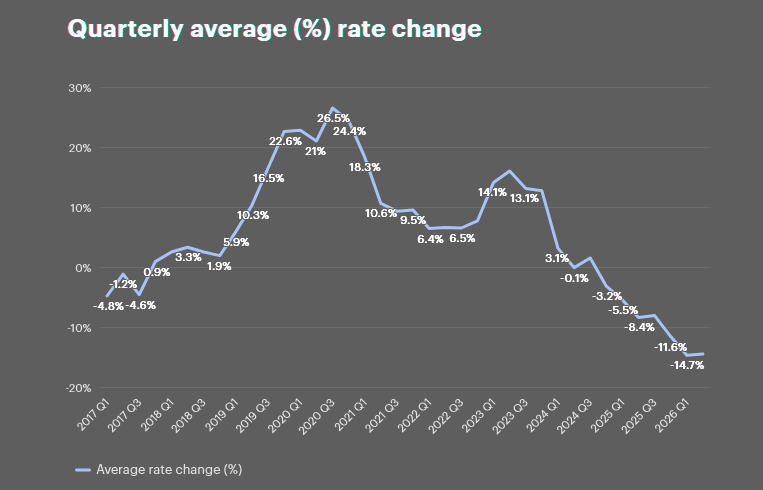
Rates for large and complex property risks within Willis’ portfolio fell 14.5% in the second quarter of 2026. A year earlier, rates for the same segment declined 8.4%, showing a faster pace of price reductions.
Shared and layered programs involving five or more carriers recorded average reductions of about 23.4% during the second quarter. Willis also reported softer treaty reinsurance renewals, adding capacity available to the primary property market.
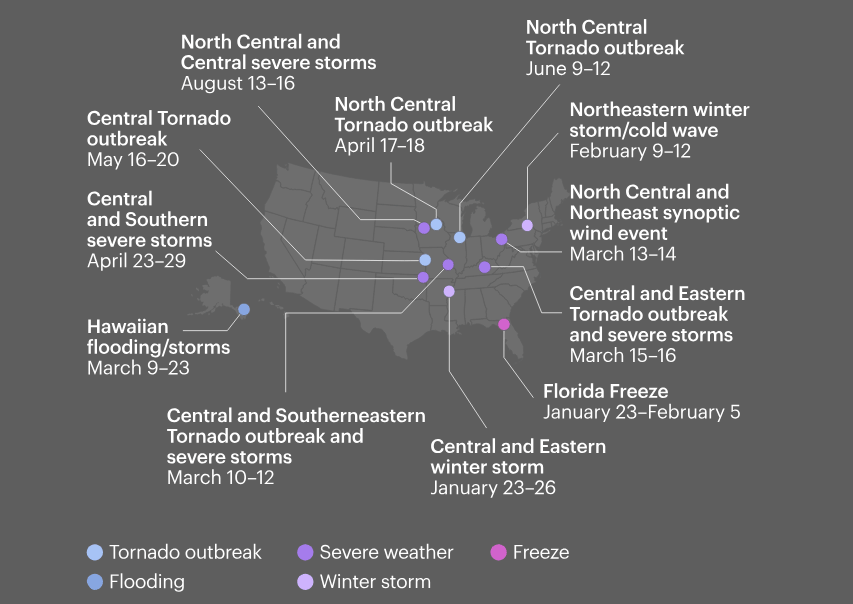
Catastrophe losses were relatively low during the first half of the year. Insured catastrophe losses totaled $42 bn, the lowest first-half figure since 2020, according to the report.
“The market trajectory has clearly reversed from the challenging period spanning Q1 2018 through Q1 2024,” Willis said.
The report covers dozens of commercial insurance lines across North America and finds generally favorable conditions for insurance buyers. Auto liability, unsupported lead umbrellas, excess liability and several difficult general liability classes remain exceptions.
Willis also sees early signs of rate increases reaching a peak in parts of excess casualty. The broker linked the change partly to broker-led facilities such as Gemini, new MGA and MGU capacity, several years of rate increases and reduced limit deployment.
Global insured CAT losses
Global insured CAT losses reached $107 bn in 2025 (the sixth consecutive year above $100 bn) led by the LA wildfires ($40 bn, the largest insured wildfire event on record) and severe convective storms ($50 bn). H1 2026 losses totaled $42 bn, the lowest first half since 2020, reflecting the absence of a repeat wildfire event and lighter SCS activity in Texas and the Southeast.
TSR’s August forecast calls for a below-normal Atlantic hurricane season (10 named storms, four hurricanes, one major hurricane), with just one hurricane and three tropical storms expected to make U.S. landfall, but a quiet H1 does not guarantee a quiet year, and a single major landfall could quickly tighten conditions
Cyber insurance rates remain broadly stable
Cyber insurance pricing is holding between a 5% decrease and a 5% increase, even as insurers face higher exposure to ransomware, artificial intelligence and other digital risks. Willis said current market conditions still favor buyers and advised clients to consider using insurance savings to purchase higher limits.
Ransomware remains one of the main sources of cyber losses. AI is adding new exposures while businesses adopt the technology to improve efficiency and accelerate decision-making.
“Buyers may still have the opportunity to enhance their insurance programs through 2026, although signs of rate moderation are emerging across certain cyber insurers and classes of business,” Willis said.
The report discusses AI extensively across insurance products and industry sectors. It references AI more than 70 times and data centers more than 20 times, covering their effects on energy, technology, financial institutions, healthcare and other industries.
Growth in AI, cloud computing and digital infrastructure is increasing demand for specialized insurance products.
At the same time, the technologies are creating new exposures across several insurance lines, requiring insurers and brokers to assess risks across multiple areas of coverage.
Construction cost indices since 2017
| Index | 2017 | 2018 | 2019 | 2020 | 2021 | 2022 | 2023 | 2024 | 2025 | 2026 |
| ENR – Building Cost Index | 3.3% | 3.3% | 1.74% | 3.96% | 13.94% | 9.4% | 2.9% | 1.9% | 2.8% | 3.9% |
| FM Global – US Industrial Buildings Average | 1.2% | 5.2% | 1.73% | 1.42% | 18.40% | 11.1% | 1% | 1% | -0.6% | 2.5% |
| RSMeans – 30 City Average | 4.0% | 5.5% | 2.05% | 1.71% | 15.83% | 12.1% | 1.9% | 1.3% | 0.1% | 4.7% |
| Marshall & Swift – US Average | 2.7 to 3.7% | 3.2 to 6.0% | 0 to 1.3% | 3 to 6.1% | 16 to 24.5% | 11.1% | 1.04% | 1.2% | 2% | 3.4% |
Casualty rate increases begin to moderate
Rate increases across casualty insurance are generally slowing, according to Willis. Loss severity, social inflation and litigation remain major underwriting concerns, while improving competition and capacity are giving buyers more options.
Insurers are still using higher retentions and tighter program structures for difficult risks. Willis said capacity deployment remains selective, even as rate increases slow and pricing becomes more predictable.
Third-party litigation funding and larger verdicts continue to affect casualty underwriting. Tariff uncertainty, climate volatility, concentration risk, digital dependencies and geopolitical instability are also influencing pricing and coverage decisions across commercial insurance.
Political violence, terrorism and marine insurance remain exposed to geopolitical volatility. Willis said capacity has remained available across those lines despite the pressure.
The broader commercial market remains favorable for many clients, according to the report, with property among the areas experiencing the sharpest price reductions. The 14.5% decline in large and complex property rates during Q2, compared with an 8.4% reduction a year earlier, shows how quickly conditions have moved in buyers’ favor.