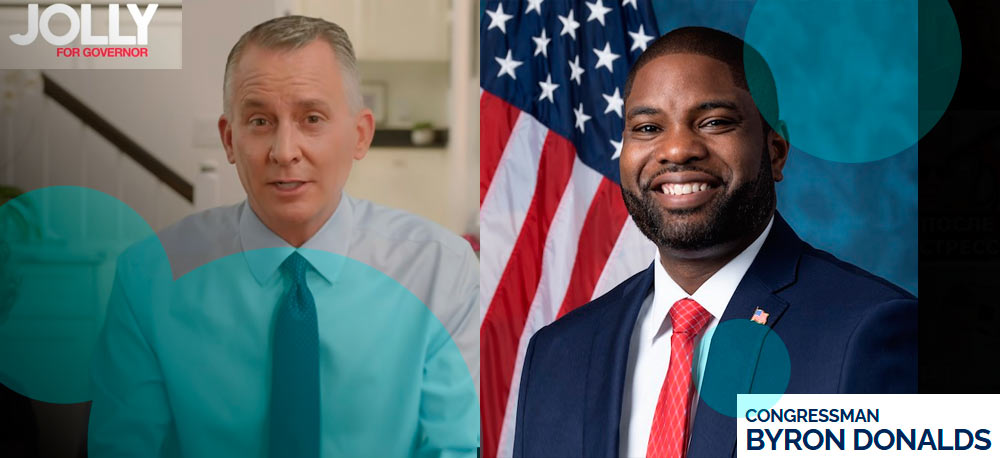
Florida gubernatorial candidates David Jolly and Byron Donalds have released competing plans aimed at reducing property insurance costs ahead of the Nov. 3, 2026 general election.
Both campaigns put affordability near the centre of their insurance proposals. Their approaches differ substantially on catastrophe risk, Citizens Property Insurance Corporation and the role of private carriers.
Jolly, the Democratic nominee, proposes moving hurricane and wind coverage out of private homeowners policies and into a state-backed catastrophic insurance fund.
Private insurers would continue covering other homeowners risks. Jolly argues removing hurricane exposure from their policies would reduce premiums by 60% to 70%.
His campaign bases the estimate on the share of Florida homeowners premiums associated with wind and hurricane exposure. Jolly’s published plan cites a comparison for a $300,000 home showing a 64% difference between coverage priced with hurricane risk and coverage without it.
The proposed state fund would require financing before assuming homeowner risk. Jolly’s campaign says coverage would begin after the fund reached a financially sound level and secured reinsurance protection.
His proposed funding sources include taxes on insurance companies his campaign says insurers currently avoid. Other options include fees on real estate transactions.
Existing local tourist development taxes represent another possible funding source. The Florida Legislature would determine the final financing structure under the proposal.
Jolly points to the Florida Hurricane Catastrophe Fund as an existing state model. The current FHCF reimburses participating insurers for portions of hurricane losses rather than issuing coverage directly to homeowners.
Jolly has criticised this structure because payments flow through insurers. His proposal would shift the state-backed hurricane mechanism toward direct homeowner coverage.
The plan also addresses condominium costs following Florida’s stricter inspection and reserve requirements. Jolly proposes a state-backed, no-interest loan programme for condominium associations and individual owners facing required repair expenses.
Donalds, the Republican nominee, has introduced a different insurance package called the Bring Down the Bill Plan.
His proposal retains private insurers as the principal writers of homeowners coverage. It focuses instead on regulation, catastrophe financing and construction-related expenses.
Donalds proposes a public Insurer Scorecard showing consumers information about each carrier’s pricing. The system would also report claim approval and denial rates.
Payment speed would appear as another comparison measure. Insurers would face expanded reporting requirements supporting the database.
The proposal also calls for changes to the Florida Office of Insurance Regulation’s existing CHOICES Rate Comparison Tool. OIR currently uses CHOICES to provide sample homeowners insurance rates based on predefined risk scenarios.
Donalds wants to reform the Florida Hurricane Catastrophe Fund as well. His plan calls for reducing policyholder surcharges during periods when the fund holds sufficient reserves.
The campaign has also discussed using the catastrophe fund to help insurers pool certain reinsurance purchases. Donalds argues collective purchasing would reduce reinsurance expenses passed through to homeowners.
Another section addresses the My Safe Florida Home programme. Donalds proposes restructuring mitigation grants around projects expected to produce larger insurance savings.
State agencies receiving money for homeowner projects would coordinate their grant priorities. The objective is to concentrate public funding on property upgrades linked to premium reductions.
Donalds supports continued depopulation of Citizens Property Insurance Corporation. Citizens operates as Florida’s state-backed property insurer and has transferred hundreds of thousands of policies into the private market through its depopulation programme.
His plan would retain insurance and litigation changes adopted by Florida lawmakers in 2022 and 2023.
Donalds also proposes optional binding arbitration for insurance policies. Policyholders and insurers choosing the provision would use arbitration as an alternative process for resolving covered disputes.
Replacement costs form another part of his proposal. Donalds wants permitting reforms intended to reduce rebuilding expenses after storms.
His plan also calls for reviewing building material mandates. Contractor licensing reciprocity would allow qualified contractors from other jurisdictions to enter Florida’s rebuilding market more easily.
The candidates have also disputed the potential financial effects of their competing approaches.
Donalds argues Jolly’s proposal would transfer too much catastrophe exposure to the state. His campaign has described the proposal as creating a $1,000 hurricane tax on Florida households.
Donalds has cited an August 2026 Florida State University feasibility study examining expanded state-backed windstorm coverage. The Legislature requested the research into a proposal involving Citizens Property Insurance Corporation.
The FSU study did not analyse Jolly’s specific campaign proposal. Researchers instead examined scenarios in which Citizens would offer hurricane and wind coverage more broadly while private carriers handled other property risks.
Researchers concluded catastrophe exposure would remain within the insurance system rather than disappear. The proposal would redistribute those costs across different periods and groups of policyholders.
The study identified the prospect of broader statewide assessments following severe losses. It also examined geographical subsidies resulting from a statewide wind programme.
Under scenarios modelled by the researchers, premium effects ranged from increases of 21% to 139%. The study did not conclude that moving wind exposure into a state-backed system guarantees lower total insurance costs.
Jolly disputes Donalds’ use of the study because its structure differs from his campaign proposal.
His campaign says the plan contains no additional $1,000 homeowner tax or assessment. Jolly has also said his proposal wouldn’t proceed unless its financing structure produced lower costs for Florida households.
Jolly argues funding should come partly from insurance-related taxes and other revenue sources rather than a new direct homeowner assessment.
He has criticised Donalds’ proposal as preserving much of Florida’s existing insurance structure. Jolly has also argued greater insurer transparency doesn’t directly reduce premiums.
Donalds disputes that assessment. His campaign says maintaining recent litigation reforms, reducing rebuilding expenses and managing catastrophe financing differently would lower insurer costs and put downward pressure on premiums.
The two plans leave Florida with a clear policy split on property insurance. Jolly wants the state to assume hurricane and wind exposure directly, while Donalds would keep those risks in the existing market and focus on regulation, catastrophe financing, mitigation and rebuilding costs.
Both approaches would require legislative action for major changes to state insurance programmes, funding mechanisms or statutory rules.