Follow Beinsure

Global air freight volumes increased 6% year-on-year in September, extending the growth recorded in July and August, according to Xeneta. Shippers remain cautious about committing to long-term capacity and are increasingly looking for floating pricing mechanisms that adjust as market conditions change.
Demand had risen 6% in August and 5% in July, helping slow expected rate declines. Global air cargo spot rates, valid for up to one month, averaged $3.10 per kg in September, 27% above the same month last year and 2% higher than in August.
The month-on-month increase was consistent with the usual seasonal firming toward the end of the third quarter. Jet fuel prices also rose amid continued tensions in the Middle East, reaching roughly twice their pre-conflict level, while Brent crude moved above $100 per barrel in early September.
Capacity increased 2% year-on-year in September after remaining flat in July and August. Demand therefore continued to grow faster than available capacity, pushing Xeneta’s dynamic load factor up two percentage points to 62%. The measure tracks capacity utilisation using both cargo volume and weight against available capacity.
Shippers move toward shorter air freight contracts
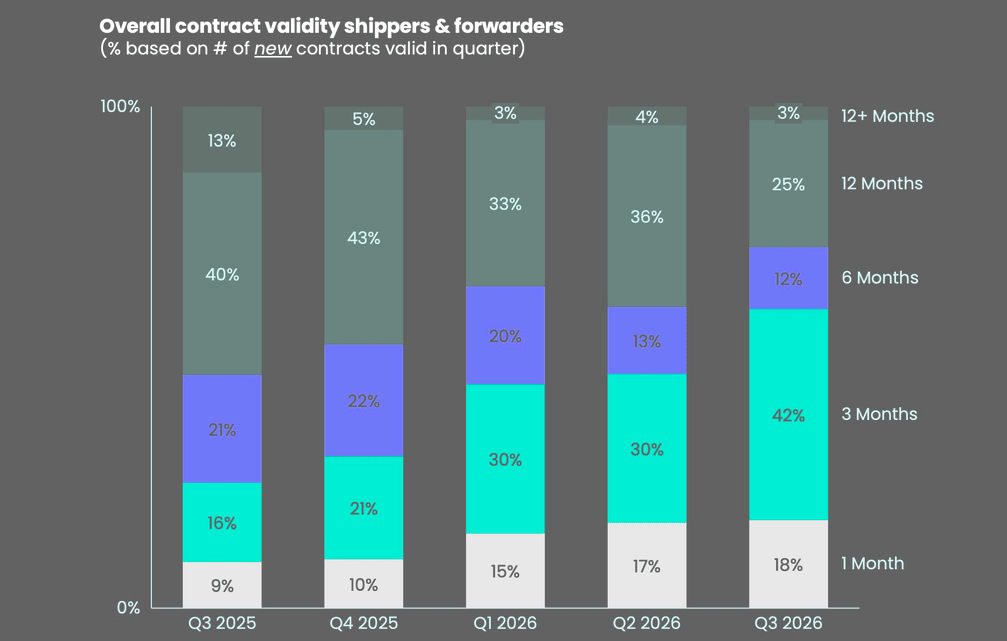
The largest change in Xeneta’s latest data came from contract duration. Among new agreements beginning in Q3 2026, 60% were for three months or less, compared with 25% in Q3 2025 and 47% in Q2 2026.
Three-month contracts accounted for 42% of new agreements, up from 16% a year earlier. The share of 12-month contracts fell from 40% to 25%, while agreements running longer than one year declined to 3%.
Niall van de Wouw, chief airfreight officer at Xeneta, said shippers are looking for pricing structures that start with a base rate and adjust according to market movements.
There is a high degree of realism in the way shippers are approaching the market. There remains a lot of instability and that’s making it almost impossible for shippers to make long-term capacity deals without having T&Cs in place to deal with these volatile conditions.
Niall van de Wouw, chief airfreight officer at Xeneta
Van de Wouw said fixed one-year agreements are becoming less suitable for the current market. Shippers are instead seeking commercial structures that allow rates to move during the contract period.
“A one-year deal without any adjustment mechanism is becoming more the exception than the rule. If they do exist, not many will survive the upcoming 12 months,” he added.
China-Europe e-commerce exports fall 40%
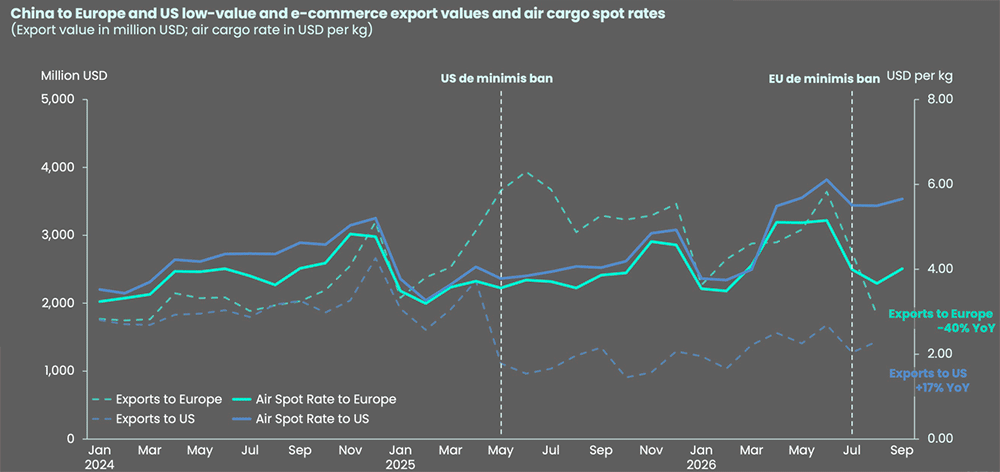
China’s low-value and e-commerce exports to Europe fell 40% year-on-year in August, according to analysis from Xeneta and Trade and Transport Group using China Customs data. The decline accelerated from 25% in July following the introduction of the EU’s €3 per-item customs duty on July 1.
China’s e-commerce exports to the U.S. moved in the opposite direction, rising 17% year-on-year in August. The increase continued the recovery following removal of the U.S. de minimis threshold in 2025, although volumes were coming from a lower base.
The difference between the two markets is also appearing in freight pricing. The gap between China-U.S. and China-Europe air cargo spot rates widened after the EU duty took effect.
China to Western Europe spot rates still rebounded 10% month-on-month in September to $4.26 per kg. The increase reversed a 6% decline in August and a 22% fall in July as outbound demand from China strengthened ahead of Golden Week.
Major air freight corridors post September rate increases
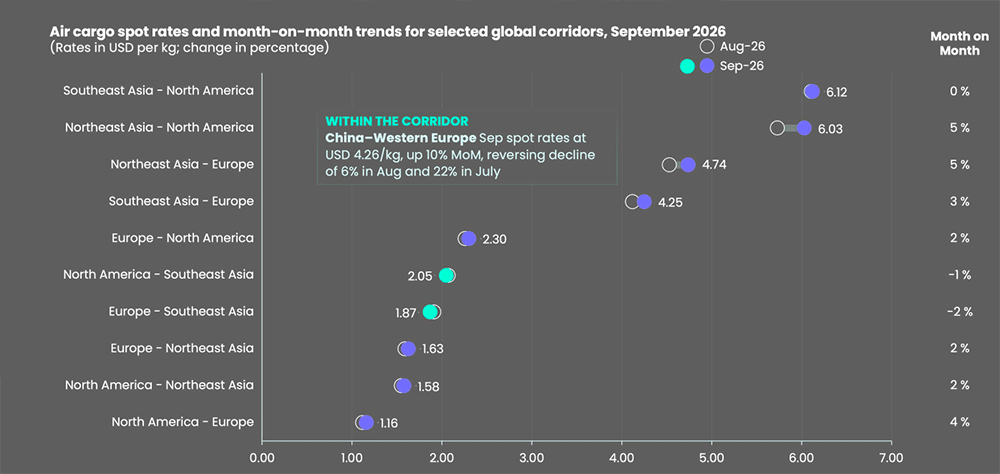
Most major trade lanes recorded higher spot rates in September after summer declines. Northeast Asia to Europe increased 5% month-on-month to $4.74 per kg, while Northeast Asia to North America also rose 5%, reaching $6.03 per kg.
- Southeast Asia to Europe gained 3%. Transatlantic pricing strengthened in both directions, with Europe to North America up 2% and North America to Europe rising 4% from August.
- Only two major corridors recorded declines. North America to Southeast Asia slipped 1%, while Europe to Southeast Asia fell 2%.
- Rates into the Middle East remain much higher than before the escalation of the Iran war in late February. During week 39, covering Sept. 21-27, South Asia to the Middle East spot rates were 91% above late-February levels, while Europe to the Middle East was 80% higher.
- Northeast Asia to North America rates were 34% above their late-February level, while Southeast Asia to North America stood 29% higher. Xeneta attributed support on these lanes to recovering e-commerce demand and AI-related shipments.
- Europe to North America remained 20% below late-February levels. The gap had narrowed from 25% in August as summer belly capacity gradually left the market.
Floating rates gain attention from shippers
Xeneta expects global air freight demand to grow about 4% year-on-year in 2026, above what many market participants expected at the start of the year. Van de Wouw said the high share of short-term agreements suggests shippers are using three-month contracts while negotiating alternative ways to price longer-term capacity.
The high percentage of short-term, 3-month deals we are recording is one of the current mechanisms shippers are using while they take time to negotiate what they see as a fairer way to buy capacity.
Niall van de Wouw, chief airfreight officer at Xeneta
Xeneta argues that floating arrangements should be linked to the all-in rates airlines charge freight forwarders rather than relying on a fuel surcharge alone. Van de Wouw said this provides a better reference for adjusting prices when market conditions change.
The company isn’t seeing signs of a strong air cargo peak season from its shipper and freight forwarder community as October begins. Xeneta’s current indicators still point toward a muted final quarter, consistent with its mid-year outlook.
Ocean freight remains a variable for air cargo demand. Schedule reliability has not returned to pre-pandemic levels, while renewed disruption in the Red Sea and port congestion have pushed Asia-U.S. West Coast ocean freight rates back toward pandemic-era levels.
When ocean becomes this unreliable and this expensive, some volume moves to air. We are not yet seeing that in the September data, and it doesn’t change our view of a muted peak season, but it is the factor we are watching most closely.
Changes in trade policy are adding further uncertainty. Xeneta cited the recent partial easing of China-U.S. tariffs, although its September data had not shown a clear break in the broader air freight trend.