Follow Beinsure
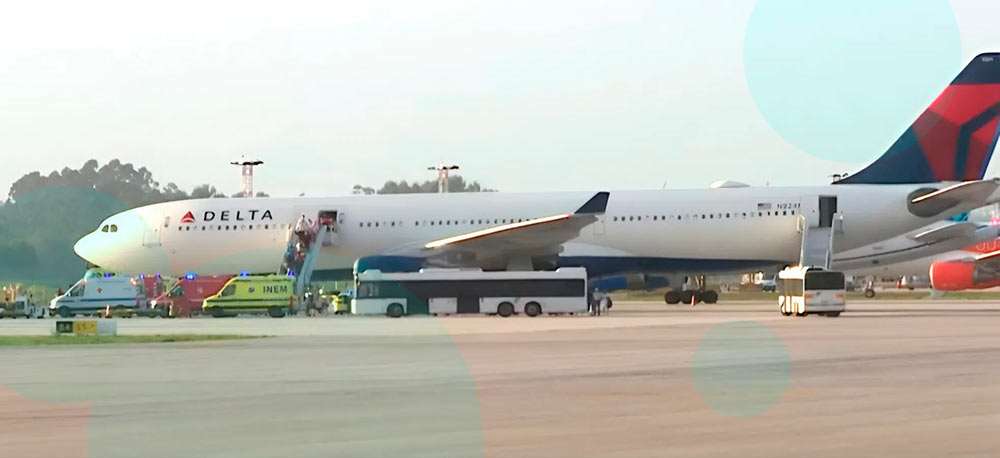
A Delta Air Lines flight from Barcelona to Boston made an emergency landing in Porto, Portugal, on Sunday after a reported mechanical problem and smoke inside the cabin. Flight DL251 landed safely at Francisco Sá Carneiro Airport after diverting from its transatlantic route, Delta said.
The Airbus A330 departed Barcelona at about 3:15 p.m. local time and landed in Porto at roughly 5:45 p.m., according to flight-tracking data from Flightradar24.
Smoke was reported inside the aircraft before the diversion. Portugal’s emergency and civil protection authority said medical teams treated eight passengers on the tarmac after the landing.
Three additional passengers were taken to hospital for further treatment. Authorities did not immediately provide details on the severity of their injuries.
Delta described the incident as a mechanical issue. The airline said the aircraft landed safely after the crew diverted to Porto.
The flight had been traveling from Barcelona-El Prat Airport to Boston Logan International Airport when the problem developed around two and a half hours after departure.
Emergency services met the aircraft after landing. Passengers requiring medical attention were assessed at the airport, while three were transferred to hospital. The exact source of the smoke and the mechanical fault had not been publicly identified following the landing.
Aviation insurance exposure from the Delta diversion
The incident could trigger several areas of aviation insurance, depending on the findings of the technical inspection and whether injured passengers file claims.
Commercial airline insurance usually includes aircraft hull cover together with passenger and third-party liability. Hull policies cover insured physical damage to the aircraft, while liability policies respond to covered claims from passengers and other parties.
Eight people received treatment at the airport and three were taken to hospital after smoke entered the cabin.
The Barcelona-Boston journey falls under international carriage rules established by the Montreal Convention. The convention governs airline liability for passenger death or bodily injury when an accident occurs onboard the aircraft or during embarking or disembarking.
ICAO’s revised liability limits took effect on December 28, 2024.
The first tier for passenger death or bodily injury is 151,880 Special Drawing Rights per passenger. Claims above this level are handled under the convention’s additional liability provisions and available defenses.
Any claims from passengers on DL251 would depend on the injuries involved, medical documentation and the circumstances surrounding the smoke event. Hospital treatment alone does not indicate the eventual claim amount.
Hull insurers would become involved if inspections find insured physical damage to the Airbus A330. Repair costs for damaged systems or components could fall under the aircraft’s hull policy, subject to deductibles, exclusions and other policy terms.
A diversion by itself does not mean there is a hull claim. The same applies to smoke in the cabin. Insurers would need evidence of physical damage covered by the policy.
Aerospace product liability could also come into play if investigators trace the incident to a defective engine, electrical system, cabin system or manufactured component. Aircraft and component manufacturers typically buy liability cover for claims tied to their products.
The diversion also generated operational costs for Delta. These can include passenger accommodation, rebooking, ground transport, crew changes and repositioning the aircraft.
Such expenses are not automatically covered under standard hull and liability policies. Recovery depends on the airline’s insurance programme and any additional cover purchased.
The insured cost of the incident will depend on the inspection findings, passenger injury claims and any confirmed aircraft damage. If the aircraft is cleared without material damage and passenger injuries remain minor, the insurance loss could remain limited.