- Aer Lingus flight diverted to French military airbase after bomb threat
- Bulgarian fighter jets escort three Ryanair flights after bomb alerts
- Wizz Air flights diverted or evacuated following security threats
- No explosives found on four aircraft arriving in Prague
- Finnair aircraft escorted by Italian fighter jets to Rome
- LOT Polish Airlines flight cleared after security inspection in Brussels
- Aviation security expert warns of high costs from repeated bomb threats
A new series of bomb threats disrupted passenger flights across Europe on November forcing aircraft diversions, emergency security inspections and military fighter jet deployments in several countries.
More than 10 flights were reportedly affected, including services operated by Aer Lingus, Ryanair, Wizz Air, Finnair and LOT Polish Airlines.
- Multiple European flights received bomb threats on November 5, including services operated by Aer Lingus, Ryanair, Wizz Air, Finnair and LOT Polish Airlines.
- Aer Lingus diverted a Dublin-Rome flight to a French military airbase, while Bulgarian and Italian fighter jets escorted civilian aircraft during security operations.
- Authorities found no explosives on four aircraft arriving in Prague or on affected flights inspected in Rome and Brussels. Investigations into the wider series of threats continued.
The incidents occurred two days after at least seven European flights received similar threats, raising questions about whether the latest alerts were coordinated or reflected separate incidents (see Deadliest Aircraft Crashes and Worst Aviation Accident Statistics).
Authorities in several countries reported finding no explosives following aircraft inspections, although security procedures and investigations remained underway for other affected flights (see Aviation Insurance Market).
Aer Lingus flight diverted to French military airbase after bomb threat
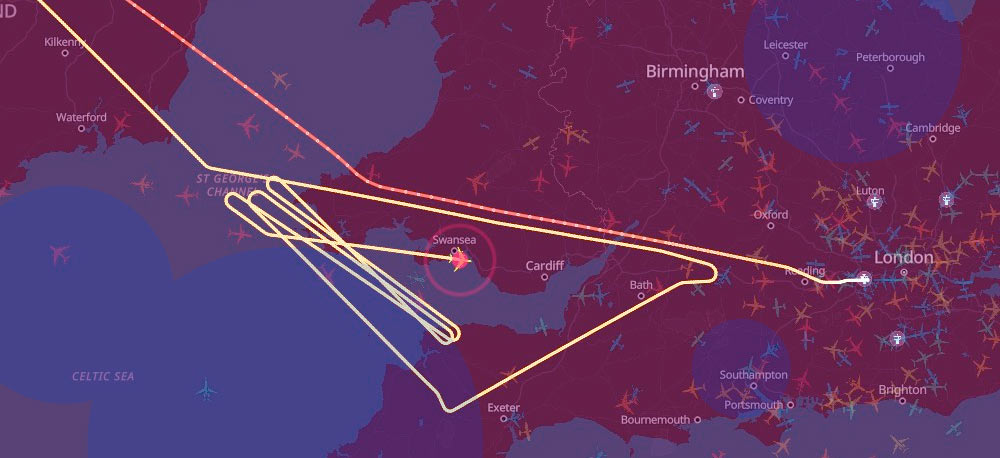
An Aer Lingus Airbus A320 operating flight EI402 from Dublin to Rome was diverted to Evreux Air Base in northern France after receiving a security warning during the journey.
The aircraft issued an emergency alert before changing its intended route and landing at the military installation west of Paris.
Communications subsequently reviewed by aviation specialists indicated that air traffic control had informed the crew of a reported bomb threat.
The aircraft had initially planned to divert to Paris Charles de Gaulle Airport before being directed to the military airfield by government authorities.
The decision to isolate the aircraft at a military facility reflected the security measures adopted in response to a potentially serious threat.
The incident was among several reported across European airspace on Thursday morning.
Bulgarian fighter jets escort three Ryanair flights after bomb alerts
Bulgaria’s Ministry of Transport confirmed that three Ryanair aircraft arriving from Copenhagen, Madrid and London Stansted were affected by bomb threats.
The Bulgarian Air Force deployed MiG-29 fighter jets from Graf Ignatievo Air Base at 10:11 a.m. local time, equivalent to 08:11 GMT.
According to the military, the aircraft were dispatched on an air-policing mission to intercept and escort the civilian flights.
Two Ryanair services continued to Vasil Levski Airport in Sofia. The flight arriving from Madrid landed at 10:15 a.m., followed by the Copenhagen service at 10:19 a.m. The third Ryanair aircraft, traveling from London Stansted, was diverted to Plovdiv Airport.
Bulgarian authorities reported that no explosive devices had been discovered on the first two aircraft inspected in Sofia.
The use of military aircraft demonstrated the scale of the response required when bomb threats are reported against passenger flights already operating in national airspace.
Wizz Air flights diverted or evacuated following security threats
Wizz Air confirmed that a flight traveling from Milan Malpensa Airport to Warsaw was diverted to Vienna after a bomb threat was received during the journey. The airline said the decision followed established aviation security procedures intended to protect passengers and crew.
The diversion was initiated in accordance with established security protocols and procedures, with the safety of passengers and crew as the highest priority.
The carrier acknowledged that other European airlines had experienced similar threats, resulting in additional flight diversions and security inspections.
A separate Wizz Air flight from Milan to Bucharest was also affected. Flight WMT3064 landed safely at Henri Coandă International Airport in Bucharest at 11:08 a.m. local time. Nearly 200 passengers were evacuated following the reported threat.
Airport authorities activated emergency procedures in coordination with Romanian state institutions and began establishing a crisis management unit.
A specialist explosives disposal team from Romania’s Intelligence Service (SRI) was assigned to inspect the aircraft.
Bucharest National Airports Company said the airport continued operating safely, with other scheduled flights proceeding without disruption.
No explosives found on four aircraft arriving in Prague

Czech police confirmed that four aircraft heading to Prague had received threats concerning the possible placement of improvised explosive devices.
Authorities initially prepared for the aircraft to land and announced plans to conduct explosives inspections. Although police assessed the credibility of the threats as low, they proceeded with the necessary security measures.
A police spokesperson subsequently told the Czech news agency CTK that inspections had found no explosives on any of the four aircraft.
The findings followed similar negative security checks involving other flights affected by Thursday’s alerts.
Finnair aircraft escorted by Italian fighter jets to Rome
A Finnair flight from Helsinki to Rome was escorted by Italian Air Force fighter jets after authorities received an anonymous report concerning a possible bomb on board.
The aircraft landed safely at Rome Fiumicino Airport at approximately 9:30 a.m. A spokesperson for Aeroporti di Roma confirmed that the flight was subjected to security procedures following its arrival.
Italian police bomb disposal specialists conducted inspections of the aircraft, which returned negative results. No explosives were discovered. The airport operator said the security operation had been completed without affecting normal airport activities.
LOT Polish Airlines flight cleared after security inspection in Brussels
LOT Polish Airlines also confirmed a security alert involving flight LO235 from Warsaw to Brussels.
After receiving information about a possible threat, the airline notified the flight crew, which conducted an onboard inspection in accordance with established procedures.
The aircraft subsequently landed safely in Brussels. Security personnel carried out an additional inspection after landing. According to the airline, neither the onboard check nor the subsequent examination identified any dangerous or suspicious items.
The inspections allowed authorities to rule out the reported threat to that aircraft.
Aviation security expert warns of high costs from repeated bomb threats
The latest incidents have raised questions about whether Europe’s repeated aviation security alerts are part of an organized campaign or whether some threats are being copied following earlier incidents (see What Lessons Should Be Learn the Insurance Industry After Russia’s Seizure of EU Aircrafts?).
The cost of sending a warning can be negligible, while the response may require aircraft diversions, airport security operations, military escorts, explosives specialists and disruption to airline schedules.
The cost to the person issuing a threat is “almost nothing” compared with the resources required from airlines, airports and national air forces.
The diversion of the Aer Lingus aircraft to a French military installation illustrated the operational consequences of treating a bomb warning as potentially credible. The combination of aircraft diversion, military escort and isolation reflected the high cost of false alarms to avoid a single missed attack.
The repeated incidents have affected flights across several European countries, although the security checks reported so far have not established the presence of explosive devices.
Authorities and airlines continue to respond to individual threats through established aviation security procedures while investigations seek to determine whether the alerts are connected.