
24% U.S. workers now report health insurance job lock, according to new research from the West Health-Gallup Center on Healthcare in America.
The study found that 24% of employed adults, equal to about 23 mn people, remain in their current job despite wanting to leave because they fear losing health insurance.
The share has risen eight percentage points since 2021, giving employers, insurers and policymakers another signal that healthcare coverage still weighs on labor-market decisions.
West Health and Gallup conducted the research through the West Health-Gallup Center on Healthcare in America, a joint project that tracks Americans’ experiences in the healthcare system.
Gallup surveyed 5,660 U.S. adults aged 18 and older from Oct. 27 to Dec. 22, 2025, through web and mail questionnaires drawn from the Gallup Panel.
The job lock analysis focuses on 2,322 respondents who work and use employer-sponsored health insurance as their main source of coverage.
The rise comes as healthcare affordability pressures grow. About half of Americans say they struggle to pay consistently for needed medical care or prescriptions. Another 51% say they worry about paying for healthcare over the next 12 months, the highest level recorded in five years.
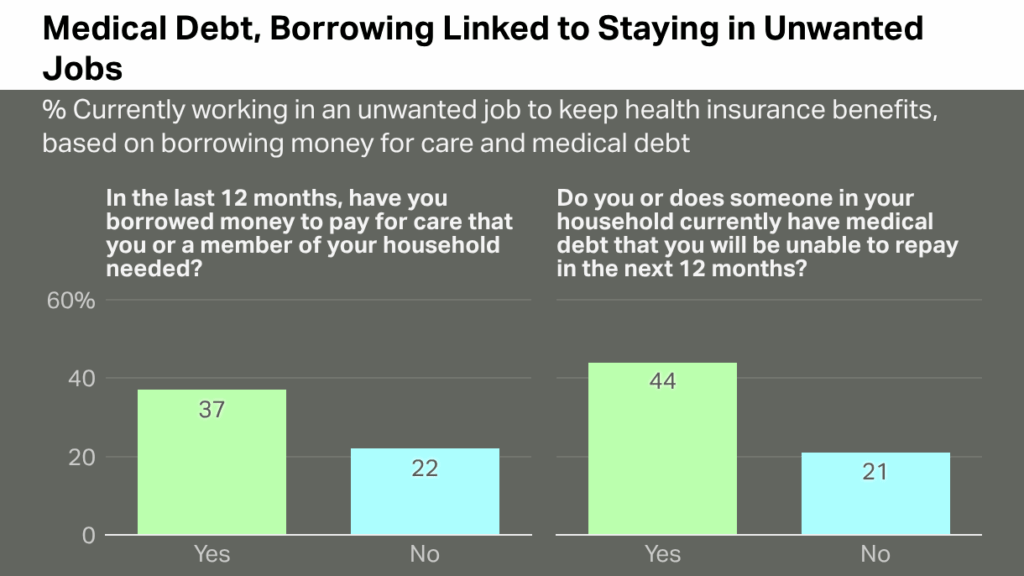
Workers under healthcare-related financial strain report much higher rates of job lock.
Among respondents with personal or household medical debt, 44% say they stay in an unwanted job to keep insurance. Among workers without medical debt, the rate drops to 21%. The gap shows how debt ties coverage decisions to employment choices, and honestly, it isn’t hard to see why.
Workers who borrowed money during the past year to pay healthcare expenses also report higher job lock. Gallup found a 37% rate among those who borrowed, compared with 22% among those who did not.
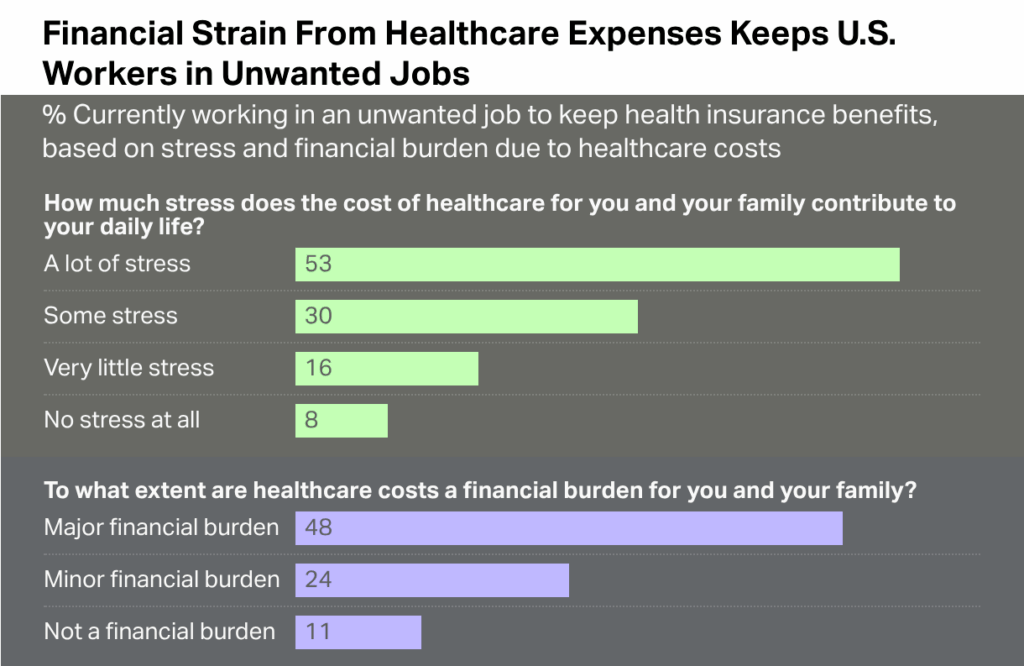
The pressure rises further when healthcare expenses become a major household burden. Nearly half of workers who describe healthcare costs as a major financial burden, 48%, say they stay in a job for insurance. Among people who report a lot of daily stress over healthcare costs, the share reaches 53%.
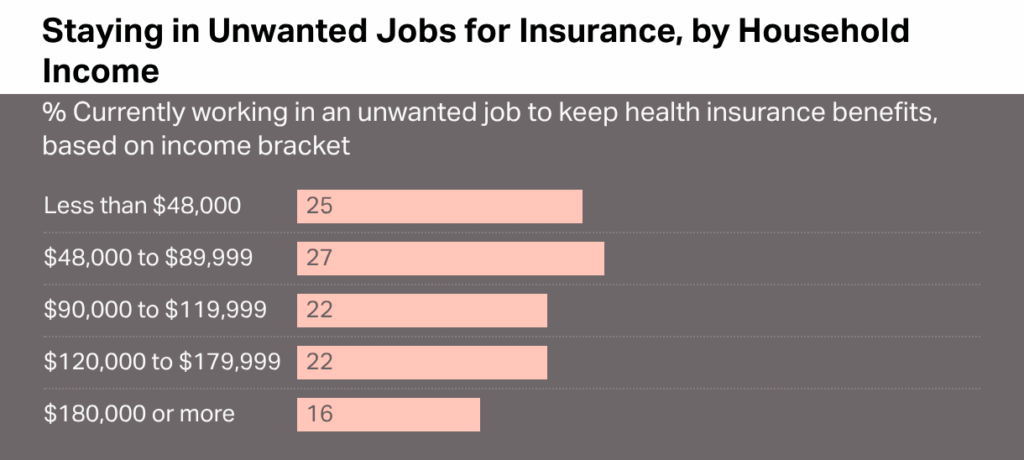
Income also shapes the pattern, though not in a straight line. Job lock peaks at 27% among workers in households earning $48,000 to under $90,000 a year. Rates tend to fall among higher-income households, where workers often have more savings, more job options and more tolerance for gaps between coverage. Still, the behavior doesn’t vanish at higher incomes. Health insurance remains sticky.
Chronic conditions add another layer. Workers diagnosed with one or more chronic conditions, excluding high blood pressure or high cholesterol, report job lock at 29%. Among workers without those diagnoses, the rate stands at 17%.
The rate climbs sharply for people with heavier health burdens. Workers with three or more diagnoses report job lock at 41%, which suggests that health needs narrow career flexibility as care becomes more frequent, expensive or hard to interrupt.
The association appears stronger for conditions that require ongoing treatment or create higher risk from coverage disruption. Among workers with asthma, 29% report staying in an unwanted job for insurance. Among those with immune-compromising conditions, 36% report the same.
Mental health diagnoses follow a similar pattern. Gallup found job lock among 35% of workers with depression and 33% of workers with anxiety. Those conditions often involve recurring care, medication management or therapy access, all of which depend on plan design and provider networks. Losing a job might mean losing the doctor too. That part bites.
Women report job lock at higher rates than men. Gallup found that 30% of women stay in a job they would rather leave to keep health benefits, compared with 20% of men.
The gender difference appears alongside wider gaps in healthcare-related strain. Women report higher financial stress from healthcare expenses, 56% versus 44% for men. They also report more medical debt, 22% versus 12%, and more multiple chronic conditions, 66% versus 57%.
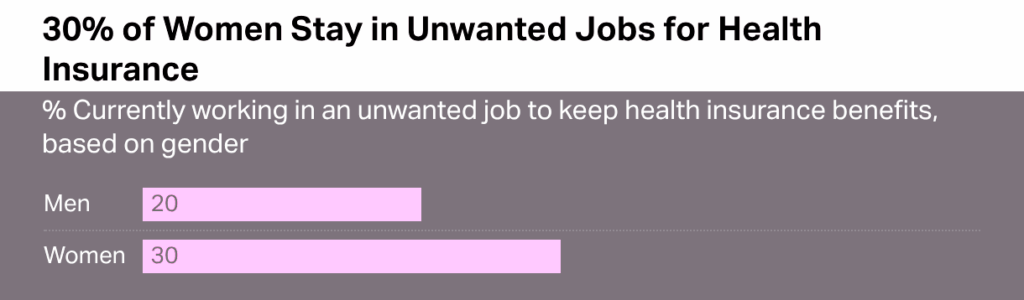
Those differences help explain why women report less freedom to leave unwanted jobs. They face more direct healthcare cost exposure, greater ongoing care needs and higher debt pressure. The insurance benefit isn’t abstract. It sits inside monthly budgets and medical decisions.
The findings point to a labor-market problem that extends beyond benefits administration. Job lock restricts worker mobility, limits entrepreneurship, weakens wage growth and leaves some employees tied to roles that no longer fit their personal or professional needs.
Academic research has linked job lock with lower life satisfaction, poorer wellbeing and higher rates of occupational injury. A worker staying for health insurance isn’t necessarily engaged, productive or committed to the organization.
Healthcare costs sit behind much of the trend. Premiums, prescription drug prices and out-of-pocket costs have climbed in recent years, raising the financial risk of leaving employer-sponsored coverage. High-deductible health plans have also shifted more cost exposure onto workers, according to the report’s framing.
Uncertainty around the Affordable Care Act adds another complication. Workers weighing a job change must compare employer coverage with non-employer options, subsidies, networks, deductibles and prescription coverage. It’s a lot for a household to price under pressure, especially when someone needs regular care.
According to Beinsure analysts, job lock also matters for insurers because it shows how coverage design affects labor behavior.
Employer-sponsored insurance still works as a retention device, though often unintentionally. The same structure that protects families from medical costs also raises the cost of career movement.
For policymakers, the data points to a broader coverage problem. When affordable healthcare depends on employment, workers often make career decisions around insurance rather than opportunity. That trade-off reduces mobility, slows income gains and narrows quality of life.