Insurtech Lemonade trimmed its third-quarter net loss to $37.5 mn, a 45% improvement from $67.7 mn a year earlier, helped by AI-fueled automation that slashed expense ratios and lifted efficiency across claims operations.
The company said its claims team actually shrank while handling more work.
Our claims department shrank in absolute terms, even as claims volume increased more than 2.5 times over the past three years.
During that stretch, its loss adjustment expense (LAE) ratio dropped to 7% from 13%. The company credited the decline to direct AI integration, noting that its LAE ratio now runs below that of many larger incumbents,” Lemonade said.
A Snapshot: Lemonade Q3 2025 Earnings Results
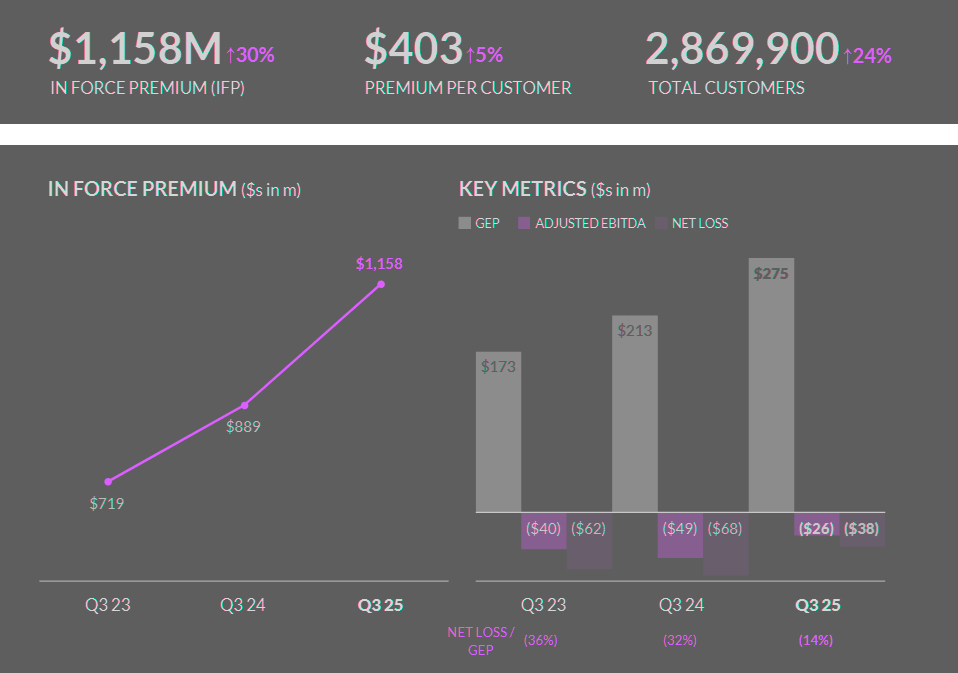
- 8th consecutive quarter of accelerating IFP growth
- Topline at $1.16 Bn IFP, reached 30% YoY growth ahead of schedule
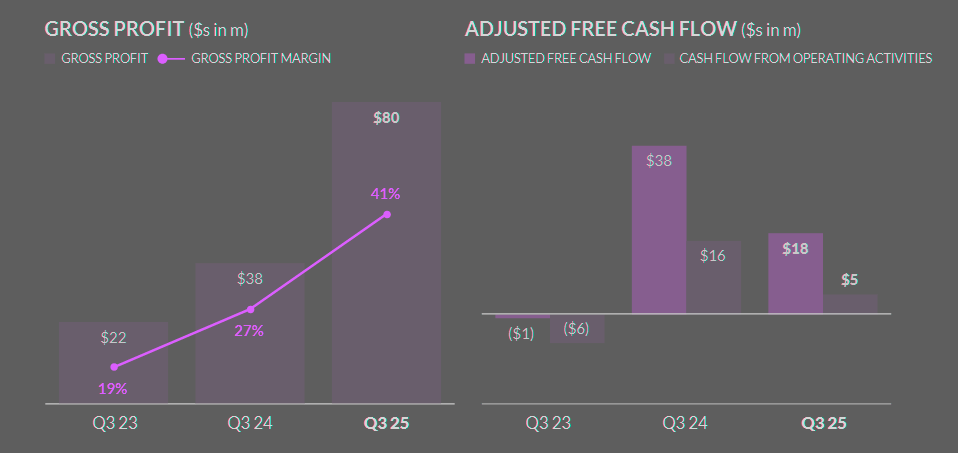
- Gross Profit increased 113% YoY to $80m
- Gross Profit Margin at 41%
- 2.87 mn Customers, increased 24% YoY
- Adj. EBITDA loss almost cut in half vs prior year, now at ($26) mn
- Gross Loss Ratio at an all time low: 62%; Car Gross Loss Ratio improving fast, now at 76%
Net written premium more than doubled to $276.6 mn from $115.5 mn, with growth across product lines and European markets.
In-force premium climbed across categories, led by pet insurance, which rose to $394 mn from $254 mn a year earlier. Pets now stand as Lemonade’s second-largest business after homeowners coverage.
Looking forward:
- Raised full year 2025 guidance for all metrics
- Car growth to continue to accelerate, fueled by TAM expansion from new state launches
- On plan to sustain 30% IFP growth in 2026 & generate positive Adj. EBITDA in Q4 2026
“Achieving a materially lower LAE while operating at a fraction of their scale bodes well,” the company said, adding that new AI tools are deployed into its infrastructure within hours of clearing reliability tests.
Loss and loss adjustment expenses rose to $89.6 mn from $77.9 mn, while total operating expenses climbed 13% on higher customer acquisition spending.
Even so, stronger underwriting results offset much of the drag. The net loss ratio improved sharply to 64 from 81 in the prior-year period.
The company said it plans to expand into Pennsylvania soon.
We expect car growth to continue to accelerate, fueled in part by total addressable market expansion from new state launches and increased brand and growth investment.
We think the message is clear – AI isn’t just trimming headcount; it’s compressing cost structures that traditional carriers still can’t match.
If underwriting keeps tightening, those efficiency gains could finally start showing up as sustained profitability.
According to Beinsure’s data, Lemonade reduced its Q2 2025 net loss by 23%, reporting a loss of $44 mn as premium volume continued to climb. Net earned premiums rose to $112.5 mn, up from $89.3 mn year-over-year. In-force premium reached $1.08 bn, marking a 29% annual increase.
Despite improving topline results, the net loss ratio deteriorated by 20 points, reaching 99.
The company noted stronger performance in U.S. auto as well as growth in European renters and homeowners, particularly across Germany, France, the UK, and the Netherlands. Lemonade now serves over 250,000 policyholders in those four markets.
Management highlighted Europe as a long-term growth engine, citing lower catastrophe risk and a regulatory structure that allows real-time pricing and underwriting adjustments without the delays of rate filings.
Its platform, built with automation from the ground up, operates efficiently across borders without large teams or country-specific systems.
The company credited its AI-based approach for maintaining cost efficiency while expanding across markets. It said the tech stack allows it to launch new products and adjust pricing across multiple jurisdictions while keeping operational costs low.