Billionaire investor Mark Cuban has called on Americans to examine their retirement portfolios and pressure investment funds to sell shares in major health insurance companies, arguing that shareholders are helping sustain the financial incentives behind rising US healthcare costs.
- Mark Cuban has urged investors to pressure retirement funds to sell shares in major health insurance companies, arguing that shareholders contribute to rising US healthcare costs.
- About 62% of Americans own stocks directly or indirectly, according to Gallup, with many retirement funds holding large health insurers through broad market indexes.
- Employer-sponsored family health coverage averaged $28,303 in 2026, up 5% year over year, with workers contributing $7,471, according to KFF.
In a post on X, Cuban criticized investors whose retirement accounts include exposure to the country’s largest health insurers, even when those holdings come indirectly through index funds or employer-sponsored retirement plans.
If you own shares in a fund that owns any of the biggest insurance carriers, you are part of the cost of healthcare problem in this country. Those companies put the share price over the health of you, your family, co-workers and friends. The worst part Is they will lie and mislead you to make more.
“Tell the funds you own that you will sell if they don’t divest their interests in the biggest insurance companies,” Cuban wrote.
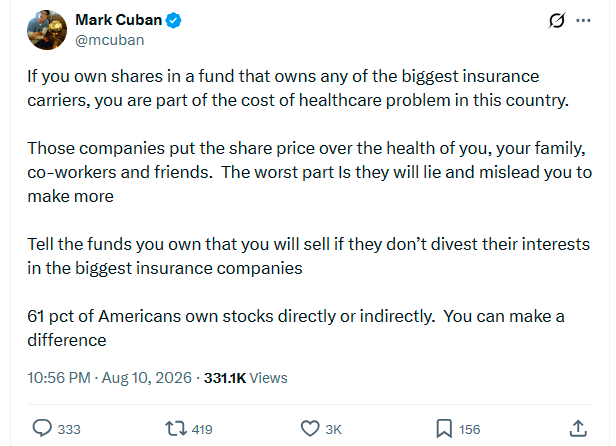
He encouraged investors to push fund managers to divest from those companies.
The argument extends Cuban’s longstanding criticism of the US healthcare system to millions of retirement savers who may hold insurance stocks without actively choosing them.
How 401(k) retirement funds invest in health insurance companies
Approximately 62% of Americans own stocks directly or indirectly, according to Gallup research. Much of that exposure comes through retirement accounts, mutual funds and other diversified investment products rather than individual stock purchases.
Workers contributing to employer-sponsored 401(k) plans frequently invest in target-date funds, S&P 500 index funds or total-market funds. These products hold shares across multiple industries, including major publicly traded health insurers such as UnitedHealth Group and CVS Health.
The healthcare sector accounts for roughly 10% of the S&P 500 by market capitalization. That exposure includes insurance companies, pharmaceutical manufacturers, medical equipment producers and hospital operators.
Cuban’s proposed divestment focuses specifically on the largest health insurance carriers rather than the entire healthcare sector. He has repeatedly argued that publicly traded health insurers face incentives to prioritize shareholder returns over the interests of patients, employees and families.
Cuban also founded Cost Plus Drugs, a pharmaceutical business established to challenge traditional prescription drug pricing.
His latest comments extend that criticism to retirement investors who may benefit financially when insurance companies report stronger earnings.
Why index funds make health insurer divestment difficult
Most employer-sponsored retirement plans provide a limited selection of investment funds rather than unrestricted access to individual stocks.
Broad market index funds generally track established benchmarks and hold the companies included in those indexes. Investors cannot simply remove an unwanted insurer from an S&P 500 fund while retaining the rest of the portfolio.
Target-date retirement funds operate similarly, allocating investments among equities, bonds and other assets according to an investor’s expected retirement date.
Their equity holdings typically include broad market exposure, meaning major health insurers may remain part of the portfolio even as its overall asset allocation changes.
Cuban’s criticism does not suggest that workers should abandon retirement saving. Instead, he is questioning whether investors understand which companies their savings support.
Someone concerned about higher insurance premiums or opaque medical billing practices may simultaneously benefit from the financial performance of insurers held in their retirement portfolios.
That creates a potential conflict between an investor’s preferences regarding healthcare costs and the companies represented in their investments.
Can retirement investors avoid health insurance stocks?
Investors seeking to reduce exposure to major health insurers have several options, although each comes with limitations.
Some 401(k) plans offer environmental, social and governance (ESG) or socially responsible investment funds. Availability depends on the investment options selected by the employer and retirement plan administrator.
Screening policies differ considerably between funds. A product marketed as socially responsible may exclude industries such as tobacco or weapons while continuing to invest in health insurers, hospital companies or medical equipment manufacturers.
Investors therefore need to examine actual portfolio holdings rather than relying on a fund’s name or investment category.
Specialized investment products may also charge higher expense ratios than conventional index funds.
Outside employer-sponsored retirement accounts, investors generally have greater flexibility to select individual stocks or exchange-traded funds that exclude particular companies.
Such strategies can increase concentration risk by reducing diversification. Cuban has also encouraged shareholder engagement as an alternative to selling investments.
Investors can pressure fund managers over their holdings and voting policies, while shareholders with applicable voting rights can participate in decisions involving executive compensation and corporate governance.
Shareholder proposals addressing pricing transparency provide another potential route for influencing company policies. Investors holding funds do not necessarily have direct voting rights over the individual companies within those funds, however.
US family health insurance premiums reach $28,303 in 2026
Cuban’s comments come as employer-sponsored healthcare coverage becomes more expensive for American businesses and households.
According to KFF’s 2026 Employer Health Benefits Survey, the average annual premium for employer-sponsored family health insurance reached $28,303, an increase of 5% from the previous year.
Workers contributed an average of $7,471 toward those premiums, with employers covering the remaining cost.
Cuban argues that rising health insurance expenses affect more than household budgets. Higher employer contributions can influence hiring decisions, wage growth and the availability of employee benefits.
When businesses allocate more money to health insurance premiums, they have fewer resources available for salary increases or additional positions, according to his argument.
His call for retirement fund divestment connects those healthcare affordability concerns with the investment decisions of millions of Americans whose savings are held in diversified portfolios containing major insurance companies.