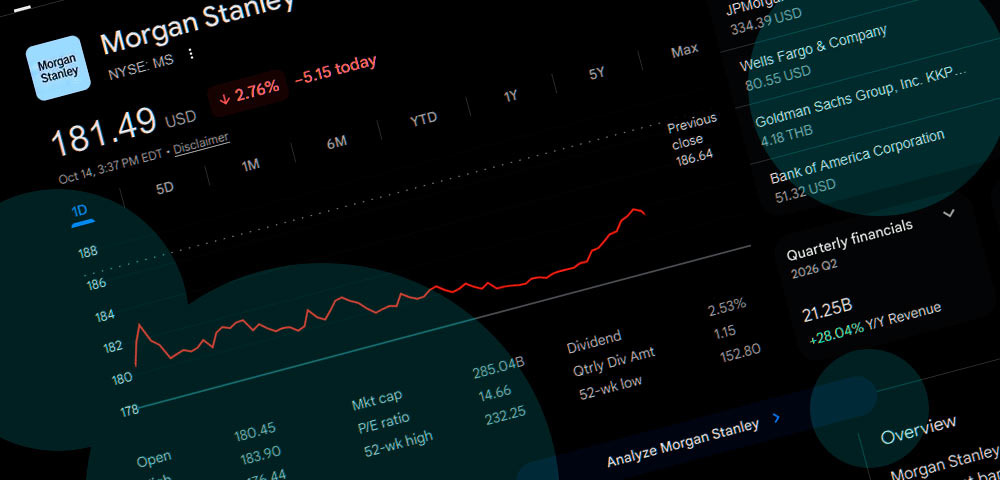
Morgan Stanley (NYSE: MS) shares fell 2.74% to $181.52 on October 14, 2026, despite the investment bank reporting third-quarter revenue and earnings above analyst expectations. The decline came amid broader pressure on financial stocks as stronger-than-expected US inflation raised concerns about interest rates.
Wall Street remains moderately positive on Morgan Stanley’s 12-month outlook. The average analyst price target stands at $222.14, representing potential upside of approximately 22.4% from the October 14 closing price.
- Morgan Stanley shares closed at $181.52 on October 14, 2026, down 2.74%, despite quarterly earnings exceeding Wall Street expectations.
- The consensus 12-month price target from 26 analysts is $222.14, implying approximately 22.4% upside. Individual forecasts range from $184 to $262.
- Record Wealth Management inflows of $232.4 bn and 41% growth in equity trading revenue supported Q3 results, although fixed income trading and investment management weakened.
Among 26 analysts tracked by S&P Global Market Intelligence, 11 have positive recommendations, 14 recommend holding the stock, and one has a negative rating. The overall consensus is Buy, although individual forecasts differ considerably.
Morgan Stanley stock price targets from leading analysts
Barclays maintains one of the most optimistic forecasts, with an Overweight rating and a $262 price target. Bank of America Securities and Keefe, Bruyette & Woods have targets of $250, while UBS rates the stock Buy with a $236 target.
Goldman Sachs has a Neutral rating and a $233 target. RBC Capital Markets’ target stands at $243, BMO Capital Markets expects $215, and Citigroup maintains a Neutral rating with a $210 target. JPMorgan is more cautious, with a Neutral rating and a $195 forecast.
These targets were issued before the October 14 earnings release and may be revised as analysts incorporate the latest results. The consensus range of $184 to $262 reflects different expectations for trading activity, asset inflows and earnings growth.
Q3 earnings beat Wall Street expectations
Morgan Stanley reported third-quarter net revenue of $20.34 bn, up 12% year over year and above consensus expectations of approximately $19.95 bn.
Earnings per share reached $3.03, exceeding forecasts of $2.91 to $2.94. Net income attributable to Morgan Stanley totaled $4.91 bn, while return on tangible common equity was 22.6%.
Institutional Securities generated $10.03 bn in revenue. Equity trading increased 41% year over year to $5.80 bn, offsetting weaker fixed income trading, which declined 7% to $2.01 bn. Investment banking revenue increased 2% to $2.16 bn.
Wealth Management delivered record revenue of $9.07 bn, with $232.4 bn in net new assets and $80.5 bn in fee-based flows. Its pre-tax margin remained above 30%, reaching 30.4%.
More than half of the quarterly net new assets were associated with IPO-related activity, making the sustainability of inflows an important consideration for future earnings.
Across Wealth and Investment Management, combined client assets reached $10.5 trillion. Investment Management revenue declined to $1.46 bn, although assets under management increased to $2.05 trillion.
Private credit and capital returns
Liquidity pressures remain visible in Morgan Stanley’s North Haven Private Income Fund. Third-quarter repurchase requests represented 11.4% of outstanding units, compared with 11.6% in Q2.
- The fund will repurchase 5% of outstanding units, satisfying approximately 43.8% of investors’ requested withdrawals. The restrictions relate to fund-level liquidity rather than Morgan Stanley’s overall financial position.
The bank ended Q3 with a Common Equity Tier 1 capital ratio of 14.9%. It repurchased approximately $1.5 bn of shares and declared a quarterly dividend of $1.15 per share.
Morgan Stanley technical outlook
Morgan Stanley shares have declined approximately 22% from their July 15 high of $232.25. The stock closed below its previous $186.64 level on October 14, reinforcing near-term selling pressure.
The relative strength index has approached oversold territory near 30, but weak momentum does not guarantee a recovery.
The October 14 intraday low of $176.44 is an immediate reference level for downside risk. On a rebound, $186.64 and the $193.10 area represent potential resistance levels.
The next meaningful test is whether Morgan Stanley can sustain its record Wealth Management inflows, maintain margins near 30% and offset weaker fixed income trading with equities and recurring fee revenue.
The $222.14 analyst consensus indicates positive longer-term expectations, but the stock’s decline following stronger-than-expected earnings shows that investors remain sensitive to interest rates, market valuations and the sustainability of recent growth.