Follow Beinsure
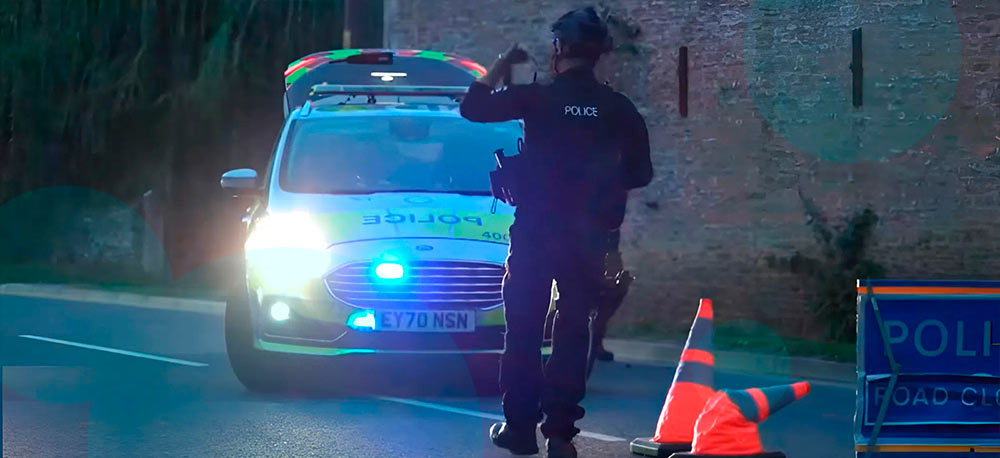
British counterterrorism police were questioning five men on Monday following arrests near RAF Fairford, a military airbase used by U.S. forces for operations against Iran. The suspects were detained early Sunday after police received reports of three suspicious white vans travelling towards the Gloucestershire base.
Officers later arrested the men on suspicion of offences under the Explosives Act and preparation of a terrorist act. All five are British nationals from London, aged between 23 and 25.
Investigators are examining several possible motives. Police haven’t identified Iran, Russia or an Islamist group as responsible, and no state-backed connection has been established.
A source familiar with the investigation told Reuters an Iran-linked motive was viewed as the most likely line of inquiry. Russian sabotage and an Islamist plot were also under examination. Iran has denied involvement.
The Iranian embassy in London rejected the allegations and described speculation over Tehran’s involvement as unfounded. British police have urged against drawing conclusions while interviews, forensic work and searches continue.
RAF Fairford has become a sensitive military site during the conflict with Iran. The British-owned base hosts U.S. aircraft and has been used by American bombers for operations in the Middle East, including missions against Iranian targets.
Iran’s Revolutionary Guards said in July any base used for attacks on Iranian territory would be regarded as a legitimate target.
Police examine vans and suspected explosives
The arrests followed an emergency call from a local farmer who reported three vans and a group of hooded, masked men near the airfield. According to her account, some of the men ran into nearby fields after being spotted.
She contacted emergency services and armed police arrived shortly afterwards. The farmer later said she believed her 999 call disrupted whatever the group intended to do.
Defence Secretary Wes Streeting said the witness had only a partial picture of the operation. He declined to provide details about intelligence activity or security procedures around the base.
The account has raised questions over earlier comments from U.S. President Donald Trump, who said British and American authorities had been watching the suspects for some time.
Trump said the group was looking to cause major damage at the base and credited cooperation between British and U.S. authorities for the arrests. A source cited by Reuters said the arrests weren’t intelligence-led, although security at RAF Fairford had already been increased before the incident.
Counter Terrorism Policing said investigators had developed several new lines of inquiry after examining the scene overnight.
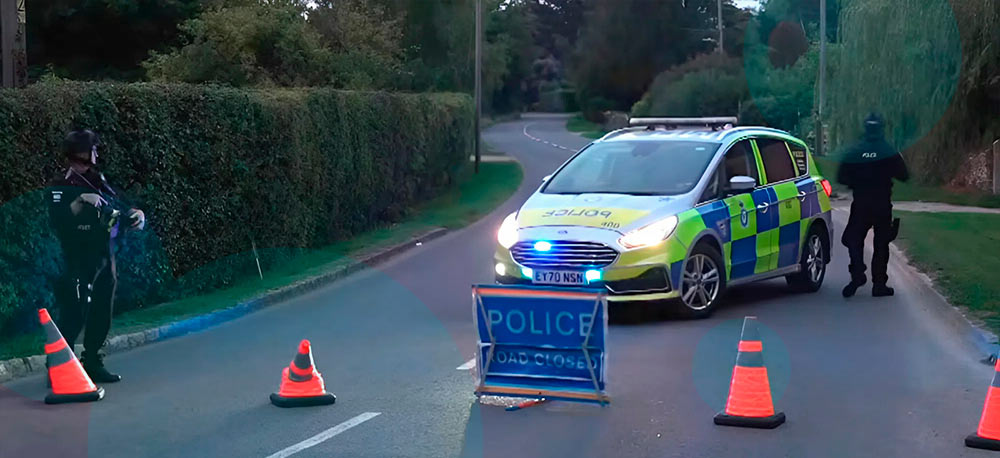
Army bomb-disposal specialists deployed a robot around the three vans while police established a 400-metre cordon. Residents from 85 homes in nearby Whelford were evacuated as a precaution. Armed officers guarded access points around the airbase, with heavy equipment used to block some entrances.
The suspects remain in custody. Under British terrorism legislation, investigators have additional time to question people arrested on suspicion of terrorist offences before prosecutors decide whether charges should follow.
Iran connection remains unconfirmed
The Fairford investigation comes during a period of increased concern in Britain over alleged hostile-state activity. British security officials have accused Iran and Russia of using intermediaries for operations inside the UK. Iranian authorities have repeatedly denied directing attacks or plots in Britain.
Britain raised its national terrorism threat level from substantial to severe in April, meaning authorities assess a terrorist attack as highly likely. Police have also investigated possible Iranian links to incidents involving Jewish sites and Iranian dissidents.
In May, the British government imposed sanctions on 12 people and entities linked to Iran, accusing them of involvement in hostile activity, including alleged attack planning and financial support for groups seeking to destabilise Britain. Iran rejected similar accusations.
Streeting said officials would not speculate about the Fairford suspects while the criminal investigation remained active. He said the wider threat from Iran and Iranian proxies remained a concern for British authorities.
Foreign Secretary Ed Miliband also referred to security threats facing Britain after the arrests. His comments followed a meeting with Iranian Foreign Minister Abbas Araghchi at the United Nations in New York, where Britain warned against intimidation, threats and hostile activity on UK territory.
The current investigation hasn’t established any Iranian involvement in the Fairford incident.
U.S. tightens security around facilities in Britain
The U.S. Embassy issued a security alert following the arrests, advising American citizens in Britain to exercise caution around U.S.-associated facilities, organisations and gatherings.
Security was also increased at other American military facilities in Britain. U.S. Air Force personnel at RAF Fairford remain on alert, although the service hasn’t disclosed specific protection measures.
Fairford has long supported U.S. long-range bomber deployments. During the conflict with Iran, American aircraft operating from the base have taken part in missions against Iranian missile sites.
The British government authorised U.S. use of Fairford for strikes against missile facilities after Iranian attacks against British interests and allied forces in the Gulf.
Prime Minister Andy Burnham has been receiving updates on the investigation and cancelled several appearances at the Labour Party conference after the incident, according to the government.
For now, police are treating motive as an open question. The five arrests involve suspected terrorist preparation and explosives offences, but investigators haven’t publicly attributed the incident to Iran, Russia or any militant organisation.
What the RAF Fairford case means for terrorism insurance in Britain
The Fairford investigation also has an insurance angle, even without an attack or physical loss. A terrorism incident around a military installation creates possible exposures for nearby commercial property, business interruption, denial of access and temporary closures.
The evacuation of 85 homes and the police cordon around Fairford show how disruption starts before investigators determine whether an explosion or physical attack occurred.
For British businesses, terrorism losses sit outside many ordinary commercial property arrangements unless terrorism protection has been purchased or included by the insurer. Pool Re provides the main reinsurance structure behind much of Britain’s commercial terrorism market.
Pool Re operates with government backing and reinsures terrorism exposures written by its member insurers. Its scheme covers commercial property damage and business interruption associated with certified terrorist events. Non-damage business interruption, including denial of access or loss of attraction, is also within the scheme where the underlying insurance policy provides such protection.
A loss doesn’t enter the Pool Re scheme simply because police investigate terrorism offences. HM Treasury must certify the incident as an act of terrorism under the statutory definition used by the scheme.
So the Fairford arrests, by themselves, don’t create a Pool Re terrorism loss. No terrorist attack has been confirmed and no Treasury certification has been announced.
The distinction becomes important for businesses around a security cordon. A retailer, hotel, warehouse or other company might lose revenue because customers or staff are unable to reach the premises even though the building itself suffers no damage. Whether an insurer pays such a loss depends on the policy wording, the terrorism extension purchased and, for Pool Re-backed protection, the status of the event under the scheme.
Britain widened the statutory framework for Pool Re after the 2017 attacks exposed gaps around business interruption without physical property damage.
The legislation permits Pool Re to reinsure financial losses arising from terrorism even where direct physical damage isn’t the trigger, subject to the insurance terms involved.
Pool Re estimated in August 2026 only around 5% of UK SMEs had terrorism insurance. The figure leaves most smaller businesses without dedicated protection for terrorism-related property or interruption losses.
Pool Re introduced an SME incentive scheme in April 2026 designed to encourage member insurers to put terrorism protection back into selected SME commercial property products as standard. Insurers receive lower reinsurance pricing when eligible cover is incorporated into qualifying products or portfolios.
Aviva became the first member to join the programme in August. Terrorism protection was added as standard to selected digitally traded commercial products covering offices, shops, property owners and other SME risks.
Pool Re entered 2026 with substantial claims resources behind the market. Its fund stood at £7.4 bn at 31 March 2026, alongside £2.75 bn of private-market retrocession and £200 mn of insurance-linked securities capacity.
The scheme protects around £2.3 tn of commercial property and business interruption exposure in Britain.
An incident such as Fairford therefore raises two separate insurance questions. One concerns whether an eventual attack produces insured property or interruption losses. The other concerns how many surrounding businesses bought terrorism protection before anything happened.
The second question is often the harder one. With roughly 95% of SMEs still outside dedicated terrorism insurance, a serious event involving a military site, transport hub or dense commercial district would leave a large share of smaller companies dependent on ordinary policy wording, government support or their own balance sheets.
Fairford hasn’t reached that stage. Police are still investigating suspected preparation rather than the aftermath of a completed attack.
For insurers, brokers and reinsurers, though, the episode gives a practical example of how terrorism exposure spreads beyond the intended target through evacuation zones, restricted access and interrupted trading.