Follow Beinsure
Redwire Corp. (RDW), a space technology and infrastructure company, has secured a new contract from Axiom Space to supply two Roll-Out Solar Array wings for the second module of Axiom Station.
The agreement expands Redwire’s work on the planned commercial space station. The company is already producing ROSA systems for Axiom Station’s first module, giving it solar-array work across the first two elements of the project.
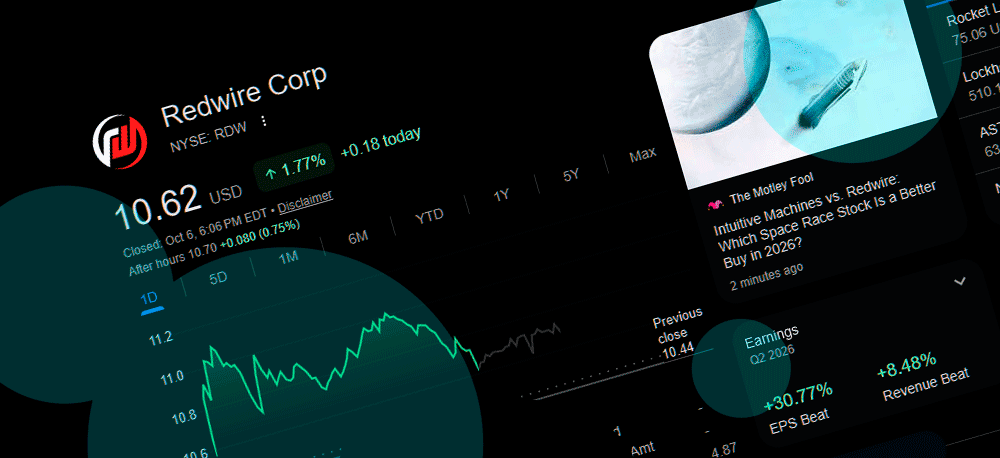
Redwire stock traded more than 1% higher in premarket trading after falling more than 6% during the previous week.
The new contract covers two additional ROSA wings as Axiom Space develops a privately operated station in low-Earth orbit. Axiom plans to use the station for scientific research, product development, microgravity manufacturing and human spaceflight involving governments and commercial customers.
The unparalleled track record of ROSA supporting the International Space Station in low-Earth orbit makes it the ideal system to provide the robust power needed to support Axiom Space’s global customers and pioneering commercial space station, Axiom Station.
Mike Gold, president of Redwire Space
ROSA uses a flexible architecture intended to provide expandable solar power while reducing mass and storage volume compared with traditional rigid solar panels. Redwire said the technology has recorded a 100% mission success rate across deployments in low-Earth orbit, geostationary orbit and other space environments.
More than 65 solar-array wings have either been delivered or remain under development, according to the company. Redwire is also targeting future lunar and Mars missions with its power systems, alongside proposed orbital data-center projects.
The Axiom contract adds another commercial program to Redwire’s existing space infrastructure work. In September, the company was selected as one of 15 participants for a U.S. Space Systems Command contract valued at more than $980 mn, covering technology and services for military space testing and training.
Axiom Station’s first module is in final assembly at Thales Alenia Space in Turin, Italy. After assembly, it is scheduled to move to Houston for integration and testing before shipment to Kennedy Space Center in Florida for launch.
Axiom plans to launch the first module in 2028. The second module is also preparing for final assembly and is scheduled to launch less than a year after the first, placing Redwire’s latest ROSA order within the station’s early deployment schedule.
For Redwire, the contract adds to a broader push into long-duration orbital infrastructure rather than isolated component programs. The Axiom Station work, Honda robotics concept and Sophia Space memorandum all place the company in projects tied to a larger buildout of commercial space infrastructure.
Execution remains an important issue for the business. Redwire is working across complex fixed-price programs while integrating Edge Autonomy, with investors also watching whether administrative expenses remain elevated as the combined company grows.
Cost overruns or schedule delays on first-of-a-kind programs remain a material operating risk. Revenue growth alone would not resolve profitability pressure if program costs rise faster than expected or delivery dates move.
The new contracts add backlog and longer-term revenue visibility, but they also increase the number of programs Redwire needs to integrate and deliver simultaneously. That makes execution across engineering, production and customer schedules increasingly important to its financial performance.
The Axiom Station award has a direct connection with Redwire’s existing commercial space work because the company will now provide solar arrays for both of the station’s first two modules.
Their planned launches in 2028 and less than a year later give Redwire repeat business on the same commercial low-Earth-orbit platform.
That concentration brings both program depth and customer exposure. Successful delivery across assembly, integration and launch would give Redwire additional operating history for ROSA on commercial stations, while delays or technical problems would add pressure around margins, contract estimates and the timing of profitability.
Redwire is positioning ROSA beyond traditional spacecraft power systems as well.
The company sees potential demand from future commercial stations, lunar and Mars missions and orbital computing projects, where large deployable power systems would support higher electricity requirements.
The Axiom contract therefore adds another customer program for a technology Redwire already has in production. Nearer term, the financial question remains less about the size of the opportunity than whether the company delivers its expanding program portfolio on schedule and within contracted economics.