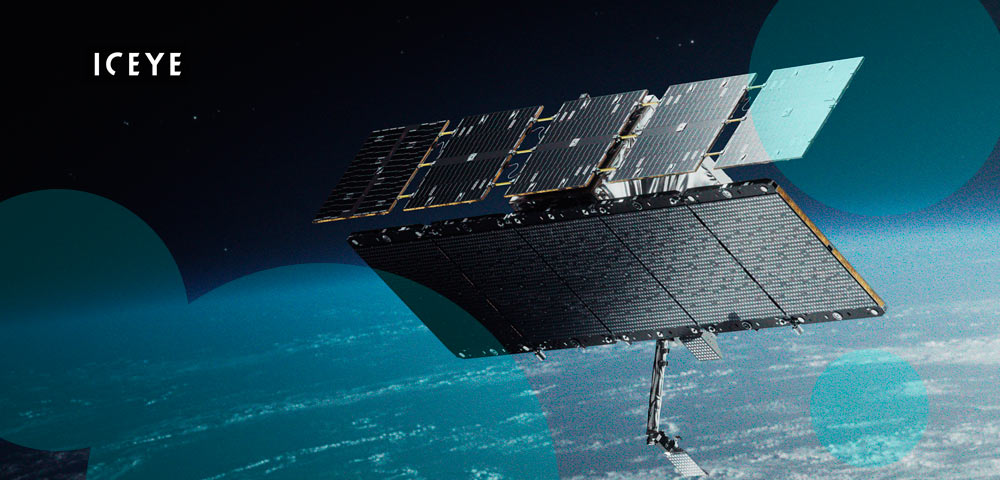
SpaceTech ICEYE has introduced Gen5, its latest generation of synthetic aperture radar (SAR) satellites, offering ground imaging resolution as fine as 11 cm for government customers and expanded capabilities for space-based intelligence, surveillance and disaster monitoring.
The new satellite system combines higher-resolution radar imaging, increased collection capacity and improved orbital control with onboard artificial intelligence processing.
For eligible government users, Gen5 supports imaging bandwidth of 1,800 MHz, enabling 11 cm resolution subject to compliance with International Telecommunication Union (ITU) regulations.
- ICEYE has introduced Gen5, its latest synthetic aperture radar (SAR) satellite system, capable of achieving 11 cm ground resolution for eligible government customers.
- Gen5 doubles imaging time per orbit and reduces minimum image window separation by more than 30%, increasing image collection capacity.
- The satellites include onboard AI processing, daily repeat-pass capabilities and software updates, with sovereign systems available for deployment within 12 months.
The increased resolution allows analysts to distinguish smaller objects and detect more detailed changes on the ground, regardless of weather conditions or daylight.
Commercial and other customers can operate Gen5 at 1,200 MHz bandwidth, delivering resolution as fine as 16 cm.
ICEYE Gen5 increases SAR imaging capacity and resolution
Gen5 introduces improvements in satellite imaging frequency, flexibility and image quality.
The system reduces minimum image window separation, the distance required between consecutive image acquisitions, by more than 30% compared with previous ICEYE satellites.
This allows the satellite to capture images closer together along its orbital path, increasing the number of potential observations during each pass.
Gen5 also provides twice the imaging time per orbit compared with earlier ICEYE generations.
The combination of longer imaging periods and shorter intervals between acquisitions enables more extensive collection of radar imagery during individual orbital passes.
Higher transmission power and larger incidence angles further improve image quality and imaging flexibility.
ICEYE said these developments are intended to increase the amount of usable intelligence collected during each mission while improving the ability to identify smaller objects.
Daily satellite monitoring improves change detection
Gen5 features more powerful and precise orbital control, allowing satellites to revisit the same geographic location daily from a consistent observation angle. This repeat-pass capability improves comparisons between images acquired on different days.
Maintaining a consistent viewing geometry helps analysts identify smaller changes in infrastructure, equipment, terrain and other observed objects.
The capability supports applications requiring frequent monitoring, including maritime surveillance, defense intelligence and natural disaster assessment.
SAR imaging can operate during darkness and through cloud cover, providing observations when conventional optical satellites face visibility limitations.
For government customers, the combination of daily revisits and higher-resolution imagery can improve the timeliness and consistency of intelligence collection.
ICEYE introduces onboard AI processing for satellite intelligence
Gen5 includes an onboard AI processor designed to support future image screening, preliminary data processing and automated detection capabilities directly in orbit.
The technology is intended to reduce reliance on ground-based processing for selected intelligence tasks.
Over time, ICEYE plans to introduce capabilities such as automated screening and tip-and-cue functions, allowing satellites to identify relevant observations and support follow-up collection.
These functions are designed to shorten the interval between image acquisition and delivery of actionable intelligence.
The satellite architecture supports over-the-air software updates, allowing ICEYE to introduce new functionality to satellites already operating in orbit.
Time to decision is everything in space-based intelligence, whether you’re tracking a vessel or responding to a flood. Gen5 shortens it at every step: sharper and more images per pass, and AI analysis that starts in orbit.
Rafal Modrzewski, CEO and co-founder of ICEYE
According to the company, its satellite development cycle delivers a new generation approximately every 18 months, alongside quarterly software releases.
Sovereign Gen5 satellite systems available within 12 months
ICEYE designed Gen5 to operate with the same software infrastructure and ground segment used by previous satellite generations.
Existing customers can therefore integrate Gen5 into their satellite operations without replacing established tasking workflows or retraining operators.
The common architecture also allows customers to operate different generations of ICEYE satellites within the same infrastructure.
For new customers, ICEYE offers a fully sovereign Gen5 satellite system, including spacecraft, ground segment, operational software and operator training.
The company says these systems can become operational within 12 months of contract signing and are not subject to US International Traffic in Arms Regulations (ITAR) restrictions.
The sovereign configuration is intended for government customers seeking independent control over satellite imaging operations and access to intelligence data.
ICEYE expects the combination of higher-resolution SAR imagery, increased collection capacity, precise orbital control and software-based upgrades to support government intelligence requirements and disaster response operations.