Follow Beinsure
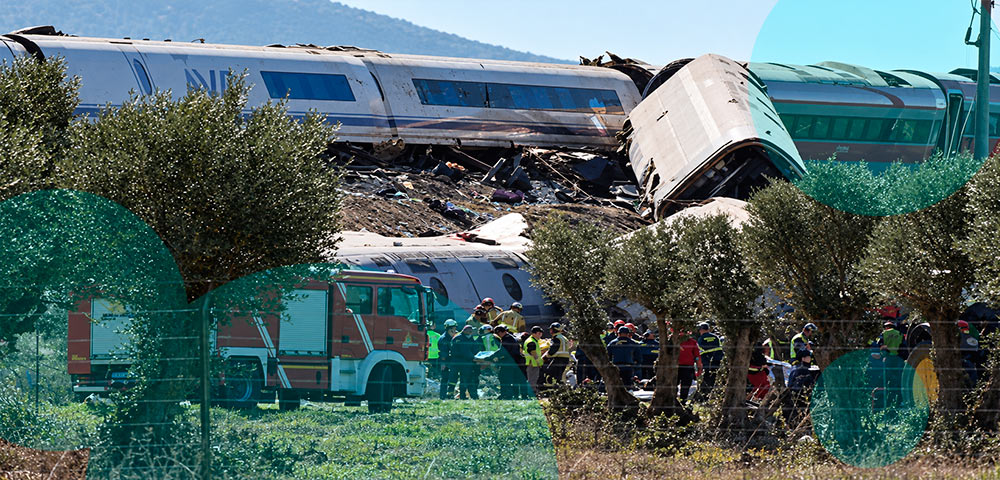
At least 64 people were killed and 58 injured when two high-speed trains collided in Spain’s Toledo province on Wednesday, October 28, in one of the country’s deadliest railway accidents in decades.
The collision occurred shortly before 9 a.m. local time near Urda, approximately 150 kilometers south of Madrid, on the high-speed railway connecting the Spanish capital with Seville.
- At least 64 people died and 58 were injured when a Renfe AVE high-speed train collided with a stationary Iryo service in Toledo province.
- The collision disrupted the Madrid-Seville high-speed railway, with two Iryo carriages derailing and rail services between Madrid and Andalusia suspended.
- Investigators are examining a possible signaling system failure and human error, while authorities in Andalusia and Seville have declared three days of mourning.
Initial reports indicate that a Renfe AVE train struck the rear of a stationary Iryo service at a speed exceeding 100 kilometers per hour (62 mph). At least two carriages of the Iryo train derailed, with some falling down an embankment.
The regional government of Castilla-La Mancha confirmed that 40 of those killed had been traveling on the Iryo train, while 24 were aboard the AVE service. More than 500 passengers were traveling on the two trains when the accident occurred.
The cause of the collision remains under investigation. Spanish railway infrastructure operator Adif is examining the sequence of events and the signaling systems operating along the affected section of track, according to the Spanish news agency EFE.
Emergency response and disruption to Spain’s high-speed railway
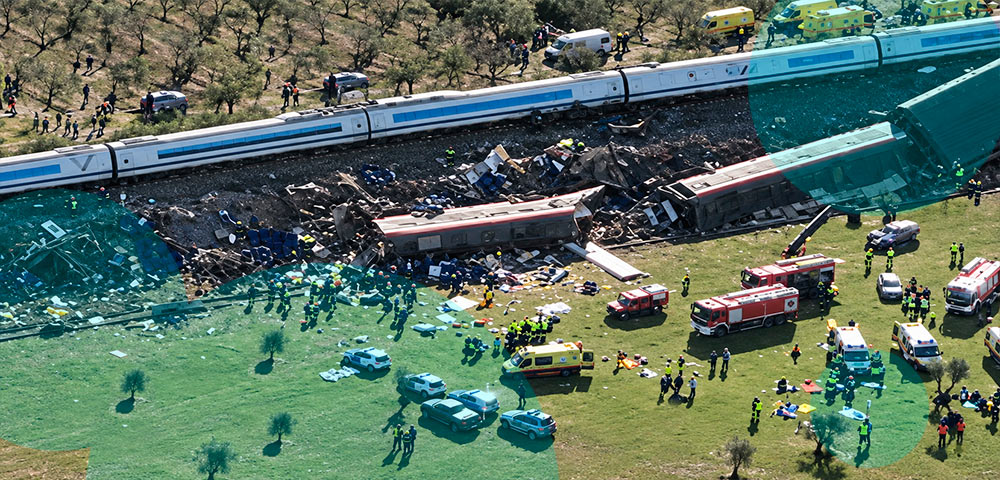
Emergency services were deployed immediately following the collision, with rescue workers, medical personnel and helicopters attending the accident site between Urda and Los Yébenes.
Authorities established an Advanced Medical Post near the wreckage to assess injuries, provide emergency treatment and coordinate transfers to hospitals.
A local sports hall in Urda was converted into a temporary reception center for survivors and others affected by the accident. Photographs from the facility showed passengers receiving assistance from medical teams and emergency workers.
Images from the crash site showed severely damaged railway carriages, some overturned along the embankment, as rescue personnel worked through the wreckage.
Adif suspended high-speed railway traffic between Madrid and Andalusia following the collision, disrupting services connecting the capital with southern Spain.
Passengers at Seville’s Santa Justa railway station faced cancellations and uncertainty as the suspension affected scheduled departures and arrivals.
The accident involved trains operated by Renfe’s AVE service and private rail operator Iryo, both of which serve Spain’s high-speed passenger network.
The death toll exceeded that of the January 2026 railway disaster near Adamuz in southern Spain, which killed 45 people. The Toledo collision has been described as Spain’s third-deadliest railway accident since the 1970s.
Investigators examine possible signaling failure and human error
The investigation is expected to concentrate on the signaling and train protection systems used on the Madrid-Seville high-speed railway.
Government sources told El País that a possible operating error occurred after the railway’s automated signaling equipment experienced a failure.
Under normal circumstances, the system manages train movements automatically. When signaling equipment fails, railway operations can require additional manual intervention.
According to early, unconfirmed reports in Spanish media, the Iryo train may have stopped after detecting a failure in the LZB signaling system.
Investigators have not established whether a technical malfunction, human error or a combination of factors caused the collision.
The LZB system, originally developed in Germany, uses continuous electronic communication between trains and railway infrastructure to monitor speeds and maintain safe distances. Its name derives from the German term Linienzugbeeinflussung, commonly translated as linear train control.
The technology is designed to intervene automatically when a train approaches an occupied section of track, including when a driver fails to apply the brakes.
A rear-end collision between two trains operating under this protection system would therefore be considered an unusual event.
The system should normally prevent a following train from entering an occupied section at a dangerous speed, making its operation a central issue for investigators.
Spain is gradually replacing different railway signaling technologies with the European Rail Traffic Management System (ERTMS), intended to establish common train control standards across European rail networks.
The Toledo accident presents a different investigative challenge from the January disaster near Adamuz, where faulty rails were identified, and the 2013 railway disaster in Galicia, which involved a train operating under a system that allowed the driver to disregard speed warnings.
A similar comparison has been drawn with a fatal rear-end passenger train collision on Britain’s Midland Main Line earlier in 2026.
In that accident, the relevant section of railway lacked technology capable of automatically stopping the following train after its driver passed a red signal. It was Britain’s first fatal collision of that type between passenger trains in more than 40 years.
The circumstances in Toledo remain uncertain, particularly whether the LZB system was functioning normally when the collision occurred and what operational procedures were in effect.
Spain declares mourning as government responds to railway disaster
Spanish Prime Minister Pedro Sánchez said he was shocked by the collision and expressed support for those affected.
Emergency services are working on the ground to assist those affected and ensure their safety, in coordination with all the involved administrations. My affection, solidarity, and support to all the victims and their families.
Sánchez said in a statement posted on X
The Spanish government said Sánchez would travel to Urda to support emergency teams and meet those affected by the accident.
Officials said the immediate priority was assisting victims and ensuring coordination among the authorities involved in the rescue operation.
Transport Minister Óscar Puente was also expected to address the accident as Adif continued examining the circumstances surrounding the collision.
The regional government of Andalusia declared three days of official mourning. “We are devastated,” Andalusian President Juanma Moreno said, adding that the region stood with the victims of the latest railway disaster.
Seville Mayor José Luis Sanz separately announced three days of mourning and suspended official events in the city.
The accident comes as Spain prepares for a snap general election next month, called by Sánchez following widespread public unrest over the country’s housing crisis.
The prime minister faces a difficult political contest, with the far-right Vox party expected to make gains.
Vox leader Santiago Abascal criticized Sánchez’s government following the collision, linking the latest disaster to what he described as failures in public administration.
The political reaction comes less than a year after the Adamuz disaster raised concerns about railway infrastructure and safety oversight.
For investigators, the immediate question is how a high-speed train could strike another service from behind on a railway equipped with automatic train protection technology. Adif has not yet confirmed the cause of the collision or established whether the signaling failure reported by Spanish media directly contributed to the accident.