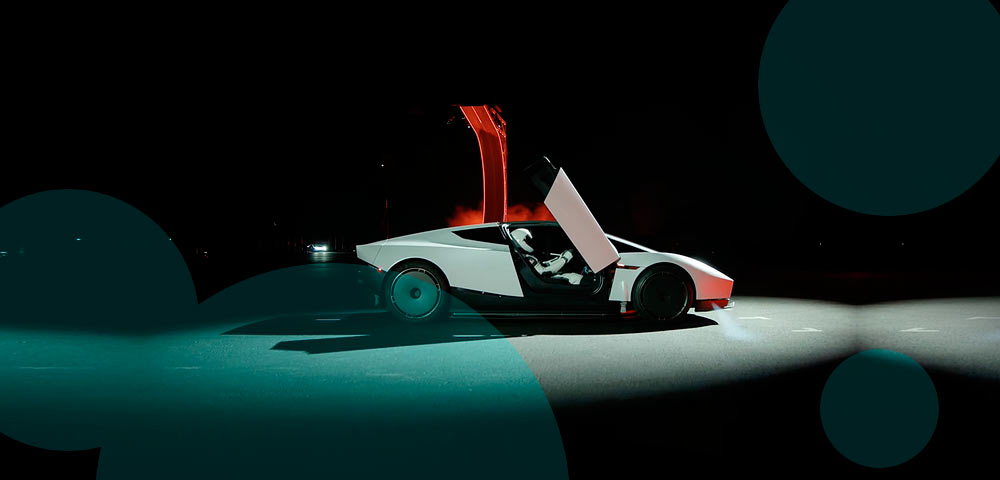
Tesla (NASDAQ: TSLA) has unveiled a redesigned version of its long-delayed Roadster electric sports car, featuring propulsion technology developed with SpaceX that enables the vehicle to briefly fly, rotate in midair and accelerate from zero to 60 mph in less than one second.
The demonstration took place on October 15, 2026, at a SpaceX test facility in McGregor, Texas. Tesla CEO Elon Musk said production would begin in 2028, more than a decade after the second-generation Roadster was first announced in 2017.
- Tesla unveiled its next-generation Roadster on October 15, 2026, demonstrating an upside-down driving maneuver, midair rotation and jumps powered by SpaceX-developed thrusters.
- The electric sports car offers claimed acceleration from 0 to 60 mph in under one second, a top speed exceeding 230 mph and a driving range of more than 300 miles.
- Production is scheduled for 2028, eight years later than originally promised, with reservation deposits ranging from $50,000 to $250,000 and no confirmed final pricing.
During the event, a white two-seat Roadster drove up a curved ramp and remained attached while inverted using a fan-based suction system. The vehicle then launched into the air, rotated and landed on its wheels with assistance from integrated compressed-gas thrusters.
A second demonstration showed the car jumping over several vehicles, including a semi-truck, before completing another aerial maneuver.
This is the clmination of incredible work by Tesla and SpaceX engineers working closely together to make something that you haven’t seen in any movie.
Tesla CEO Elon Musk
The technology combines Tesla’s electric vehicle engineering with SpaceX propulsion expertise. According to Musk, the Roadster uses ultra-high-pressure air tanks to generate thrust, allowing certain versions to overcome the traction limitations of conventional tires.
Tesla Roadster specifications and performance
Tesla vehicle engineering chief Lars Moravy said the redesigned Roadster could accelerate from zero to 60 mph (97 kph) in under one second and reach speeds exceeding 230 mph (370 kph).
The company also claims a driving range of more than 300 miles (480 km) per charge, considerably below the approximately 620 miles promised when the second-generation model was introduced in 2017.
Tesla presented three configurations following the event. The Performance version is a two-seat electric sports car with advanced aerodynamics and a suction system. The Thrust variant adds compressed-gas acceleration thrusters, while the invite-only Rocket model features a single-seat configuration and a more extensive propulsion system designed for aerial maneuvers.
The Rocket configuration is not approved for public road use. Tesla has not announced final vehicle prices. Its reservation system lists a $50,000 deposit for the Performance model and $250,000 for the Thrust version.
When Tesla originally presented the Roadster in 2017, it quoted a starting price of $200,000 and planned deliveries for 2020. The company subsequently missed several production deadlines.
Musk acknowledged that the new vehicle’s commercial success is uncertain, although the demonstration attracted considerable attention from investors and automotive enthusiasts.
Tesla shares rise as investors assess Roadster launch
Tesla shares gained approximately 5% in premarket trading on October 16 following the unveiling. The Roadster serves primarily as a demonstration of Tesla’s engineering capabilities rather than a major expected source of revenue.
Musk previously described the vehicle as a relatively small contributor to Tesla’s financial performance, suggesting its commercial impact would be limited compared with the company’s larger businesses.
Morningstar analyst Seth Goldstein said the Roadster could fill a gap in Tesla’s product portfolio by serving as a high-performance flagship vehicle.
Gene Munster, managing partner at Tesla investor Deepwater Asset Management, described the demonstration as an engineering achievement with limited direct commercial value. “It was an engineering flex with no commercial value beyond embarrassing traditional car makers,” Munster wrote on X.
Tesla does not currently have a halo car, or high-performance luxury vehicle designed to showcase an automaker’s best engineering and technology. The Roadster will be Tesla’s new halo car
Seth Goldstein
The collaboration also renewed speculation about a possible combination of Tesla and SpaceX, two companies controlled by Musk.
Munster suggested the Roadster event demonstrated why Musk might want to bring the businesses together. No merger announcement accompanied the unveiling.
Tesla shifts investment toward robotics and autonomous vehicles
The Roadster’s return comes as Tesla increasingly concentrates on artificial intelligence, autonomous driving and robotics rather than expanding its conventional passenger vehicle lineup.
The company has stopped selling its Model S and Model X vehicles to make room for production of Optimus humanoid robots. It has also introduced Cybercab, a two-seat autonomous vehicle designed without a steering wheel, pedals or conventional mirrors.
Tesla’s existing electric vehicle lineup has faced declining sales over the past two years, although higher gasoline prices helped support deliveries during the third quarter of 2026.
The Roadster also carries historical significance for Tesla. The original model, introduced in 2008 and produced until 2012, was the company’s first electric vehicle and used a chassis derived from the Lotus Elise. Its successor is intended to demonstrate the performance potential of electric propulsion combined with technologies developed outside conventional automotive engineering.
Regulatory approval and the commercial availability of the Roadster’s aerial capabilities remain unresolved. Tesla has not established whether all demonstrated features will be included in production vehicles.
Investors will next assess Tesla’s financial performance when the company reports third-quarter results on October 21, 2026. Those results are expected to provide a clearer indication of its near-term earnings outlook than the Roadster launch, with production of the new sports car still targeted for 2028.