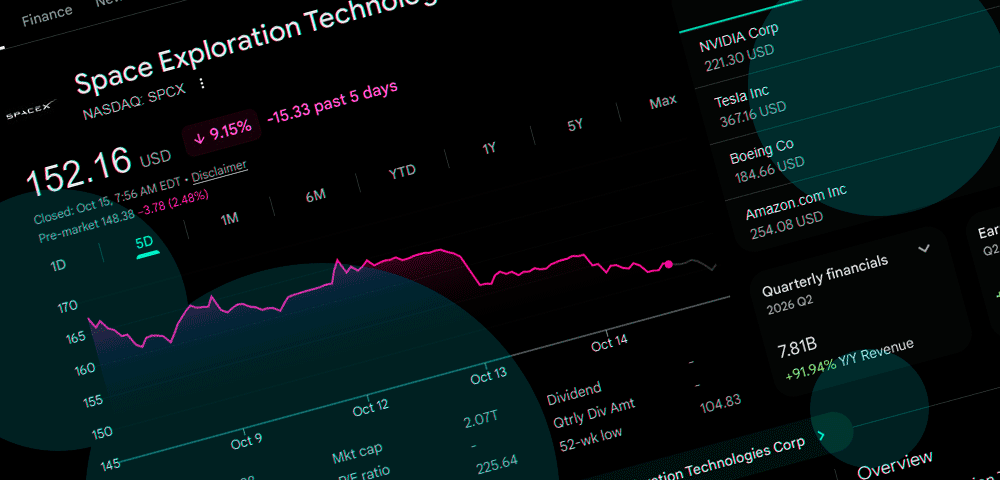
- SpaceX (NASDAQ: SPCX) closed at $152.16, down 2.8%, with shares trading near $148 in early October 15 premarket activity.
- Analysts maintain a Moderate Buy consensus and an average 12-month price target of approximately $220, implying 45% upside from the latest closing price.
- SpaceX’s planned $8 bn spectrum acquisition could expand Starlink into the US mobile market, although network investment requirements and competition remain significant risks.
Space Exploration Technologies Corp. (NASDAQ: SPCX) remains a favored stock among Wall Street analysts despite a recent selloff, as investors assess the company’s expansion into mobile telecommunications and rising capital requirements.
As of October 15, 2026, the average 12-month SpaceX stock price target stands at approximately $220-$221, suggesting potential upside of around 45% from the October 14 closing price of $152.16.
MarketBeat’s consensus covers 45 analysts, including 31 Buy or Strong Buy recommendations, nine Hold ratings and five Sell ratings. S&P Global’s narrower group of 38 analysts has a similar average target of $221.26.
- Morgan Stanley analyst Adam Jonas maintains an Overweight rating and a $300 price target, one of the more optimistic forecasts among major investment banks. His valuation reflects expectations for Starship and SpaceX’s longer-term opportunities in space-based AI infrastructure.
- Barclays analyst Anthony Valentini initiated coverage with an Overweight rating and a $254 target, citing SpaceX’s launch capabilities, Starlink subscriber growth and potential orbital computing applications.
- Bernstein’s Douglas Harned maintains a Buy rating and a $248 target, while RBC Capital Markets analyst Kenneth Herbert has a $225 forecast. Pivotal Research’s Jeffrey Wlodarczak raised his target from $220 to $230, reiterating Buy.
More cautious estimates include Stifel’s $190 Buy target and Susquehanna’s $173 Neutral forecast. MoffettNathanson’s $142 target points to potential downside from the October 14 closing price.
The wide range of forecasts reflects uncertainty over how quickly SpaceX can convert its satellite infrastructure, telecommunications ambitions and AI investments into sustainable earnings.
SpaceX shares have retreated approximately 11.5% from their October 6 close of $171.92. The stock’s latest decline coincided with broader pressure on technology companies as investors reassessed spending on AI infrastructure and the cost of financing expansion.
The company’s latest strategic development is an agreement to acquire 14 MHz of low-band 800 MHz wireless spectrum from Grain Management in a transaction reportedly valued at approximately $8 bn.
The acquisition, subject to Federal Communications Commission approval, would expand Starlink Mobile’s spectrum holdings and support plans for a hybrid network combining satellite connectivity with terrestrial infrastructure.
The announcement triggered a sharp selloff in AT&T, Verizon and T-Mobile shares on October 9, reflecting concerns that SpaceX could eventually challenge established US wireless operators.
William Blair analysts expect SpaceX to develop a competitive package combining Starlink broadband and mobile services, potentially including additional digital products.
Technical limitations remain substantial. SpaceX would hold approximately 79 MHz of spectrum following the acquisition, far below the holdings of major wireless carriers. Its 800 MHz frequencies improve coverage characteristics but provide limited capacity compared with broader terrestrial networks.
T-Mobile technology chief John Saw has questioned whether the additional spectrum can overcome the signal loss associated with satellite communications. Building a competitive nationwide service would require further investment in spectrum, satellites, network equipment and ground infrastructure.
SpaceX’s existing Starlink business provides an important source of growth. The company reported approximately 12 mn broadband subscribers at the end of the second quarter, while analysts estimate that the service could generate $4.8 bn in third-quarter revenue, compared with $4.3 bn in Q2.
Consensus forecasts compiled by S&P Global project SpaceX revenue of approximately $45.3 bn in 2026 and $117.5 bn in 2027. These estimates depend on substantial business expansion and remain subject to considerable execution risk.
For investors, the near-term technical level to watch is $150, close to the stock’s opening price when SpaceX went public in June 2026. A sustained move below that level could increase selling pressure, while a recovery above $160-$175 would indicate improving momentum.
The average analyst target near $220 suggests substantial potential appreciation over the next 12 months.
Whether that valuation is achievable will depend on Starlink subscriber growth, Starship deployment, capital spending discipline and SpaceX’s ability to establish a commercially viable mobile network.