Spring Labs, an AI-native compliance and operations platform for financial institutions, raised $5 mn in funding led by BankTech Ventures and Haymaker Ventures.
The company plans to use the capital to expand beyond complaint and dispute automation into a broader compliance workflow and AI agent orchestration platform serving banks, sponsor banks, and fintech companies.
Compliance teams inside financial services face mounting operational pressure. Regulatory obligations keep expanding, customer interactions generate growing amounts of review work, and staffing models struggle to keep pace with rising case volumes.
Spring Labs argues the bottleneck no longer sits primarily around data collection. It sits around execution.
Every customer interaction creates downstream operational tasks, including complaint identification, dispute routing, escalation handling, reporting requirements, and case documentation.
Most of that work still depends heavily on manual review processes spread across fragmented internal systems.
According to Beinsure analysts, financial institutions increasingly search for AI systems capable of automating operational compliance workflows rather than simply assisting analysts with document search or reporting tasks.
The pressure intensified as fintech partnerships expanded and sponsor banks absorbed larger compliance oversight burdens.
Spring Labs built its platform specifically for regulated financial environments.
The company combines AI models with workflow management, enterprise-grade security controls, human oversight layers, and policy-based governance systems allowing institutions to monitor and manage AI agent behavior directly.
John Sun, CEO and co-founder of Spring Labs, said compliance workloads are growing faster than institutions can scale operational teams. According to Sun, many entrenched compliance problems stem from workflow execution complexity rather than data availability.
“The next generation of companies that win with banks will be AI-native, operationally efficient, and led by teams that genuinely understand how to build trust on the bank side of the table. Spring Labs is one of the few we’ve watched consistently demonstrate all three,” said Carey Ransom, Managing Director of BankTech Ventures.
We’ve known the team for a while, and partnering more closely through this investment was an easy decision.
The company’s first major product, Zanko, focuses on complaints, quality assurance, quality control, and disputes.
Zanko helps financial institutions identify potential complaints, standardize workflow handling procedures, and automate parts of complaint resolution operations. Spring Labs says its Complaints Agent achieved up to 97% complaint identification accuracy during internal testing and customer pilot deployments using human evaluation data.
Compliance operations at banks and fintechs have long been a cost that scales with size – every new customer brings a new edge case, and every edge case eventually finds an analyst.
Phin Upham, Haymaker Ventures Managing Partner
“Spring Labs breaks that link by automating the long-tail workflows that consume most analyst time. The value of this compounds as regulatory demands intensify,” said Phin Upham.
The platform aims to move institutions away from partial manual review models toward broader workflow automation governed through customer-defined policies and controls.
Carey Ransom, managing director at BankTech Ventures, said companies succeeding in bank infrastructure markets increasingly combine AI-native operating models with deep understanding of financial institution trust requirements and operational realities.
Haymaker Ventures managing partner Phin Upham said compliance operations historically scaled linearly with institution growth, where every edge case eventually required additional analyst review capacity.
According to Upham, Spring Labs automates many of the long-tail workflows consuming large amounts of analyst time as regulatory pressure continues increasing.
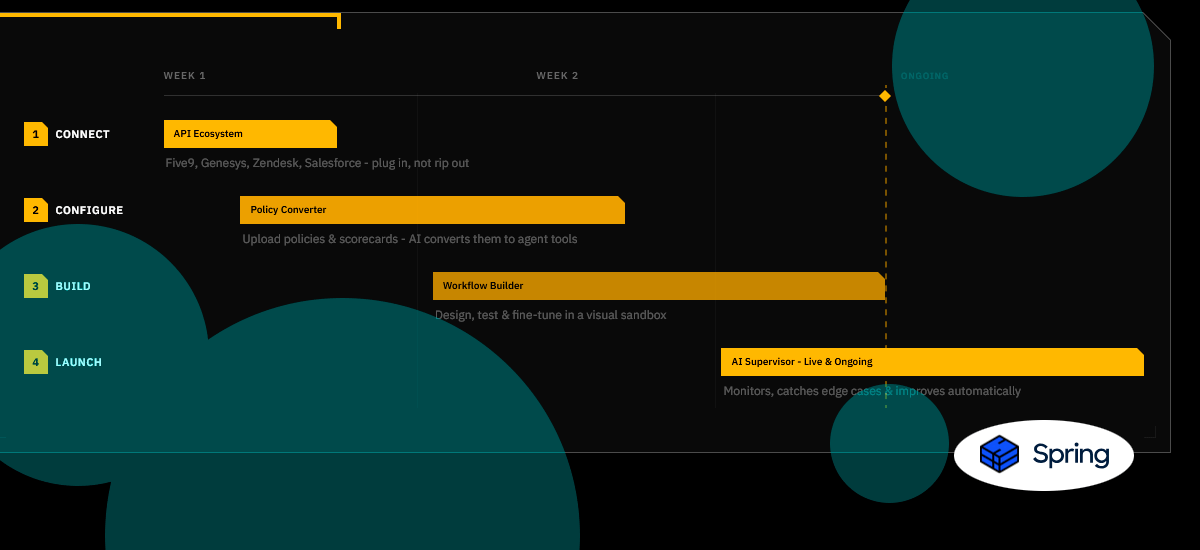
The company is already testing the next stage of its platform with existing customers. That expansion introduces a compliance-focused AI agent orchestration layer extending beyond complaints and disputes into broader operational risk workflows.
The system allows financial institutions to deploy, manage, monitor, and control AI agents across multiple compliance processes while maintaining ownership of decisions, customer data, and regulatory accountability.
Spring Labs currently works with dozens of sponsor banks and fintech companies, including WebBank, First Electronic Bank, and multiple fintech partners operating through sponsor banking frameworks.
The company argues compliance teams should receive the same productivity improvements software engineering teams experienced through AI-assisted development tools.
The difference, according to Spring Labs, is that financial services environments require much tighter governance, auditability, security controls, and operational oversight.
Compliance automation has existed for years inside banking infrastructure, though many older systems relied heavily on rigid rule-based engines and manual escalation workflows.
AI-native platforms like Spring Labs now push further into dynamic operational decision support, where autonomous agents assist with workflow execution directly inside regulated environments.
Banks still move carefully around autonomous compliance systems. They don’t really have much choice anymore. Regulatory obligations continue growing faster than operational headcount.