- Verisk estimates insured losses from the July 28 Kumamoto earthquake at JPY 220 bn to JPY 340 bn, or about $1.4 bn to $2.1 bn.
- The magnitude 6.8 earthquake struck near Kumamoto City at a shallow depth of about 10 km, creating strong ground shaking across Kumamoto Prefecture.
- Damage affected homes, commercial buildings, infrastructure and major manufacturing facilities, raising concerns over semiconductor, electronics and automotive supply chain disruption.
Verisk’s Catastrophe and Risk Solutions group estimates insured losses from the magnitude 6.8 earthquake near Kumamoto City at JPY 220 bn to JPY 340 bn, equal to roughly $1.4 bn to $2.1 bn. The earthquake struck near Kumamoto City on Japan’s Kyushu Island on July 28.
The U.S. Geological Survey said the earthquake occurred south of Kumamoto at a shallow depth of about 10 kilometers. It resulted from shallow strike-slip faulting within the Eurasian Plate.
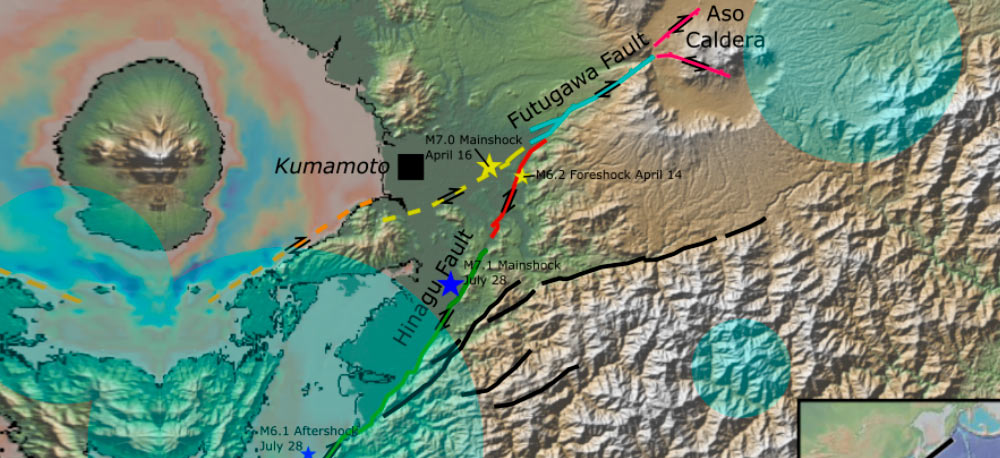
The affected region has a recent history of severe seismic losses. In 2016, Kumamoto experienced a major earthquake sequence, including a magnitude 7.0 mainshock that caused widespread building damage and substantial loss of life.
The July event caused broad damage across Kumamoto Prefecture. Authorities recorded the strongest shaking in Uki City and Hikawa Town.
Reports cited hundreds of damaged homes and commercial buildings, damage to cultural landmarks and public infrastructure, and continuing reviews of structural impacts across the region.
Transport systems also took a hit. Highways, bridges and rail infrastructure suffered damage, and around 48,000 households lost power shortly after the earthquake.
The quake also disrupted one of Japan’s major manufacturing centers. Several semiconductor, electronics and automotive facilities temporarily suspended operations while companies inspected sites and assessed damage.
That raised concern over supply chain delays in industries already sensitive to production stoppages.
Verisk said ground shaking accounts for most of its insured loss estimate. Other modeled earthquake perils contribute only a smaller share. The loss range reflects uncertainty around fault slip distribution, ground-motion intensity, damage estimates and earthquake insurance take-up rates in Japan.
The estimates include insured physical damage to residential, commercial, industrial and mutual property risks. That includes structures and contents.
Verisk excludes several loss categories from the estimate.
The figures do not include uninsured properties, infrastructure, automobiles, business interruption, workers’ compensation, marine and aviation risks, loss adjustment expenses, demand surge, landslide losses or fire-following losses outside the modeled scope.
Verisk said it continues to monitor the event’s impact and could release more information as assessments develop.
- The July 28 earthquake struck near Kumamoto City on Japan’s southern island of Kyushu at 4:27 p.m. local time. USGS measured the event at magnitude 6.8 after an initial 7.1 reading, while Japanese reports cited a magnitude 7.1 quake in Kumamoto Prefecture. The epicenter was reported about 14 km to 20 km south or south-southeast of Kumamoto City, near Uki, at a shallow depth of roughly 10 km.
- The quake hit a region with major seismic history. Kumamoto suffered a destructive earthquake sequence in April 2016, including a magnitude 7.0 event beneath Kumamoto City that caused heavy property damage and fatalities. The July 2026 event again affected the same broad fault-prone area in central Kyushu, where shallow inland earthquakes create strong ground motion over short distances.
- Early reports pointed to serious local disruption. Authorities issued emergency earthquake warnings across several Kyushu prefectures, including Kumamoto, Nagasaki, Kagoshima, Fukuoka, Saga, Oita and Miyazaki. Reuters reported deaths, injuries, power outages and road damage, with the epicenter close to a major urban area of about 700,000 residents.