Follow Beinsure

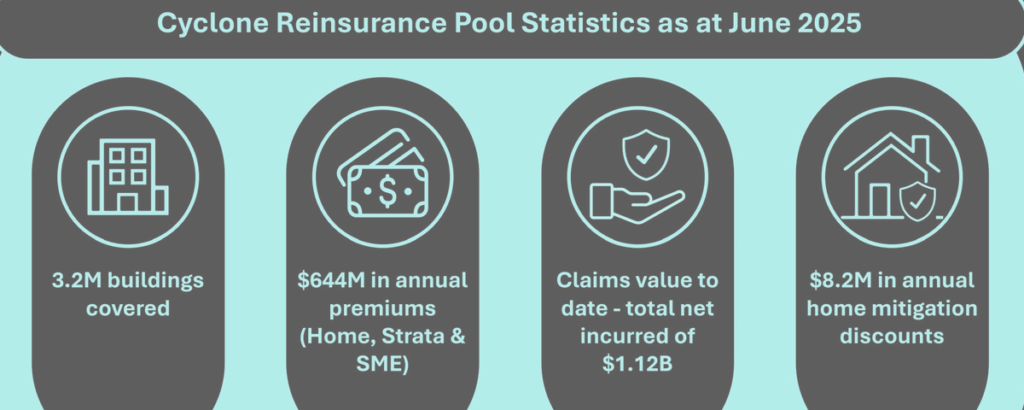
Australia’s cyclone pool, run by the Australian Reinsurance Pool Corporation, recorded $1.12bn in net incurred claims for the June 2025 quarter, the bulk tied to Tropical Cyclone Alfred.
The pool handled 111,860 claims during the three-month period, according to ARPC’s quarterly statistics.
As of June 30, the scheme covers more than 3.2mn buildings against financial loss from cyclones, with in-force annual premiums of about $563mn for home properties, $56mn for strata, and $25mn for small to medium enterprises.
Alongside that, home property owners received $8.2mn in annual premium discounts for mitigation projects such as roof and roller door upgrades.
Severe Tropical Cyclone Alfred, the seventh named storm and sixth severe system of the 2024–25 Australian cyclone season, tracked erratically across the Coral Sea after forming from a tropical low on 20 February.
Meteorologists flagged it early as a major threat, warning it could become one of the most significant weather events in recent Australian history.
Authorities issued widespread watches and warnings, ordering evacuations across South East Queensland and the northern coast of New South Wales. The region, dense with population but rarely struck directly by tropical cyclones, braced for a high-impact landfall.
In the end, Alfred weakened more quickly than forecast. By 8 March, just before crossing the coast, the storm had dropped back to a tropical low. Even so, it left behind damaging impacts—torrential rainfall triggered widespread flooding across communities, cutting transport links and swamping property.
The storm’s long duration, unusual track, and the sheer scale of its rainfall made it one of the most disruptive weather events of the season, even without the full-force landfall originally feared.
Background on the cyclone pool
The cyclone pool launched in July 2022 under amendments to the Terrorism and Cyclone Insurance Act 2003, with the aim of making cover more affordable and available in cyclone-prone areas.
It provides reinsurance for insurers across residential, strata and SME policies, operates nationwide but concentrates its support in higher-risk regions, and is backed by a $10bn annually reinstated Commonwealth guarantee.
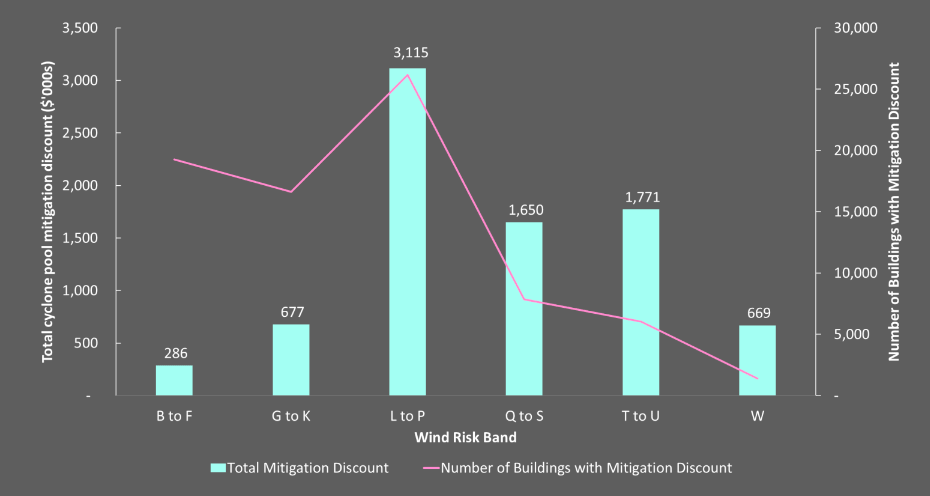
Breakdown of total premium discount by wind band
ARPC said its rate on line for home properties has remained relatively steady, with fluctuations tied mainly to sums insured and the changing mix of risks ceded by insurers.
Trends in SME and strata should be read more cautiously, given shifting risk mixes and reporting practices.
Mitigation discounts, grounded in research on resilience benefits, include 8% for roller door bracing upgrades in homes built before 2012, 10% for cyclone shutters, 20% for tie-down roof structure upgrades on homes built before 1982, and 30% for full roof replacement with structural tie-downs for those same older homes. Discounts for strata buildings were added from April 2025.
ARPC noted only a small portion of home buildings currently receive mitigation discounts, but expects take-up to climb as insurers strengthen data collection and as policyholders respond to incentives embedded in cyclone pool pricing.
The regulator said it will continue tracking discount use to measure how effectively the program encourages resilience measures.
An increased premium discount for higher wind risk properties is expected as the relative benefit for risk reduction is higher. Wind Risk Band ‘W’ (containing more exposure in north-west Western Australia) has lower rates of discount take-up than ‘L’ to ‘U’. Bands ‘L’ to ‘U’ have a greater proportion of policies in Queensland.
The higher discount in these areas shows the benefit of the Queensland Household Resilience Program, which offers up to $11,250 in funding for qualifying mitigation. The cyclone pool premium discounts align with the activities funded by this program.