Overview
Bank of America (NYSE: BAC) enters the week of October 12 with its consumer banking and lending operations providing support for earnings, even as investment banking activity slows following an exceptionally strong second quarter. Investors are preparing for the bank’s third-quarter results on Wednesday, October 14, which will test whether growth in net interest income can compensate for weaker capital markets revenue.
Bank of America will publish its third-quarter financial results at approximately 6:45 a.m. ET on October 14, followed by an earnings conference call at 8:30 a.m. ET.
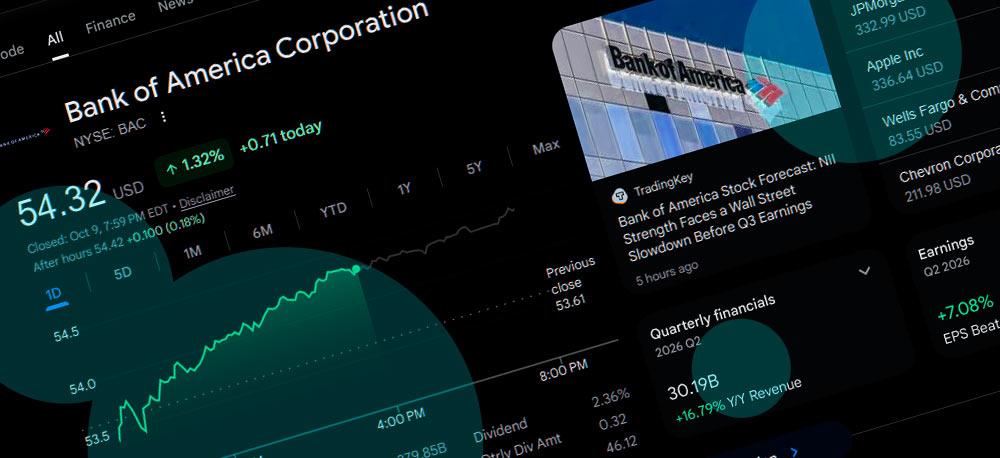
- Bank of America (BAC) stock closed at $54.32 on October 9, gaining 1.32% after a prolonged decline. The shares remain below key moving averages, although technical indicators suggest selling pressure may be easing.
- Bank of America is scheduled to report Q3 2026 earnings on October 14. Analysts forecast approximately $30.6 bn in revenue and earnings of $1.11–$1.12 per share, supported by net interest income growth despite weaker investment banking fees.
- Management expects third-quarter investment banking fees to decline at least 10% year over year, while full-year net interest income growth is projected near the upper end of its 6%–8% guidance range.
Analyst expectations point to continued earnings growth, although at a slower pace than in the second quarter. Recent forecasts put revenue near $30.6 bn, an increase of approximately 9% year over year, with diluted earnings per share expected around $1.11–$1.12, compared with $1.06 a year earlier.
The report arrives as higher Treasury yields, persistent inflation and elevated borrowing costs create competing pressures for U.S. banks. Higher asset yields can support interest income, but rising deposit costs and weaker financing demand may limit those benefits.
Investment banking fees expected to decline at least 10%
Bank of America has already warned that investment banking revenue will weaken in the third quarter.
Chief Executive Brian Moynihan said on September 14 that investment banking fees were expected to decline at least 10% year over year, reaching approximately $1.6–$1.8 bn, compared with $2 bn in the third quarter of 2025.
Analyst forecasts have subsequently pointed toward the middle of that range. The latest consensus estimate for investment banking fees is approximately $1.71 bn, representing a decline of about 15% from a year earlier.
Sales and trading revenue is expected to remain roughly unchanged from the $5.4 bn reported in the comparable quarter last year.
These expectations represent a substantial moderation after the second quarter, when sales and trading revenue rose 33% year over year to $7.1 bn. Investment banking fees increased 50% to $2.1 bn, supported by strong capital markets activity, debt underwriting and advisory transactions.
Moynihan nevertheless described the investment banking pipeline as strong in September. He indicated that higher interest rates could discourage some financing activity, even where corporate demand for transactions remains intact.
The distinction matters for the earnings outlook. Delayed transactions could support revenue in subsequent quarters, whereas a sustained deterioration in financing conditions would present a more persistent challenge.
Net interest income remains a central earnings driver
Bank of America’s traditional banking operations provide an important counterweight to weaker investment banking fees.
Second-quarter net interest income reached $16.0 bn, increasing 9% year over year. On a fully taxable-equivalent basis, the figure was approximately $16.2 bn.
Growth was supported by higher loan and deposit balances, the repricing of fixed-rate assets and increased lending activity within Global Markets.
Management expects full-year 2026 net interest income growth near the upper end of its previously established 6%–8% range.
Analysts project third-quarter net interest income of approximately $16.55 bn on a fully taxable-equivalent basis, compared with $15.39 bn in the corresponding period of 2025. That represents expected growth of about 7.5%.
The bank’s balance sheet continues to support this outlook. Average loans and leases increased 8% year over year to $1.22 trillion in Q2, with every major business segment contributing to the expansion.
Average deposits reached $2.02 tn, extending the bank’s consecutive quarterly deposit growth record to 12 quarters.
Higher interest rates can improve returns on interest-earning assets, particularly as older fixed-rate holdings mature and are replaced with higher-yielding instruments. The benefit depends partly on how quickly deposit costs rise.
Consequently, the third-quarter report will be closely examined for changes in net interest margin, deposit pricing and management’s assumptions about interest rates.
Bank of America’s Q2 earnings provide a strong comparison
Bank of America reported net income of $9.1 bn in the second quarter of 2026, up 27% year over year. Diluted earnings per share increased 34% to $1.21.
Revenue, net of interest expense, rose 15% to $31.6 bn, reflecting stronger net interest income, trading activity, asset management fees and investment banking revenue.
Return on average tangible common shareholders’ equity reached 17.0%, while the efficiency ratio improved to 59%, from approximately 61% in the preceding quarter.
Operating leverage stood at 6.6%, as revenue growth exceeded the increase in operating expenses.
Noninterest expenses totaled $18.6 bn, increasing 8% year over year, with spending driven by revenue-related costs and investments in employees, technology and the bank’s brand.
The combination of double-digit revenue growth and slower expense increases contributed to improved profitability. It also provides an important benchmark for evaluating the sustainability of operating performance.
Third-quarter earnings are unlikely to match Q2’s absolute levels if capital markets revenue declines as management anticipates.
The more relevant measure will be whether consumer banking, wealth management and lending continue generating sufficient growth to offset weaker investment banking activity while maintaining expense discipline.
Consumer credit quality remains relatively stable
Consumer credit performance will be another important factor in Bank of America’s October 14 results.
During Q2, provisions for credit losses declined to $1.4 bn from $1.6 bn a year earlier. Net charge-offs also decreased to $1.4 bn, compared with $1.5 bn in the corresponding period of 2025.
Moynihan said in September that consumer spending remained strong and credit quality was healthy.
Those conditions have supported the bank’s retail operations, although higher borrowing costs and persistent inflation present risks, particularly for lower-income households and credit card borrowers.
Higher energy prices could add pressure to household budgets, while sustained elevated interest rates may eventually affect repayment capacity.
Analysts are also monitoring early signs of deterioration in asset quality. Estimates for third-quarter nonperforming loans and leases are approximately $6.46 bn, compared with $5.35 bn a year earlier.
An increase in nonperforming loans would not necessarily translate immediately into equivalent credit losses, but it could lead to higher provisions if borrowers’ financial positions weaken.
The earnings release will therefore provide an updated view of consumer delinquencies, net charge-offs and management’s assumptions about future credit losses.
Bank of America plans to double AI spending in 2027
Artificial intelligence investment is becoming another significant component of Bank of America’s operating strategy. The bank expects to approximately double its AI expense budget in 2027, reflecting management’s plans to expand internal applications and productivity initiatives.
Co-President Jim DeMare discussed the bank’s use of AI during a September 23 financial services conference, describing measurable productivity benefits from existing applications.
Bank of America’s approach focuses on deploying AI across employee workflows, customer service and internal operations rather than developing a general-purpose AI platform.
Management has reported approximately 140 implemented AI use cases, with associated expenditure of about $400 mn and estimated benefits of $800 mn.
The bank is also expanding the use of its Erica virtual assistant to support internal services and reduce administrative workloads.
The financial impact of these investments will depend on whether efficiency improvements and additional revenue justify the higher technology spending.
Although Bank of America’s efficiency ratio improved in Q2, the third-quarter results will provide further evidence of whether operating costs remain controlled as investment continues.
Bank of America stock forecast
Bank of America’s immediate share price direction will depend heavily on the balance between net interest income growth, capital markets performance and credit costs in Wednesday’s earnings report.
A result above the roughly $30.6 bn revenue consensus, accompanied by resilient interest margins and stable credit performance, could strengthen the case for a recovery toward $56.66.
Stronger-than-expected investment banking fees or constructive guidance for the fourth quarter would provide additional support.
Conversely, disappointing net interest income, rising provisions for credit losses or weaker management guidance could undermine Friday’s rebound.
The bank’s operating performance remains supported by a large deposit base, expanding lending activity and recurring revenue from consumer and wealth management operations. Investors will now assess whether those businesses can sustain earnings growth as the contribution from investment banking moderates.