Overview
Berkshire Hathaway’s investment outlook is drawing renewed attention following Warren Buffett’s warnings about speculative trading and interest rate risks, as the conglomerate adjusts its investment portfolio and management structure under Greg Abel.
The developments come as investors assess how higher Treasury yields could affect Berkshire’s insurance operations, investment holdings and capital allocation across its diversified businesses.
- Warren Buffett’s warnings about speculative trading and rising interest rates have renewed attention to Berkshire Hathaway’s investment strategy and capital allocation under Greg Abel.
- Higher Treasury yields could increase investment returns on Berkshire’s insurance float while affecting equity valuations, utility investments, housing operations and long-term holdings.
- Simply Wall St forecasts Berkshire’s revenue will reach $448.5 bn by 2029, with earnings of $53.1 bn. Its valuation model indicates approximately 3% potential stock upside.
Berkshire’s investment case has traditionally depended on disciplined capital deployment, substantial insurance float and cash generation from operating subsidiaries rather than rapid expansion. Its businesses span insurance, regulated utilities, rail transportation, housing-related operations, manufacturing and retail.
The leadership transition places greater attention on Abel’s ability to maintain that approach while managing changing financial conditions.
Recent developments, including a Texas investigation involving Fruit of the Loom and a shift toward index exposure, have introduced additional considerations for shareholders. Neither development has yet materially changed the central investment narrative presented in the analysis.
Investors are also monitoring data center-related utility projects, housing market exposure and the possibility of earnings pressure identified in some forecasts.
Buffett’s interest rate warning raises questions about Berkshire’s investments
Buffett’s renewed attention to interest rate risk is particularly relevant to Berkshire’s investment portfolio and its ability to allocate capital across different asset classes.
Higher long-term Treasury yields change the relative attractiveness of fixed-income securities and equities. They can also affect the valuation of investments held on Berkshire’s insurance and holding company balance sheets.
For Berkshire’s insurance operations, higher yields create opportunities to earn greater investment income from securities purchased using insurance float. The conglomerate benefits from substantial funds generated through insurance premiums that can be invested before claims are paid.
Other businesses face different considerations. Berkshire’s regulated utilities and housing-related operations must evaluate investment returns against changing financing costs and required rates of return.
Higher interest rates can affect the economics of capital-intensive projects, including utility investments associated with data center development.
Long-duration equity investments, including Berkshire’s stakes in Alphabet and Japanese trading houses, may also be sensitive to changes in discount rates.
These differences make capital allocation under Abel an important factor in assessing Berkshire’s investment performance. Higher rates can improve returns on newly acquired fixed-income assets while creating valuation and financing pressures elsewhere in the portfolio.
Berkshire Hathaway revenue forecast to reach $448.5 bn by 2029
The current investment narrative published by Simply Wall St projects Berkshire Hathaway’s annual revenue will reach $448.5 bn by 2029, based on average yearly growth of 5.3%.
Earnings are projected to reach $53.1 bn over the same period, representing a decline of $32.7 bn from the $85.8 bn earnings figure used as the forecast’s starting point.
The projections indicate that revenue growth is not necessarily expected to translate into higher reported earnings over the forecast horizon.
Simply Wall St’s fair value analysis currently suggests approximately 3% potential upside for Berkshire Hathaway shares relative to the market price used in its assessment.
That relatively narrow estimated upside leaves the valuation sensitive to changes in earnings expectations, interest rates and investors’ assumptions about future operating performance.
The forecast should be distinguished from Berkshire’s own financial guidance, as it represents an external valuation assessment rather than a company projection.
Berkshire Hathaway stock valuations vary widely among investors
Other valuation estimates indicate considerable disagreement over Berkshire Hathaway’s future share price.
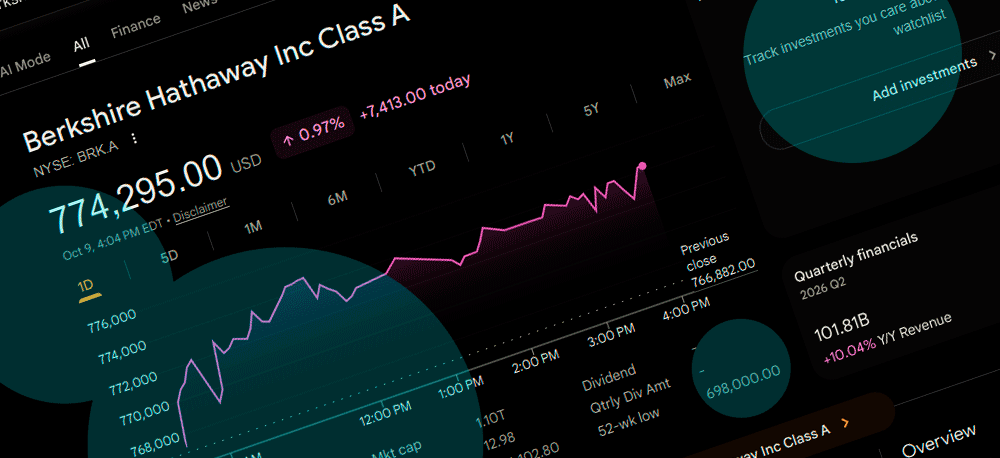
Five fair value assessments submitted by members of the Simply Wall St Community range from approximately $799,503 to $1,181,872 per Berkshire Class A share.
The substantial difference reflects varying assumptions about the management transition, data center-related investment risks and Berkshire’s exposure to the housing market.
Among the alternative estimates, one suggests potential upside of as much as 53% from the share price used in the analysis, considerably above the approximately 3% upside indicated by the main Simply Wall St valuation model.
These estimates illustrate how Berkshire’s valuation depends on assumptions about future earnings, investment returns and the performance of its operating subsidiaries.
The company’s diversified structure complicates such assessments because interest rate changes can affect individual businesses in different ways.
Capital allocation decisions remain a key consideration
For Berkshire Hathaway shareholders, the immediate investment questions center on the leadership transition, earnings performance and the use of the conglomerate’s substantial financial resources.
Insurance operations could benefit from higher reinvestment yields, but utility and housing-related investments face different economic pressures. Changes in long-term Treasury rates also influence how investors assess the relative value of Berkshire’s equity holdings.
The company’s ability to maintain capital discipline under Abel will therefore be closely watched, particularly as investment opportunities and financing conditions change.
Simply Wall St’s broader fundamental assessment identifies three potential investment strengths and one significant warning sign, alongside its financial health analysis.
With its central valuation model indicating only modest upside and community estimates showing a much wider range of outcomes, Berkshire Hathaway’s investment outlook remains closely tied to future earnings, interest rates and the capital allocation decisions made during its management transition.