Follow Beinsure
Berkshire Hathaway (NYSE: BRK.B) enters the final months of 2026 with investment bank forecasts divided over its valuation. UBS expects the shares to reach $628 over the next 12 months, while other analysts see limited upside or a possible correction following the stock’s recent gains.
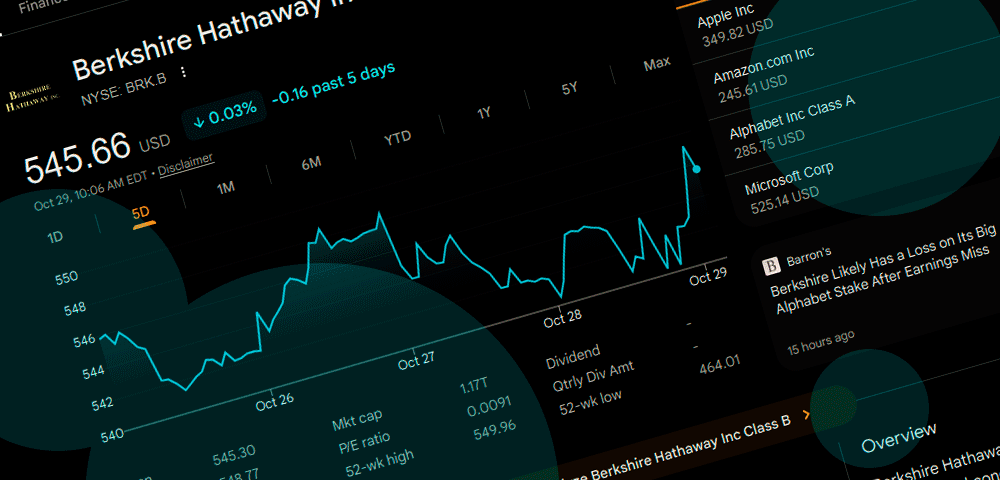
As of October 29, 2026, the consensus 12-month price target is $555.67, compared with Berkshire’s October 28 closing price of $540.34. That represents potential appreciation of 2.8%. The published forecast range runs from $510 to $628, with two analysts recommending Buy and two assigning Hold ratings.
- UBS raised its Berkshire Hathaway BRK.B price target to $628, implying 16.2% upside, while DA Davidson maintains a $592 target.
- The average 12-month analyst price target stands at $555.67, just 2.8% above the latest closing price of $540.34.
- Analysts expect third-quarter 2026 revenue to increase 2.5% to $97.3 bn, although earnings per share are projected to decline 5.6%.
The shares have gained approximately 87% over five years and recently approached their 52-week high of $549.96. The question for investors is whether operating earnings and capital deployment can support further appreciation after that performance.
Berkshire Hathaway BRK.B stock price targets from investment banks
UBS has the most optimistic recently updated forecast among the major banks covering Berkshire Hathaway’s Class B shares.
Analyst Brian Meredith increased the bank’s target to $628 from $604 and maintained a Buy rating. UBS has raised its target several times during 2026, from $570 in May to $585 in July and $604 in August. The latest forecast represents 16.2% upside from $540.34.
UBS expects Berkshire’s diversified operations to support modest year-over-year growth in third-quarter operating earnings. The bank anticipates that improved results from BNSF Railway and Berkshire Hathaway Energy will offset weaker insurance underwriting profitability.
GEICO remains a concern as claims costs outpace pricing improvements and premium growth moderates. UBS nevertheless considers the shares attractively valued relative to their earnings capacity and substantial cash holdings.
DA Davidson also maintains a positive assessment. On August 11, the firm raised its BRK.B target from $531 to $592 while retaining a Buy recommendation. That forecast indicates 9.6% potential appreciation.
DBS takes a more conservative position. Analyst Manyi Lu maintained a Hold rating and $540 target on August 17, effectively placing fair value at the stock’s latest closing price.
Two other investment banks provide forecasts for Berkshire’s Class A shares that can be expressed on a Class B-equivalent basis using the 1,500-to-one economic share ratio.
TD Cowen raised its Class A target to $792,000 from $721,000 on August 14 while maintaining Hold. This equates to approximately $528 per Class B share, suggesting 2.3% downside.
Keefe, Bruyette & Woods (KBW) is more cautious. Analyst Meyer Shields maintained an Underperform rating and raised the Class A price target to $735,000 in August. That corresponds to approximately $490 per Class B share, or 9.3% below the latest closing price. These converted figures are comparisons, not separately published Class B targets.
Across these five bank forecasts, the simple average is approximately $555.60 and the median is $540. The sample is not identical to the published analyst consensus, but both calculations indicate that expectations are concentrated near the current share price despite UBS’s more optimistic position.
The different ratings also matter. A consensus based solely on analysts covering BRK.B may exclude negative assessments issued for BRK.A, even though both share classes represent economic interests in the same company.
Berkshire Hathaway Q3 2026 earnings forecast
Berkshire’s third-quarter earnings will provide the next test of the investment banks’ valuations.
The Zacks Consensus Estimate projects revenue of $97.3 bn, representing 2.5% growth from the corresponding quarter of 2025. Earnings are forecast at $5.91 per share, down 5.6% year over year.
The EPS consensus has increased 4.4% over the past 30 days, indicating improving expectations ahead of the results.
Berkshire exceeded earnings estimates in three of the previous four quarters, with an average positive surprise of 12.04%. Nevertheless, its Earnings ESP currently stands at -0.59%, with the Most Accurate Estimate of $5.87 below the $5.91 consensus. That measure does not provide a positive signal for another earnings beat.
The main operating variables are insurance underwriting profitability, investment income, freight volumes and energy earnings.
Berkshire’s insurance businesses may benefit from premium retention, favorable reserve development and contributions from reinsurance operations. GEICO’s profitability remains vulnerable to claims inflation and competitive pricing.
BNSF should benefit from freight demand and productivity improvements, although fuel prices, labor expenses and operating costs could limit margins.
Berkshire Hathaway Energy may contribute higher earnings through regulated utilities and natural gas pipeline operations. Demand for aerospace components, industrial gas turbines and specialty chemicals could also support manufacturing results.
UBS’s expectation of modest growth in operating earnings contrasts with Zacks’ forecast of a decline in per-share earnings. The distinction between operating profit, adjusted EPS and reported net income is important because Berkshire’s investment gains and losses can materially affect its reported results.
Berkshire’s valuation and capital allocation
Berkshire’s valuation depends increasingly on how effectively it deploys capital.
At June 30, 2026, its insurance and other businesses held $359.2 bn in cash, cash equivalents and US Treasury bills, net of unsettled purchase payables. Berkshire also repurchased approximately $4.8 bn of its shares during the first six months of the year, predominantly in the second quarter.
The company subsequently completed its approximately $6.8 bn acquisition of Taylor Morrison Home Corporation in July.
These transactions provide evidence of a more active approach to capital allocation under CEO Greg Abel. Continued repurchases or acquisitions could improve returns, although their effect depends on purchase prices and subsequent performance.
The valuation argument is less straightforward than Berkshire’s trailing P/E of approximately 13.5 might suggest. Reported earnings include investment gains and losses, which can distort comparisons with recurring operating income. Its forward earnings multiple is substantially higher.
Simply Wall St’s excess-returns valuation is another measure, but it is not an investment bank price target. Its reported book-value and earnings inputs are expressed on a Class A-equivalent basis and should not be compared directly with the BRK.B share price without conversion.
The same distinction applies to forecasts for Berkshire’s possible participation in large technology investments. Potential transactions do not establish additional earnings until their terms, size and expected returns become clear.
Berkshire Hathaway stock price prediction for 2027
The available bank targets define three broad valuation scenarios for the next 12 months.
- The bullish range of $592-$628, represented by DA Davidson and UBS, implies approximately 9.6%-16.2% upside. Achieving those valuations would require continued operating earnings growth, effective capital deployment and sustained investor confidence in Berkshire’s management.
- A middle range of approximately $540-$556 corresponds to the DBS forecast and the wider analyst consensus. This implies little price appreciation and suggests that much of Berkshire’s near-term earnings potential is already reflected in its valuation.
- The more cautious $490-$528 range, derived from KBW and TD Cowen’s Class A targets, implies approximately 2.3%-9.3% downside. Those assessments indicate less confidence that Berkshire’s earnings outlook justifies its current valuation.
The published consensus remains positive in rating terms, but the average target offers limited upside. UBS’s $628 forecast stands out because it assumes substantially greater value than the market currently assigns to Berkshire’s operating businesses and capital resources.
At $540.34, Berkshire Hathaway is trading close to the middle of the broader investment bank valuation range. Its third-quarter results, insurance underwriting margins and subsequent capital allocation decisions will determine whether the shares move toward UBS’s $628 target or remain closer to the $540-$556 consensus range.