Follow Beinsure
- PayPal stock price forecast: Wall Street consensus and analyst ratings
- Barclays, Citigroup and Morgan Stanley revise PayPal price targets
- JPMorgan, RBC and other banks see greater upside for PYPL shares
- PayPal Q3 2026 earnings: higher profits but slower revenue growth
- Venmo and Braintree growth versus weak branded checkout
- PayPal raises 2026 EPS forecast to $5.60
- PayPal valuation: earnings multiple and free cash flow
- PayPal share price outlook for 2027: bearish, neutral and bullish scenarios
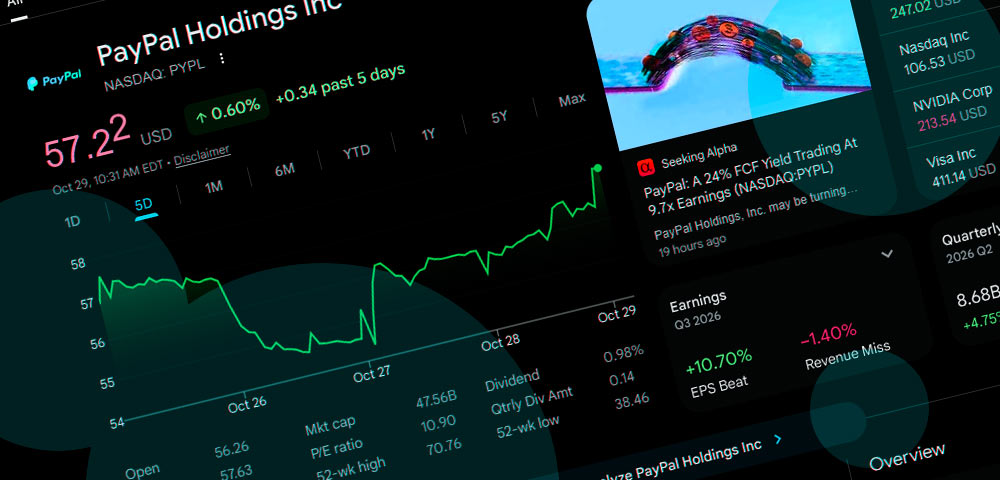
PayPal (NASDAQ: PYPL) shares are trading close to Wall Street’s average 12-month price target following a mixed third-quarter earnings report and a fresh round of investment bank revisions. As of October 29, 2026, analysts’ consensus forecast stands at approximately $57.19, offering little upside from the stock’s recent trading range.
The shares closed October 28 at $56.55, up 0.82%, and traded around $57.20 in early trading on October 29. That puts PayPal near the level at which analysts collectively expect the stock to trade over the next 12 months.
- PayPal shares have a consensus 12-month price target of approximately $57.19, with analysts predominantly recommending Hold following the company’s Q3 2026 results.
- Barclays downgraded PayPal to Underweight on October 29 and reduced its target to $53. JPMorgan maintained $65, while RBC Capital Markets and KBW remain more optimistic at $70.
- PayPal raised its 2026 adjusted earnings guidance to $5.60 per share, but weak branded checkout growth, revenue below expectations and planned investment in 2027 continue to limit analysts’ forecasts.
Barclays became the latest bank to turn more cautious on Thursday, lowering its rating to Underweight from Equal Weight and cutting its price target to $53 from $56. The downgrade followed PayPal’s third-quarter results, which exceeded earnings expectations but showed limited progress in its core branded checkout business.
Other investment banks have taken a different view. JPMorgan maintained its $65 target, RBC Capital Markets reiterated $70, and Susquehanna retained a $67 objective. Morgan Stanley, meanwhile, remains considerably more cautious with a $46 target.
The range of forecasts reflects different assumptions about how quickly PayPal can improve revenue growth, expand transaction margins and generate returns from its investment program.
PayPal stock price forecast: Wall Street consensus and analyst ratings
PayPal’s average 12-month price target is approximately $57.19, with a median estimate of $58. The broader range of published analyst projections extends from $36 to $80, although recently updated investment bank targets are more concentrated between $45 and $70.
MarketBeat’s coverage of 46 analysts shows nine Buy recommendations, 32 Hold ratings and five Sell ratings. The average target of $57.17 is effectively unchanged from the stock’s price during October 29 trading.
The consensus target was approximately $56.31 a month earlier and $55.50 three months earlier. The subsequent increases have been relatively modest compared with the stock’s recent recovery.
The distribution of ratings matters more than the small movement in the average target. Most analysts consider PayPal reasonably valued at current prices rather than significantly undervalued.
Several firms increased their targets after the earnings release without changing their neutral or negative recommendations. Those revisions primarily recognise better expense management, higher earnings estimates and continued share repurchases. They do not necessarily indicate greater confidence in revenue acceleration.
The latest investment bank forecasts are divided into three groups: analysts expecting further downside, those anticipating limited price appreciation and firms that see a more substantial recovery as PayPal’s business changes begin contributing to earnings.
Barclays, Citigroup and Morgan Stanley revise PayPal price targets
Barclays made one of the most significant changes on October 29. Analyst Nik Cremo downgraded PayPal from Equal Weight to Underweight and reduced the bank’s 12-month target from $56 to $53.
That represents approximately 7.3% downside from a reference share price of $57.20.
Barclays identified weakening online branded checkout growth as the principal concern. This business generates a substantial proportion of PayPal’s transaction profit, making its performance particularly important to future earnings.
Branded checkout growth slowed to 1% on a currency-neutral basis in the third quarter. Excluding Venmo, Barclays estimated that growth was flat.
The bank also pointed to PayPal’s fourth-quarter outlook of 1% to 2% branded checkout growth, arguing that the expected performance does not support the recovery investors had anticipated.
Barclays remains concerned about competition from Apple Pay and Shop Pay, declining use of manual card entry and the continuing shift toward mobile commerce. It also questioned whether PayPal’s existing initiatives would deliver a material improvement in its competitive position.
Citigroup adopted a less negative position but also lowered its valuation. Analyst Bryan Keane cut the bank’s price target from $61 to $58 on October 28 while maintaining a Neutral rating.
The new target represents approximately 1.4% upside from $57.20, leaving little room for appreciation under Citi’s current assumptions.
Morgan Stanley increased its target from $45 to $46 but maintained its Underweight rating. The bank acknowledged improvements in cost execution while remaining concerned about slow growth in branded checkout.
Its $46 objective implies approximately 19.6% downside from the October 29 reference price.
Bank of America Securities raised its target from $53 to $54 while retaining an Underperform rating. Its analysts remain cautious about European headwinds and the limited contribution from the core checkout business.
Goldman Sachs maintained a bearish position ahead of the earnings announcement, with a Sell rating and a $49 target in its October 13 assessment.
Evercore ISI raised its target from $40 to $45 following the third-quarter results while maintaining an In Line recommendation. The revision acknowledges an improvement in PayPal’s earnings outlook, although its valuation remains substantially below the current market price.
Together, these forecasts indicate that stronger cost controls have improved earnings expectations without resolving concerns about PayPal’s longer-term revenue prospects.
JPMorgan, RBC and other banks see greater upside for PYPL shares
JPMorgan remains more constructive on PayPal’s valuation. Analyst Tien Tsin Huang maintained a Neutral rating and a $65 price target on October 29. That implies potential appreciation of approximately 13.6% from $57.20, although the unchanged Neutral rating suggests that the bank is not treating the valuation discount as sufficient justification for a Buy recommendation.
RBC Capital Markets has a more optimistic assessment, maintaining its Outperform rating and $70 price target.
The RBC forecast represents approximately 22.4% upside from the October 29 reference price.
RBC expects PayPal to remain in an investment phase during 2027, with operating leverage becoming more visible in 2028.
The bank forecasts adjusted earnings of $5.60 per share and revenue of $34.6 bn in 2026. Its 2027 estimates are $5.88 in adjusted EPS and $36.1 bn in revenue, followed by $6.55 in EPS and $37.9 bn in revenue for 2028.
Those projections suggest that RBC’s positive valuation depends partly on improvements expected beyond the next financial year.
The bank is monitoring the contribution of financial services, Venmo monetisation and additional value-added services within PayPal’s payment processing business.
Keefe, Bruyette & Woods (KBW) also maintained a $70 target and a positive recommendation, placing it among the more optimistic analysts covering the company.
Susquehanna reiterated its Positive rating and $67 target, representing approximately 17.1% upside.
More moderate forecasts include UBS at $60, TD Cowen at $60, BMO Capital Markets at $59 and Robert W. Baird at $58.
UBS lowered its target from $61 to $60 while maintaining Neutral. TD Cowen raised its objective from $59 to $60, and BMO increased its target from $56 to $59.
Baird raised its objective from $57 to $58 and maintained Neutral, while Mizuho increased its target from $51 to $55 without changing its Neutral rating.
Clear Street also raised its target from $60 to $62 after the earnings release while retaining Hold.
These upward revisions indicate that analysts have improved some of their financial assumptions. The continued prevalence of neutral ratings shows that most are waiting for stronger evidence of sustainable growth before assigning higher valuations.
PayPal Q3 2026 earnings: higher profits but slower revenue growth
PayPal’s third-quarter results, published October 27, provide the basis for the latest investment bank forecasts.
Adjusted earnings per share increased 8% year over year to $1.45, exceeding analysts’ consensus estimate of $1.31 by approximately 10.7%.
Revenue reached $8.58 bn, up 2% from the previous year but below the expected $8.71 bn. The revenue shortfall was approximately 1.5%.
The difference between earnings and revenue performance explains why analysts have been willing to raise profit estimates without becoming materially more optimistic about the company’s growth prospects.
PayPal’s non-transaction operating expenses increased only 1%, helping offset weaker-than-expected revenue.
Transaction margin dollars rose 2% to approximately $4 bn, while the measure excluding interest earned on customer balances increased 3% to $3.7 bn.
Non-GAAP operating income increased 3% to $1.6 bn, with the adjusted operating margin expanding 16 basis points to 18.8%.
Reported GAAP performance was weaker. Operating income declined 8%, net income fell 14%, and GAAP earnings per share decreased 4% to approximately $1.25.
That distinction is relevant to valuation. Adjusted earnings growth shows that cost management and operating efficiencies are supporting profitability, but reported earnings have not followed the same trajectory.
Total payment volume increased 6% to $487.1 bn, or 7% on a currency-neutral basis. Payment transactions rose 7% to 6.8 bn, while active accounts increased 0.6% to 440 mn.
The limited increase in active accounts indicates that transaction growth is being generated primarily through greater activity and changes in transaction mix rather than rapid expansion of PayPal’s customer base.
Venmo and Braintree growth versus weak branded checkout
PayPal’s operating businesses are producing markedly different growth rates.
- Venmo recorded its eighth consecutive quarter of double-digit total payment volume growth. The company also reported double-digit growth in average revenue per active account, supported by increased adoption of monetised products.
- Braintree payment volume increased 10%, while Pay Later and Pay with Venmo grew 25% and 43%, respectively.
These businesses are contributing to transaction margin growth and helping reduce PayPal’s dependence on traditional checkout services.
Branded checkout, however, continues to grow at only 1% to 2%. The third quarter marked the fourth consecutive period within that range.
European operations created an additional constraint. The removal of the EU de minimis tax exemption reduced branded checkout growth by approximately 70 basis points, and management expects the effect to persist through the fourth quarter.
PayPal has reported improvement in its US branded checkout performance, particularly among merchants where it has implemented changes to checkout presentation and customer experience.
The broader company results have yet to demonstrate a substantial acceleration.
For analysts, this creates a valuation question. Venmo, Braintree and financial services could eventually account for a greater share of transaction profits, but their growth must be sufficient to offset weaker performance in the established checkout business.
The more optimistic investment banks expect that shift to improve PayPal’s financial results over time. Bearish analysts question whether those operations can fully compensate for competitive pressure on branded checkout.
PayPal raises 2026 EPS forecast to $5.60
PayPal increased its full-year 2026 non-GAAP earnings guidance to approximately $5.60 per share, compared with its previous forecast of $5.38. The company also expects adjusted free cash flow of at least $6.5 bn.
For the fourth quarter, management forecasts adjusted EPS of approximately $1.43 and low-single-digit revenue growth on a currency-neutral basis.
The updated guidance provides greater visibility on near-term profitability, but management has indicated that 2027 will involve additional investment in transaction margins, products and operating expenditure.
PayPal expects adjusted EPS growth next year to be broadly similar to its 2026 growth rate, rather than accelerate immediately.
The company aims to achieve mid-single-digit transaction margin dollar growth over the medium term, supported by financial services, Venmo and payment processing.
Management has also identified at least $1.5 bn in potential run-rate cost savings, with approximately $700 mn expected to be realised on an exit-rate basis by the end of the fourth quarter.
The additional savings could provide funding for investment while protecting profitability.
RBC’s forecasts illustrate the resulting timeline. Its estimates call for adjusted EPS of $5.88 in 2027 before increasing to $6.55 in 2028.
The investment case therefore depends on whether PayPal can finance its growth initiatives without allowing higher expenditure to erode the earnings improvements achieved through cost reductions.
PayPal valuation: earnings multiple and free cash flow
PayPal has an equity market value of approximately $47 bn to $48 bn, depending on the share price.
At $57.20 per share and management’s adjusted 2026 EPS guidance of $5.60, the stock trades at roughly 10.2 times expected earnings.
That valuation is low relative to the earnings multiples typically associated with faster-growing technology companies. PayPal’s relatively slow revenue growth, however, limits the usefulness of such comparisons.
The company’s cash generation provides another basis for valuing the shares.
PayPal reported $2.05 bn in adjusted free cash flow during the third quarter, although the unadjusted free cash flow figure was lower at $1.43 bn.
Both measures declined from the corresponding period in 2025, despite remaining substantial in absolute terms.
Management’s forecast of at least $6.5 bn in annual adjusted free cash flow implies a yield of approximately 13.6% to 13.8% against its recent market capitalisation.
That is an adjusted free cash flow yield, not a conventional unadjusted free cash flow yield, and the distinction matters when comparing PayPal with other companies.
Share repurchases remain an important component of the investment case.
The company bought back approximately $1.5 bn of stock during the third quarter, bringing total repurchases to $6 bn over the preceding 12 months.
Repurchases reduce the number of shares outstanding and can support earnings per share even when underlying profit growth is limited.
Institutional investors own approximately 68.3% of PayPal shares. Recent investment activity has included new positions reported by Mitsubishi UFJ Asset Management and Bank of America, alongside increased holdings by Swiss National Bank and UBS Asset Management.
Corporate insiders sold 12,705 shares worth approximately $727,886 over the reported 90-day period. The disclosed transactions included sales under pre-arranged Rule 10b5-1 trading plans.
Neither institutional ownership changes nor these insider transactions establish a clear directional forecast for the share price. The earnings outlook and the pace of branded checkout recovery remain more relevant to the differences between analysts’ valuations.
PayPal share price outlook for 2027: bearish, neutral and bullish scenarios
Investment bank forecasts suggest three broad valuation outcomes for PayPal over the next 12 months.
The bearish range of approximately $45 to $54 is represented by Evercore ISI, Morgan Stanley, Barclays and Bank of America. From $57.20, those targets imply potential declines of approximately 5.6% to 21.3%.
Such outcomes are more consistent with persistent branded checkout weakness, pressure on transaction margins and limited evidence that PayPal’s spending program can restore revenue growth.
The neutral range is concentrated between $55 and $60, incorporating targets from Mizuho, Citigroup, Baird, BMO Capital Markets, TD Cowen and UBS. That range implies modest downside to approximately 5% upside from the October 29 reference price.
These forecasts are consistent with a business that continues generating substantial cash flow and supporting adjusted EPS through cost control and repurchases, but does not achieve the growth acceleration needed for a materially higher earnings multiple.
The more optimistic targets range from $65 to $70, including JPMorgan, Susquehanna, RBC Capital Markets and KBW.
At $57.20, the $65 and $70 targets imply approximately 13.6% and 22.4% appreciation, respectively.
Reaching those valuations would require investors to assign greater value to PayPal’s earnings durability and the expected contribution from Venmo, financial services and payment processing.
RBC’s projections provide a specific financial basis for that view, with adjusted EPS expected to reach $6.55 in 2028 as the company moves beyond its planned 2027 investment period.
PayPal’s current valuation already reflects substantial doubts about its growth prospects. Its adjusted earnings multiple is approximately 10 times, and the company continues returning considerable capital to shareholders.
Yet the latest analyst revisions offer limited support for a near-term revaluation. Even after PayPal raised its earnings guidance, the average 12-month target remains close to the market price, and most investment banks retain neutral recommendations.
The next decisive operating measure is branded checkout growth. Management expects only 1% to 2% in the fourth quarter, and analysts remain divided over whether investment in checkout improvements can produce a sustained acceleration during 2027.