Follow Beinsure
Intel (NASDAQ: INTC) enters its third-quarter earnings announcement on October 29, 2026, with investment banks sharply divided over the chipmaker’s valuation. Recent analyst forecasts range from $80 to $155 per share, reflecting different expectations for Intel’s processor business, manufacturing operations and ability to convert growing AI infrastructure spending into sustainable profits.
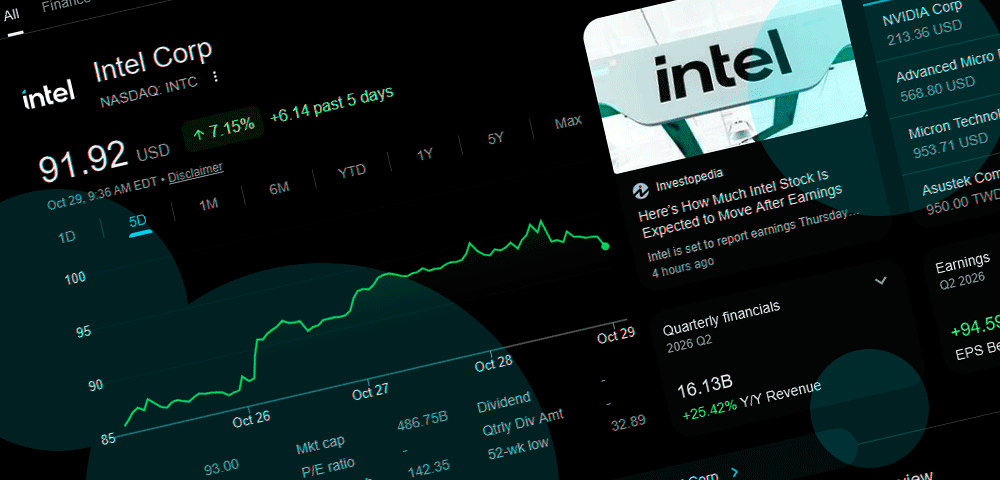
Intel closed at $95.53, gaining 1.91%, but declined toward $92 in early day trading. The shares have lost more than 20% over the past month, following a substantial rally earlier in 2026.
- Intel’s 12-month average analyst price target is approximately $115-$118, implying 20%-23% upside from its October 28 closing price of $95.53.
- Bank of America maintains a $145 target and KeyBanc forecasts $155, while JPMorgan sees $85, Morgan Stanley $84 and Rosenblatt $80.
- Analysts expect Intel’s Q3 revenue to reach approximately $16.5 bn, with adjusted earnings of $0.39-$0.41 per share. The outlook for 2027 depends heavily on server demand, margins and progress at Intel Foundry.
The average 12-month price target is approximately $115-$118 across broader analyst surveys, although the figure varies by coverage universe. One narrower consensus stands closer to $102. Most analysts continue to recommend holding the stock rather than buying it.
The disagreement concerns how much of Intel’s recovery is already reflected in its valuation. Analysts generally recognise stronger demand for server processors, but differ over the earnings potential of Intel’s manufacturing investments and the prospects for attracting external foundry customers.
Intel stock price forecasts from major investment banks
Bank of America remains among Intel’s more optimistic institutional analysts. Vivek Arya maintains a Buy rating and a $145 price target, representing approximately 52% upside from Wednesday’s closing price.
The bank expects Intel to benefit from stronger server CPU demand, higher processor prices and improving product availability. Arya anticipates that the company could exceed third-quarter earnings estimates and raise its outlook.
Bank of America’s positive assessment is principally supported by the demand outlook for Intel’s existing processor operations. AI data centers require CPUs alongside accelerators, providing opportunities for Intel to increase shipments and average selling prices.
KeyBanc is more bullish, maintaining an Overweight rating and a $155 price target. Analyst John Vinh reiterated the recommendation on October 15, suggesting approximately 62% potential appreciation from $95.53.
Citigroup also maintains a positive view. Analyst Atif Malik has a Buy rating and a $130 target, indicating approximately 36% upside. New Street Research upgraded Intel from Neutral to Buy on October 26, setting a $125 target.
Goldman Sachs presents a different case. Analyst James Schneider initiated coverage in June with a Neutral rating and a $150 price target.
Despite that comparatively high valuation, Goldman Sachs considered Intel’s risk-reward balance less attractive than those of some competing semiconductor companies.
The bank expects Intel to benefit from demand for server CPUs associated with agentic AI applications and sees longer-term opportunities in semiconductor manufacturing. Its projections include advanced packaging revenue potentially reaching $10 bn by 2030, with external wafer manufacturing revenue accelerating around 2028.
Goldman Sachs nevertheless regards Nvidia, Broadcom and AMD as companies offering better revenue visibility at comparable or lower valuation multiples.
Its $150 target was established in June, when Intel traded at substantially higher levels. The implied upside at today’s share price should therefore not be confused with a fresh bullish recommendation.
JPMorgan, Morgan Stanley and UBS remain cautious
JPMorgan upgraded Intel from Underweight to Neutral on October 19 but retained an $85 target. That implies approximately 11% downside from Wednesday’s closing price.
The upgrade represents an improvement in the bank’s assessment of the stock, rather than an expectation of substantial appreciation.
Morgan Stanley maintains an Equal-Weight recommendation with an $84 target, around 12% below the October 28 close. The bank raised its target from $75 in July but has not adopted a more positive rating.
UBS analyst Timothy Arcuri recently reduced the bank’s target from $112 to $103 while retaining a Neutral recommendation.
UBS sees favourable revenue prospects but remains cautious about valuation and the extent to which improved business performance can support Intel’s share price.
RBC Capital Markets maintains Sector Perform with a $100 target. Wedbush analyst Matt Bryson reiterated Neutral and a $98 target on October 27.
Both forecasts suggest limited appreciation relative to the latest closing price.
Susquehanna lowered its target from $115 to $105 on October 21, maintaining Neutral. TD Cowen also reduced its forecast, from $115 to $95, while retaining Hold.
Rosenblatt Securities has one of the most negative published assessments. Analyst Kevin Cassidy reiterated a Sell recommendation and an $80 target on October 27, implying approximately 16% downside from $95.53.
Several analysts have lowered their targets during October despite maintaining generally constructive views on demand for Intel processors.
Mizuho is an exception. Analyst Vijay Rakesh increased the firm’s target from $92 to $114 on October 6, although the recommendation remains Neutral.
Intel earnings forecast for Q3 2026
Intel is expected to report third-quarter earnings after US markets close on October 29.
Analysts forecast revenue of approximately $16.4-$16.5 bn, compared with $13.65 bn a year earlier. That represents growth of around 20%-21%.
Adjusted earnings per share are expected to reach $0.39-$0.41, compared with $0.23 in the third quarter of 2025.
Intel’s own guidance calls for revenue between $15.8 bn and $16.8 bn, with adjusted earnings of approximately $0.38 per share and an adjusted gross margin of 42%.
The Intel Products segment is expected to generate approximately $15.5 bn in revenue. Within that business, analysts project around $8.8 bn from PC processors and $6.6 bn from data center operations.
Server processors remain an important source of potential growth. Rising demand for computing capacity across AI infrastructure is supporting CPU orders, giving Intel an opportunity to improve revenue and profitability.
The PC market presents a weaker outlook. Higher memory and storage prices are pushing up computer costs, potentially limiting unit sales even as average selling prices increase.
Bernstein analyst Stacy Rasgon has identified this divergence between strong demand for server chips and pressure on Intel’s PC business. His firm maintains a Neutral-equivalent rating and a $110 target.
A quarterly earnings beat may therefore be insufficient to sustain a substantial stock rally unless Intel also improves its expectations for subsequent quarters.
Intel Foundry remains the decisive valuation question
Intel’s manufacturing operations are a major reason investment banks disagree over the company’s longer-term valuation.
Intel Foundry is expected to report approximately $6.1 bn in third-quarter segment revenue, potentially representing 44% year-over-year growth.
That figure requires careful interpretation because Intel Foundry reports substantial revenue from manufacturing for Intel’s own product divisions. Segment revenue growth does not necessarily indicate equivalent growth in third-party chip manufacturing contracts.
The financial case for Intel Foundry depends on manufacturing yields, production costs, capacity utilisation and the ability to secure commercially attractive external customers.
Intel has made progress with its 18A manufacturing process, supporting its efforts to compete for advanced semiconductor production contracts.
Reports that Google has placed an order involving 3 mn custom Tensor Processing Units and that Nvidia is discussing potential manufacturing arrangements have increased interest in Intel’s foundry operations. Those reports should not be treated as confirmed revenue until the commercial arrangements and production commitments are established.
Intel is also in discussions with SK Hynix over a potential arrangement involving manufacturing capacity at its Ohio facility.
The company faces substantial capital requirements as it expands manufacturing operations. Higher production volumes could eventually improve factory utilisation and profitability, but investment spending creates pressure on cash flow before those benefits are realised.
For investment banks assigning substantially higher price targets, the potential value of Intel Foundry is an important consideration. More cautious analysts place greater weight on execution risk, manufacturing costs and uncertainty over the timing of external customer revenue.
Intel stock forecast for 2027
Consensus expectations point to Intel revenue growth of approximately 15%-16% in 2027, following a stronger projected increase in 2026. That forecast supports further business recovery, but it does not automatically justify a significant increase in the stock’s valuation.
Intel’s shares have already experienced substantial appreciation following investments by the US government and Nvidia, improving sentiment toward the company’s manufacturing strategy.
At the same time, the stock has retreated sharply from its 52-week high of $142.35, reached earlier in 2026.
The company’s current valuation incorporates expectations that improvements in manufacturing technology, external customer relationships and server processor demand will produce sustained earnings growth.
Investment banks effectively disagree over the timing and scale of those benefits.
Targets around $80-$100 are consistent with a more conservative assessment of future earnings and manufacturing profitability. Forecasts between $110 and $130 allow for a stronger operational recovery, while targets of $145-$155 imply considerably more confidence in Intel’s medium-term earnings potential.
These ranges represent differences among published analyst targets, rather than independently calculated probability-weighted scenarios.
The average target also warrants caution. A mean around $117 is approximately 23% above Wednesday’s closing price, but several of the highest forecasts were established before the October correction.
The median target of approximately $112 in one broad analyst survey provides a less optimistic reference point.
Intel stock outlook: What analysts expect next
The most recent investment bank recommendations show a market that is more cautious than the highest published price targets suggest.
- Bank of America and KeyBanc see substantial appreciation potential, supported by stronger CPU demand and Intel’s manufacturing recovery. Citi and New Street Research are also positive.
- JPMorgan, Morgan Stanley, UBS, RBC Capital and Wedbush remain materially more conservative. Their targets reflect concerns about valuation, profitability and the timing of Intel’s expected operational improvements.
- Goldman Sachs occupies a distinctive position, maintaining a high numerical target alongside a Neutral recommendation and expressing a preference for semiconductor competitors with clearer earnings visibility.
Intel’s October 29 earnings release will provide the next test of these forecasts. Revenue growth toward $16.5 bn and adjusted earnings around $0.40 per share are already reflected in current expectations.
The more consequential information will concern fourth-quarter guidance, server processor demand, gross margins, manufacturing costs and progress in securing external foundry customers.
For 2027, consensus revenue growth of approximately 16% offers a measurable benchmark. Intel will need to demonstrate that this expansion can translate into stronger earnings and cash generation, particularly given the capital required by its manufacturing operations.
Until those improvements become clearer, the gap between bullish targets above $145 and cautious forecasts below $100 is likely to remain a defining feature of Wall Street’s assessment of Intel.