- Oracle stock price forecasts from major investment banks
- Guggenheim, Mizuho and Bernstein forecast stronger gains
- Oracle’s $225 bn revenue forecast and $30 bn free cash flow target
- Oracle’s financing limit addresses debt and shareholder dilution concerns
- Oracle stock outlook for 2027: What will determine the next move?
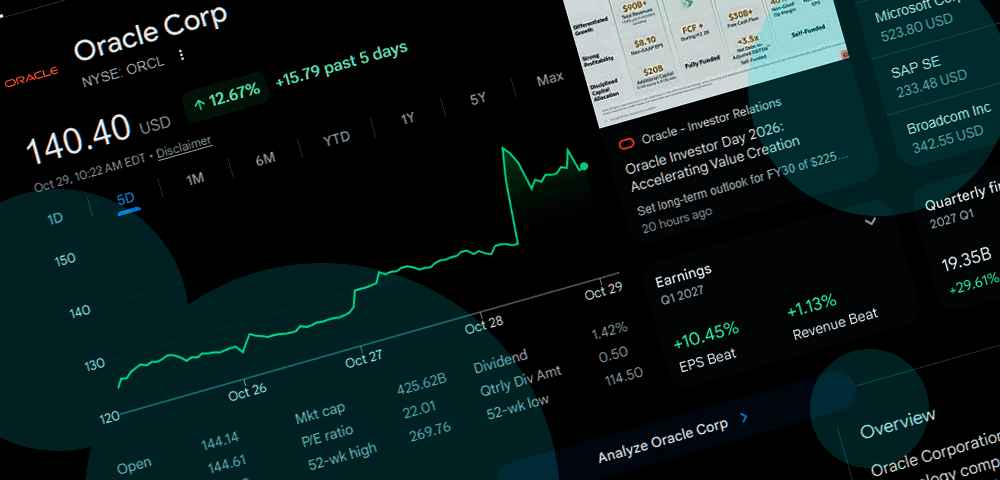
Oracle (NYSE: ORCL) shares surged 10.73% to $144.54 on October 28, 2026, after the company outlined plans to generate at least $225 bn in annual revenue by fiscal 2030 and limit additional financing for its artificial intelligence infrastructure expansion.
The rally, Oracle’s largest single-day gain since May, followed months of pressure over rising debt, substantial data center investments and negative free cash flow. Despite Wednesday’s recovery, the stock remains approximately 49% below its 52-week high of $285.46.
- Oracle’s average 12-month analyst price target of $235.80 implies 63.1% upside from its October 28 closing price of $144.54.
- JPMorgan targets $200, Goldman Sachs $206, Bank of America $240 and Barclays $252, while Guggenheim maintains a bullish $400 forecast.
- Oracle expects revenue of at least $225 bn by fiscal 2030 and positive free cash flow in the second half of fiscal 2028, although capital spending and leverage remain major concerns.
As of October 29, Wall Street’s average 12-month Oracle stock price target stands at $235.80, suggesting 63.1% potential upside. The median forecast is $225, with individual estimates ranging from $110 to $400.
Among 43 analysts covering Oracle, 35 recommend buying the shares, seven maintain hold ratings and one advises selling. The differences in valuations largely reflect expectations for cloud revenue growth, infrastructure costs and the timing of positive cash generation.
Oracle stock price forecasts from major investment banks
JPMorgan reiterated its Overweight rating and $200 price target on October 29, implying 38.4% upside. Analyst Samik Chatterjee viewed Oracle’s updated financing plans as an important response to concerns about its capital requirements.
Goldman Sachs maintains a Buy rating with a $206 target, representing 42.5% potential appreciation. The bank lowered its forecast from $240 on October 23, reflecting a more cautious valuation despite continued expectations for long-term growth.
Wells Fargo also reduced its target ahead of Investor Day, cutting it from $280 to $250 while retaining an Overweight recommendation. The revised forecast still indicates approximately 73% upside.
Bank of America Securities reiterated its Buy rating and $240 target on October 29, implying a potential gain of 66%. Analyst Tal Liani’s assessment centers on Oracle Cloud Infrastructure demand, database workloads and the company’s ability to improve data center economics.
Barclays analyst Raimo Lenschow maintained an Overweight rating and $252 price target, equivalent to 74.3% upside.
These forecasts remain positive, but the reductions by Goldman Sachs and Wells Fargo show that strong AI demand has not eliminated concerns about the cost of delivering additional computing capacity.
Guggenheim, Mizuho and Bernstein forecast stronger gains
Guggenheim remains among Oracle’s most bullish research firms, with analyst John DiFucci reaffirming a Buy rating and $400 price target on October 29. That represents approximately 176.7% upside from Wednesday’s close.
The firm’s assessment depends heavily on Oracle’s financing arrangements and the profitability of its expanding AI infrastructure business.
Guggenheim estimates that approximately $220 bn in capital expenditure will be required through fiscal 2028, with around half supported by customer prepayments, vendor financing and customer-supplied equipment. It also projects approximately $150 bn in additional gross capital expenditure to support expansion through fiscal 2030.
Mizuho Securities maintains an Outperform rating and $320 target, implying 121.4% upside. Bernstein analyst Mark Moerdler has an Outperform rating and $325 target, representing approximately 124.9% potential appreciation.
Oppenheimer analyst Brian Schwartz reaffirmed an Outperform recommendation and $275 target on October 29. The firm considers Oracle’s updated financing guidance more favorable than investors previously expected but continues to monitor infrastructure costs and potential delays in data center deployment.
More conservative forecasts come from RBC Capital Markets and Melius Research.
RBC maintains a Hold-equivalent rating and $165 target, implying just 14.2% upside. Melius analyst Ben Reitzes retains a Buy recommendation and $170 target, based on approximately 10 times estimated fiscal 2029 earnings per share of $16.76.
Melius expects Oracle’s transition to positive free cash flow roughly one year earlier than previously anticipated. Its relatively low valuation nevertheless illustrates that improving financial performance does not necessarily justify the multiples used in the most optimistic forecasts.
Baird reiterated its Outperform rating and $215 price target, while Scotiabank maintains a positive recommendation with a $205 target, reduced from $215.
The spread between RBC’s $165 forecast and Guggenheim’s $400 target reveals substantial disagreement about Oracle’s future earnings valuation, even among analysts who expect its cloud business to expand.
Oracle’s $225 bn revenue forecast and $30 bn free cash flow target
Oracle reaffirmed its fiscal 2030 financial targets at its October 28 Investor Day, forecasting annual revenue of at least $225 bn, a non-GAAP operating margin of at least 40% and adjusted earnings per share of at least $21. That implies compound annual revenue growth exceeding 35% between fiscal 2026 and fiscal 2030.
For fiscal 2027, Oracle expects revenue of at least $90 bn and non-GAAP EPS of $8.10.
Delivering these targets requires substantial infrastructure investment. Oracle spent $55.7 bn on capital expenditure in fiscal 2026, contributing to negative free cash flow of $23.7 bn, compared with negative $394 mn in fiscal 2025.
Management expects capital expenditure of approximately $90-95 bn in fiscal 2027, with spending peaking across fiscal 2027 and fiscal 2028 before declining in fiscal 2029.
Oracle forecasts positive free cash flow in the second half of fiscal 2028, rising to at least $30 bn in fiscal 2029. The company also expects growth to become self-funded in fiscal 2029, with net debt falling below 3.5 times adjusted EBITDA.
Its remaining performance obligations have reached approximately $664 bn, with roughly half expected to convert into recognized revenue over 36 months.
These contracted commitments support Oracle’s growth projections, but they depend on the company delivering the necessary computing infrastructure. Delays in construction or customer deployment could postpone revenue recognition and cash collection.
Oracle plans to deliver approximately 7 gigawatts of additional data center computing capacity over the coming years, supporting demand from OpenAI and other large AI customers.
Oracle’s financing limit addresses debt and shareholder dilution concerns
The most significant new financial commitment was Oracle’s decision to limit additional capital-market financing through fiscal 2030 to $20 bn, divided equally between equity and gross debt.
The limit excludes refinancing existing borrowings and follows a separate $20 bn at-the-market equity offering completed during the first quarter of fiscal 2027.
Oracle’s borrowings stood at approximately $125.34 bn, compared with $36.37 bn in cash. Its BBB- credit rating remains at the lowest investment-grade level, and elevated credit default swap spreads indicate continuing concern about the company’s leverage.
The financing limit reduces uncertainty over future borrowing and share issuance, but the planned $10 bn equity component still implies dilution for shareholders.
Oracle intends to reduce upfront infrastructure costs through vendor financing, customer-owned hardware and prepayments. These arrangements can ease immediate funding requirements, although they increase dependence on major customers and financing partners.
Customer concentration is another risk. A substantial share of Oracle’s AI infrastructure growth depends on large contracts with a limited group of companies, including OpenAI.
The company also faces potential construction delays, power-grid constraints and regulatory approvals that could affect when new data centers become operational.
For investors, the critical measure is whether Oracle can meet its fiscal 2029 cash flow target without exceeding its stated financing limits.
Oracle stock outlook for 2027: What will determine the next move?
Wall Street’s consensus forecast implies substantial potential appreciation, but recent analyst revisions suggest investors remain cautious about the financial cost of Oracle’s AI expansion.
The company’s next quarterly earnings report, expected in December, will provide further evidence of whether infrastructure investment and cloud revenue growth are progressing as planned.
Three financial measures will be particularly relevant: capital expenditure against fiscal 2027 guidance, conversion of the $664 bn contracted backlog into revenue, and quarterly free cash flow.
Management’s commitment to generate at least $30 bn in free cash flow during fiscal 2029 provides a measurable benchmark for Oracle’s long-term valuation.
JPMorgan’s $200 target, Goldman Sachs’ $206 forecast and Bank of America’s $240 estimate suggest meaningful upside without assuming the aggressive valuation reflected in Guggenheim’s $400 projection.
Oracle’s shares have recovered sharply, but its financial forecasts still require several years of execution. The company’s ability to deliver new computing capacity, improve margins and reduce reliance on external financing will determine whether its earnings growth supports Wall Street’s higher price targets.