Follow Beinsure
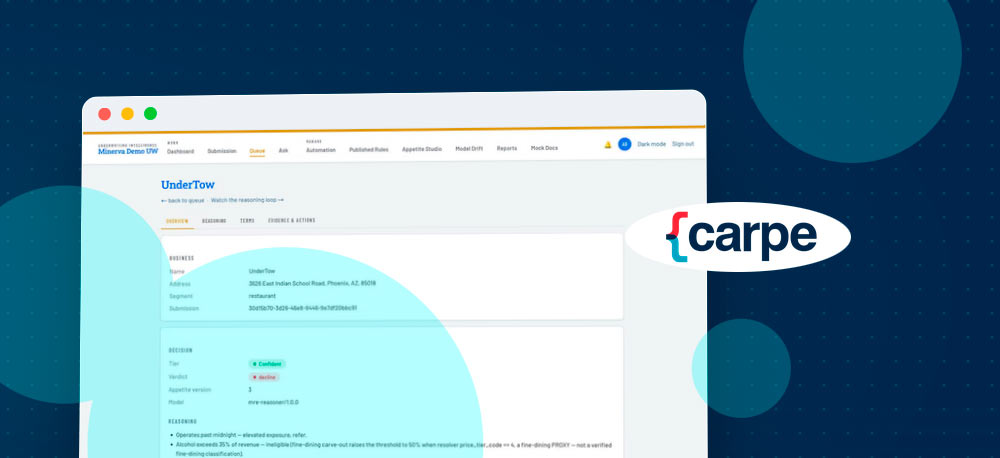
Carpe, a Santa Barbara-based AI-powered intelligence company, has launched the Minerva Reasoning Engine, an AI-native underwriting system built for small commercial insurance.
The platform uses live business intelligence to turn each carrier’s underwriting appetite into evidence-backed recommendations to quote, decline or refer a submission.
Small commercial underwriting carries a basic economic constraint. The time spent researching a business shouldn’t exceed the potential profit from writing the policy.
That puts pressure on insurers to move straightforward submissions faster while reserving underwriter judgment for harder risks.
Traditional workflows often slow the process through manual research, disconnected information and inconsistent application of underwriting appetite. Carpe designed Minerva around those operational gaps.
The system converts each carrier’s appetite into named rules that underwriters and underwriting teams can test.
Within a single workflow, Minerva identifies the business, enriches its profile and applies carrier-specific underwriting rules against current Carpe intelligence. It then returns a documented reasoning path linked to supporting sources.
That structure gives carriers a consistent way to evaluate submissions across different distribution channels. Human underwriters remain responsible for files requiring more judgment or unusual risk analysis.
“Carriers need better decisions from the data already available to them,” said Max Drucker, Chief Executive Officer at Carpe.
Carpe has spent more than a decade building commercial business intelligence. Minerva applies reasoning on top of those data assets so insurers can increase underwriting capacity without shifting complex risk decisions away from underwriters.
Max Drucker, CEO at Carpe
According to Beinsure, the system reduces underwriting touches by up to 25% by moving straightforward risks through automated workflows.
The company also says Minerva saves 30 to 45 minutes per submission by replacing manual company research with information prepared for underwriting decisions. Its models evaluate more than 200 business characteristics when determining whether a submission fits a carrier’s growth strategy. Carriers also receive access to more than 50 mn US business profiles.
Underwriting teams configure appetite rules across those records and adjust the logic in plain language when underwriting requirements change. Each recommendation includes source-backed evidence supporting the result.
The approach targets a common problem in small commercial insurance: carriers often possess substantial external and internal data, yet underwriters still spend time gathering facts before deciding whether a risk belongs within appetite.
Minerva moves that research and rule application into one underwriting process. Carpe said the platform is intended for commercial insurers seeking greater underwriting capacity and more consistent appetite decisions while controlling loss and expense performance.
The product fits into Carpe’s broader insurance technology business.
Its AI-native products convert online information and public records into intelligence used for underwriting, fraud detection and claims operations.
Carpe works with insurers that need business data tied directly to operational decisions rather than separate research tools.
With Minerva, the company is extending that model further into commercial underwriting, where speed matters most on smaller accounts and manual research quickly becomes expensive relative to premium size.
Carpe also launched Carpe Claims, a unified intelligence suite for property and casualty insurers, according to Beinsure. The product brings together the company’s claims data experience with newer AI tools built to work inside carrier systems, claims workflows and SIU operations.
The suite is available now and includes three new products: Carpe Case Management, Carpe Vision and Carpe AdWatch. They join updated versions of Carpe’s existing Online Injury Alerts and Investigative Reports products.
Carpe said its technology already runs in production with most of the 10 largest U.S. property and casualty carriers. The new suite gives insurers a broader operating layer for claims intelligence, with tools designed for adjusters, SIU teams and carrier-owned AI systems.