Overview
- Wall Street’s Dell stock price targets for 2026 and 2027
- Dell’s AI server orders reach $60.9 bn
- Global AI infrastructure spending supports Dell’s growth outlook
- Dell raises fiscal 2027 revenue forecast to $192 bn
- Dell’s PC business faces weaker global demand
- How expensive is Dell stock after its AI-driven rally?
- What could cause Dell Technologies stock to fall?
- Dell stock forecast: Can shares reach $650 or $735?
Dell Technologies (NYSE: DELL) enters October 12, 2026, with its shares trading near record highs, supported by exceptional demand for artificial intelligence infrastructure, accelerating server sales and substantial upward revisions to earnings expectations. The company’s latest financial results have strengthened the investment case, although its rapid share price appreciation has narrowed the potential upside implied by Wall Street’s consensus forecasts.
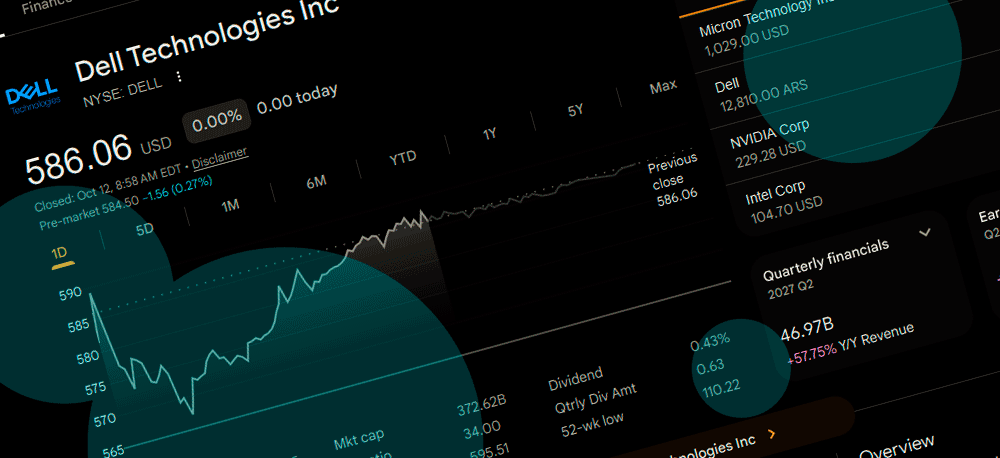
DELL closed the October 9 session at $586.06, advancing 2%, compared with a 0.59% gain for the S&P 500 and a 0.83% increase for the Dow Jones Industrial Average. The stock finished approximately 1.6% below its 52-week high of $595.51, reached on September 18.
The longer-term performance has been considerably stronger. Dell shares have appreciated almost eightfold over the past three years, substantially outperforming the Nasdaq Composite, which gained approximately 103% over the same period.
Much of this increase has followed Dell’s emergence as a major supplier of AI-optimized servers and data center infrastructure. Its traditional enterprise hardware business is also expanding, supported by demand for commercial computers, storage systems and server upgrades.
- Dell Technologies shares closed at $586.06 on October 9, 2026, gaining 2% for the session. The stock has risen sharply as investors price in accelerating demand for AI infrastructure and enterprise servers.
- Wall Street’s average 12-month price target stands at $571.12, with forecasts ranging from $289 to $735. Of 36 analysts covering Dell, 28 recommend buying or strongly buying the stock, although the consensus target is below its latest closing price.
- Dell reported record fiscal Q2 2027 revenue of $47 bn, up 58%, alongside $60.9 bn in AI server orders and a $95 bn backlog. Management raised full-year revenue guidance to $192 bn and projected $74 bn in AI server sales.
Wall Street’s Dell stock price targets for 2026 and 2027
Analyst sentiment remains predominantly positive, but forecasts differ considerably on how much further Dell shares can rise.
MarketBeat’s aggregation of 36 Wall Street analysts gives Dell a consensus rating of Moderate Buy, with an average 12-month price target of $571.12. That implies approximately 2.5% downside from the October 9 closing price.
Other market data providers calculate somewhat higher averages. Yahoo Finance and Investing.com report consensus targets close to $586, broadly in line with the stock’s latest closing price. The differences reflect the number of analysts included and the methodologies used to calculate their forecasts.
Individual investment banks have adopted substantially different positions.
- Mizuho raised Dell price target from $600 to $650, maintaining an Outperform rating. The revised forecast implies approximately 11% upside from the latest closing price.
- Melius Research has one of the most optimistic forecasts, with a $735 target established in September. JPMorgan projects $635, Evercore ISI targets $650, and RBC Capital Markets has a $640 forecast.
- Goldman Sachs maintains a Buy rating with a $570 price target, reaffirmed on October 9. That assessment remains favorable toward Dell’s business prospects even though the target is slightly below the prevailing share price.
- More cautious forecasts include Morgan Stanley’s $511 target and Equal Weight rating, and TD Cowen’s $550 target with a Hold recommendation.
The broad range of analyst expectations, extending from $289 to $735, reflects substantial uncertainty about Dell’s future earnings growth and the valuation investors may assign to its AI infrastructure business.
The upper end of that range implies approximately 25% appreciation from $586.06. Reaching those levels would likely require continued strong AI server orders, execution against the company’s raised financial guidance and confidence that elevated infrastructure spending will persist.
Dell’s AI server orders reach $60.9 bn
Dell’s latest results provide the strongest evidence supporting the positive analyst outlook.
For the second quarter of fiscal 2027, which ended July 31, 2026, the company reported record revenue of $46.97 bn, increasing 58% from $29.78 bn in the corresponding period a year earlier.
GAAP diluted earnings per share reached $6.34, up 273%, while non-GAAP diluted EPS increased 203% to $7.04. Operating cash flow totaled $2.2 bn.
The Infrastructure Solutions Group (ISG), which includes servers, networking and storage, was the principal growth driver. Segment revenue increased 89% to a record $31.8 bn.
Within ISG, AI-optimized server revenue doubled to $16.4 bn, traditional servers and networking revenue increased 122% to $10.5 bn, and storage revenue rose 26% to $4.9 bn.
Infrastructure operating income reached $4.8 bn, an increase of 225% year over year. Dell booked $60.9 bn in AI server orders during the quarter and ended the period with an order backlog of $95 bn. Orders over the preceding 12 months totaled $131.7 bn.
Management also indicated that its broader AI server sales pipeline was several times larger than the outstanding backlog.
These figures provide visibility into future deliveries, although the timing of revenue recognition depends on manufacturing capacity, component availability, customer deployment schedules and the fulfillment of existing contracts.
Jeff Clarke, Dell’s vice chairman and chief operating officer, said the company was benefiting from increased customer investment across AI servers, traditional computing infrastructure and storage.
The growth has also strengthened Dell’s position in the global server market. According to IDC’s September 2026 research, Dell held a 13.4% share of worldwide server vendor revenue in the second calendar quarter, up from 7.7% a year earlier.
Dell’s server vendor revenue in IDC’s market tracker increased 165.4% year over year, substantially faster than the overall market’s 52% expansion. This made Dell the largest branded server supplier by revenue in the research firm’s ranking.
Global AI infrastructure spending supports Dell’s growth outlook
Industry forecasts suggest that the market for AI computing infrastructure could expand substantially beyond current levels.
TrendForce projects global AI server shipments will increase nearly 31% in 2026, having raised its earlier forecast of 28%. The research firm expects the combined capital expenditure of the world’s nine largest cloud service providers to grow approximately 90% year over year to more than $886.7 bn.
These companies include Microsoft, Amazon, Google, Meta, Oracle, ByteDance, Tencent, Alibaba and Baidu.
TrendForce expects their combined investment to reach approximately $1.3 trillion in 2027, supported by demand for GPU infrastructure, custom AI accelerators, advanced networking and liquid-cooling systems.
IDC’s September research provides further evidence of market expansion. Worldwide server revenue increased 52% to a record $166.3 bn in the second quarter of 2026.
GPU-accelerated servers generated $87.4 bn in revenue, accounting for approximately 52.6% of total server spending.
The distinction between revenue and unit growth is significant. Worldwide server shipments increased 15.4%, considerably below the 52% increase in revenue, reflecting a combination of stronger demand and rising average selling prices.
Goldman Sachs has projected that the AI server market could reach $1.24 trillion in annual revenue by 2030, with traditional servers contributing approximately another $164 bn.
These forecasts indicate the potential size of Dell’s addressable market, although they do not establish how much revenue the company will capture.
Dell’s future market share will depend on its competitiveness against traditional server manufacturers, specialized AI system suppliers and cloud companies developing proprietary hardware.
Dell raises fiscal 2027 revenue forecast to $192 bn
Management’s updated financial guidance points to continued rapid expansion. Dell increased its fiscal 2027 revenue forecast by $25 bn, from $167 bn to $192 bn. The new projection represents 69% growth from the preceding fiscal year.
The company also raised its AI-optimized server revenue guidance from $60 bn to $74 bn, implying growth of approximately 200%.
Full-year GAAP diluted EPS is projected at $24.37, compared with the previous outlook of $17.31. Non-GAAP diluted EPS guidance increased from $17.90 to $25.50.
These projections represent expected annual increases of 181% and 148%, respectively. For the third quarter of fiscal 2027, Dell expects revenue of approximately $49 bn, representing 81% year-over-year growth. Management projects GAAP diluted EPS of $6.10 and non-GAAP diluted EPS of $6.50.
Wall Street’s forecasts are somewhat more optimistic. Zacks Consensus Estimates project third-quarter revenue of $50.63 bn, representing an 87.47% increase from the corresponding period a year earlier. Consensus EPS of $6.63 would represent growth of 155.98%.
For the full fiscal year, Zacks analysts expect revenue of $195.68 bn and earnings of $26.09 per share. These figures imply annual growth of 72.35% and 153.3%, respectively.
Both revenue and earnings expectations exceed Dell’s latest management guidance.
Dell has also established a record of exceeding analyst estimates. In the fiscal second quarter, its reported revenue was approximately 3.6% above the prevailing consensus forecast, while adjusted EPS exceeded expectations by 41.65%.
The company has surpassed consensus EPS estimates in each of its last four reported quarters and revenue forecasts in three of those periods.
Dell’s PC business faces weaker global demand
The Client Solutions Group (CSG) provides a second source of revenue, including commercial PCs, consumer notebooks, desktops, workstations and related equipment.
Fiscal second-quarter revenue in this division increased 20% to $15 bn. Commercial client revenue rose 22% to $13.2 bn, while consumer revenue increased 7% to $1.8 bn. Segment operating income reached $1.1 bn, up 42% year over year.
These results demonstrate Dell’s ability to increase PC revenue despite challenging conditions in the broader personal computing market.
More recent industry data, however, indicates that demand has weakened considerably.
On October 8, IDC reported that worldwide PC shipments fell 20.1% year over year in the third calendar quarter of 2026, reaching 62.7 mn units.
The contraction followed a 3.8% decline in the preceding quarter. Shipments also decreased 9.1% sequentially, reversing the typical seasonal improvement in third-quarter demand.
Dell’s own worldwide PC shipments declined 25% to approximately 7.6 mn units during the quarter.
Its market share fell from 12.9% a year earlier to 12.1%, leaving the company in third place behind Lenovo and HP.
IDC attributed the broader contraction partly to customers and distribution partners bringing forward purchases earlier in the year to avoid anticipated component price increases. Memory shortages, elevated hardware prices and weaker demand subsequently reduced shipment volumes. The latest shipment data introduces an important qualification to Dell’s positive second-quarter CSG revenue results.
Higher average selling prices and a favorable product mix may support revenue even when unit shipments are declining, but prolonged weakness in PC demand could eventually constrain the segment’s growth.
IDC expects the global PC market to contract by approximately 11.3% for the full year and has pushed its anticipated recovery toward 2028.
How expensive is Dell stock after its AI-driven rally?
Dell’s valuation presents a more complicated picture than its recent earnings performance.
According to Zacks’ analysis, Dell trades at approximately 22.02 times forward earnings, broadly in line with the Computer – Micro Computers industry’s average forward price-to-earnings multiple of 22.02.
The company’s price-to-earnings-growth ratio, or PEG, stands at 0.57, compared with an industry average of 1.69.
A lower PEG ratio can indicate that a company’s valuation is relatively modest compared with its projected earnings growth. The measure depends heavily on forecast assumptions, however, particularly for businesses experiencing unusually rapid profit increases.
Dell also trades at approximately 2.4 times sales, compared with roughly 5.3 times for the Nasdaq Composite. That discount may appear attractive, but the comparison requires caution.
Dell is primarily a hardware and infrastructure supplier, and its profit margins, capital requirements and business model differ from those of many software and semiconductor companies represented in the index.
A lower sales multiple therefore does not automatically mean that Dell shares are undervalued. Analyst earnings revisions have supported the stock’s recent performance.
The ranking reflects favorable trends in earnings estimate revisions, rather than a guaranteed future return.
Recent financial results provide additional evidence of earnings expansion. Dell reported fiscal second-quarter GAAP operating income of $5.39 bn, compared with $1.77 bn a year earlier.
Non-GAAP operating income increased to $5.93 bn from $2.28 bn. Dell also returned a record $4.3 bn to shareholders through dividends and share repurchases during the quarter. Its board declared a quarterly dividend of $0.63 per common share, payable on October 30 to shareholders of record on October 20.
What could cause Dell Technologies stock to fall?
The principal risks are related to AI infrastructure spending, component supply, profitability and the valuation investors are prepared to assign to future earnings.
Dell’s $95 bn AI server backlog indicates strong contracted demand, but converting those orders into revenue requires access to processors, high-bandwidth memory, networking equipment and other components.
Higher memory prices can increase server selling prices and reported revenue, but they also introduce cost pressures and potential delivery constraints.
IDC has identified power availability, cooling capacity and data center readiness as additional obstacles to the pace of AI server deployments.
Profitability is another consideration. AI servers can generate substantial revenue because they incorporate expensive processors and other components, but high sales volumes do not necessarily produce proportionate increases in gross profit.
Changes in product mix, pricing competition or component costs could reduce margins even if AI infrastructure revenue continues to grow.
Longer-term demand also depends on whether major technology companies can generate sufficient financial returns from their AI investments.
Goldman Sachs and other research firms expect substantial additional infrastructure spending through 2027, but a reduction in cloud capital expenditure would create risks for server suppliers.
Dell’s exposure to the traditional PC market introduces a separate challenge, particularly after the 25% decline in its worldwide PC shipments during the third calendar quarter.
The stock’s price performance increases sensitivity to these risks. Following its extensive rally, even results that meet management guidance could disappoint investors if market expectations have moved substantially higher.
Dell stock forecast: Can shares reach $650 or $735?
The range of current analyst forecasts offers several reference points for Dell’s potential performance over the next 12 months.
A price near $511 to $550 would be consistent with the more cautious published forecasts from Morgan Stanley and TD Cowen, reflecting a scenario in which growth expectations remain positive but the market applies a less generous valuation.
The $570 to $600 range includes forecasts from Goldman Sachs, Citigroup and Bank of America, suggesting limited appreciation from Dell’s October 9 closing price.
A move toward $635 to $650 would align with the targets established by JPMorgan, RBC Capital Markets, Mizuho and Evercore, implying further gains of approximately 8% to 11%.
Melius Research’s $735 forecast represents a more optimistic assessment, requiring appreciation of approximately 25%. These are analyst price targets rather than guaranteed trading ranges. Their accuracy will depend on future earnings revisions, operating performance and market conditions.
The next quarterly results will be particularly important because analysts are already forecasting stronger revenue and earnings than Dell’s own guidance.
- Investors will be assessing whether the company can exceed the $50.63 bn consensus revenue estimate, sustain its high level of AI server bookings and convert its $95 bn backlog into profitable deliveries.
Dell’s fiscal 2027 revenue forecast of $192 bn and AI server revenue target of $74 bn establish demanding operating benchmarks.