- Harbor has raised $10 mn in seed funding from Base10 Partners, Abstract and 8VC to develop a platform for managing and insuring enterprise AI agent risks.
- The platform identifies AI agents, monitors operational, security and regulatory exposures, blocks unauthorized decisions and provides insurance for remaining risks.
- Harbor targets banks, insurers and other regulated businesses across the US, Europe and Latin America as AI liability concerns and insurance exclusions increase.
San Francisco-based Harbor has emerged from stealth with $10 mn in seed funding from Base10 Partners, Abstract and 8VC to develop an enterprise platform that helps organizations identify, measure, mitigate and insure risks associated with autonomous AI agents.
The company works with banks, insurers and other regulated businesses in the United States, Europe and Latin America. Its platform combines continuous monitoring of AI agents with insurance protection against losses caused by their decisions or failures.
As companies delegate loan approvals, insurance pricing, financial transactions and customer advice to AI agents, questions about liability and insurance coverage are becoming more difficult to resolve.
Professional liability, cyber and technology errors and omissions (E&O) policies traditionally cover certain losses arising from employee mistakes and software failures. The growing use of autonomous agents introduces exposures that existing policies may not adequately address.
Insurers also lack the historical claims data needed to estimate how frequently AI agents fail and how severe the resulting losses could be. Since January 2026, insurers have been able to attach standardized generative AI exclusions to US general liability policies.
In more than twenty years placing risk for some of the largest companies in Europe, I have not seen a new exposure arrive this fast with this little data or understanding behind it
Eduardo Dávila, former CEO of Aon EMEA, board member of Santander Insurance Holding and executive advisor to Harbor
“Insurers cannot price what nobody measures. Harbor is pairing the insurance with the tools to understand and reduce the risk first.”
Recent incidents illustrate the potential consequences of AI failures. In 2024, a Canadian tribunal ordered Air Canada to honor a refund policy incorrectly provided by its chatbot. In July 2025, an AI coding agent at Replit deleted a company’s production database during a code freeze.
Autonomous agents can repeat incorrect decisions across multiple transactions before errors are detected. Their risk profiles also change when underlying models, connected tools or data are updated, limiting the usefulness of assessments performed at a single point in time.
Regulatory scrutiny is increasing. On July 7, 2026, the European Central Bank asked banks under its supervision to prepare board-approved plans addressing AI-enabled threats by the end of October.
Harbor combines AI risk monitoring with insurance
Harbor’s platform has two components: risk management technology and insurance coverage. The risk management system identifies AI agents operating within an organization and creates an inventory of their activities. It assesses operational, security and regulatory exposures using a framework developed with research and enterprise partners.
Harbor monitors agents’ decisions against company-specific rules and blocks actions that violate those requirements before execution. It also reassesses risks whenever an agent’s model, tools or data change.
The framework incorporates established standards and requirements, including the NIST AI Risk Management Framework, SR 26-2 and the EU AI Act.
The second component provides insurance for residual risks that remain after preventive measures have been applied. Harbor’s approach is intended to give insurers the information needed to assess exposures for which historical loss data is limited.
The company argues that combining insurance with monitoring creates an additional incentive to maintain effective risk controls, since insurers bear the financial consequences of covered losses.
Companies need to understand the risk of their agents, and at the current pace of adoption and development, assessing the risk at a specific point in time seems useless. There is a need for an innovative solution for managing the risk in real time.
Jesús Santos, co-founder of Harbor
“You have to be inside the agent, every decision, all the time, and put your own money behind the answer. That is what lets our clients stop asking whether an agent is safe enough to deploy and start asking how far they can let it go.”
The role of insurance in managing advanced AI risks has also attracted international attention. On September 23, AI researcher Yoshua Bengio told the UN Security Council that frontier AI should be licensed similarly to medicine, aviation and nuclear energy, adding that “as in these domains, liability insurance should be required.”
Harbor founders and investors
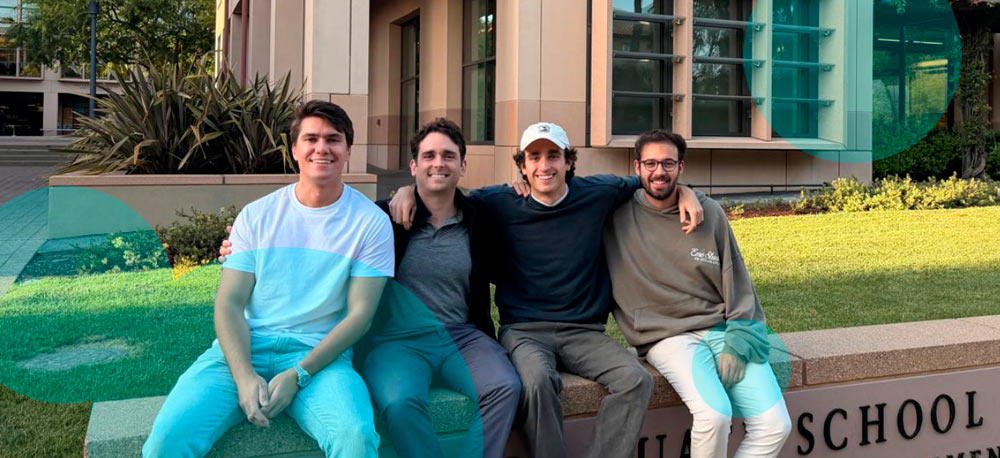
Santos is a La Caixa Fellow and Stanford Management Science and Engineering graduate who previously worked at Morgan Stanley, McKinsey and agentic payments company Crossmint. Elechiguerra studied at MIT and Stanford and worked at McKinsey & Company and Citadel.
Bartolomé previously founded Pulsar and Factored and has a decade of AI experience. He co-developed the Introduction to Machine Learning in Production course with Andrew Ng at DeepLearning AI and holds a master’s degree in Robotics from Stanford.
Botín holds a bachelor’s degree in Mathematical and Computational Science and a master’s degree in Computer Science from Stanford, specializing in AI safety and agent risk.
Harbor’s team includes former founders, International Mathematical Olympiad and International Olympiad in Informatics medalists, professional athletes and competitive programming champions. The company is headquartered in San Francisco, with employees across the US and Europe.