Follow Beinsure
Catastrophe risk modeling firm Karen Clark & Company (KCC) has estimated that Hurricane Isaias generated approximately $3 bn in privately insured losses in the United States, following its landfall on Florida’s Gulf Coast in October 2026.
The estimate is based on the high-resolution KCC US Hurricane Model and covers insured damage caused by hurricane winds and storm surge.
- KCC estimates Hurricane Isaias caused $3 bn in privately insured US losses from wind and storm surge, including property damage, automobile claims and business interruption.
- Isaias made landfall near Destin, Florida, on October 9, 2026, as a Category 2 hurricane with sustained winds of 105 mph and a peak storm surge of approximately 8 feet.
- The most severe damage occurred across the Florida Panhandle, particularly Destin, Pensacola Beach, Navarre, Milton and Pace, with widespread structural damage and electricity outages.
The modeled losses include damage to residential, commercial and industrial properties, automobiles and business interruption claims.
The estimate excludes losses involving boats, offshore properties and flood damage covered by the National Flood Insurance Program (NFIP).
KCC’s assessment is higher than the $1 bn to $2 bn insured loss range previously estimated by Verisk. Cotality placed the storm’s insured losses between $2 bn and $3 bn, while insurance-linked securities investment manager Euler ILS Partners estimated industry losses of $2 bn to $4 bn.
The estimates remain preliminary and may change as insurers process claims and obtain more detailed damage information.
Hurricane Isaias reached Category 3 before Florida landfall
Hurricane Isaias was the ninth named storm of the 2026 Atlantic hurricane season and the first to reach hurricane intensity. The storm became a hurricane on October 7, making it the latest first hurricane of an Atlantic season on record, according to KCC.
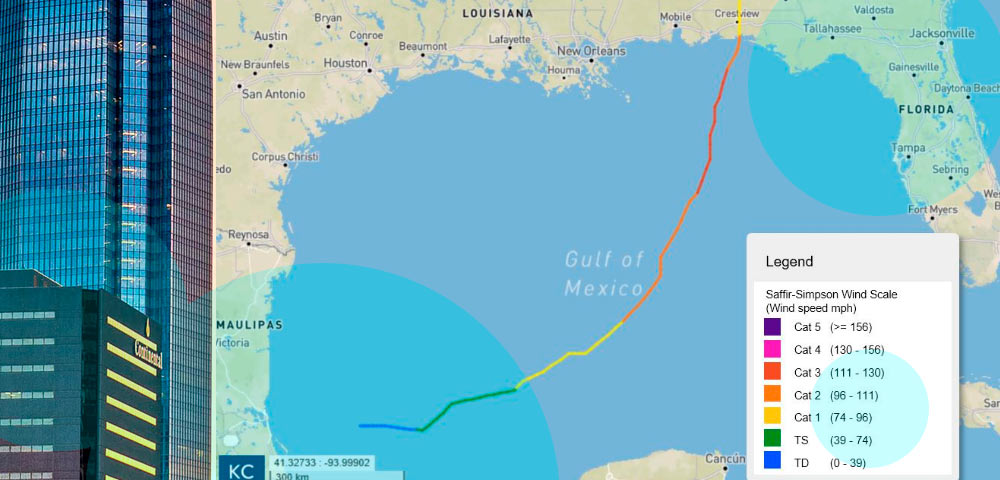
Isaias developed from an area of low pressure over the southwestern Gulf of Mexico in early October. Warm ocean temperatures and high atmospheric humidity created favorable conditions for rapid strengthening.
The system reached tropical storm intensity early on October 7 before intensifying from maximum sustained winds of 40 mph to 80 mph, becoming a Category 1 hurricane shortly before midnight.
After turning northeastward, Isaias underwent a second period of rapid intensification, strengthening from 80 mph to 120 mph and reaching Category 3 intensity on October 9.
Increasing wind shear subsequently weakened the hurricane as it accelerated toward the Florida Panhandle.
The storm’s structure became increasingly asymmetric, with its strongest winds concentrated north and northwest of the eye as the eyewall began to deteriorate.
Isaias made landfall near Destin, Florida, at approximately 8:30 p.m. Central Daylight Time on October 9, with maximum sustained winds of 105 mph.
The National Hurricane Center confirmed the Category 2 landfall, with an estimated central pressure of 971 millibars.
The hurricane made landfall on October 10 in Coordinated Universal Time, the same calendar date as Hurricane Milton in 2024 and Hurricane Michael in 2018.
After crossing the coast, Isaias moved into southern Alabama and weakened rapidly, becoming post-tropical during the morning of October 10.
Despite losing its tropical characteristics, the system continued producing tropical storm-equivalent winds as it traveled through Alabama and into the Tennessee Valley.
By October 11, Isaias had weakened to tropical depression strength over Tennessee before dissipating over Kentucky.
Florida Panhandle suffered severe wind and storm surge damage
According to KCC, the most severe hurricane impacts were concentrated in coastal communities along the Florida Panhandle, including Destin, Pensacola Beach and Navarre.
The storm produced a peak surge of approximately 8 feet, compounding the damage caused by destructive winds. Significant property losses were also reported around Pensacola Bay, particularly in Milton and Pace.
Milton, located approximately 20 miles inland from the Florida Panhandle coast, experienced extensive damage to buildings and numerous fallen trees.
KCC reported partial and complete roof failures affecting single-family homes, multifamily residential buildings, motels, grocery stores and other commercial properties.
The damage extended beyond low-rise structures. In Pensacola Beach, several mid-rise and high-rise buildings sustained damage to exterior wall siding and cladding.
Numerous gas stations in coastal communities were also destroyed, illustrating the severity of the wind impacts on exposed commercial structures.
Electricity outages affected large areas of Florida and Alabama, while damage from the hurricane’s outer rainbands extended into western Georgia, where strong winds brought down tree limbs and disrupted power infrastructure.
Isaias expected to be manageable for US insurers
Although Hurricane Isaias caused substantial damage in affected communities, its estimated insurance losses are not expected to materially weaken the broader US property and casualty insurance industry.
AM Best characterized the storm as an earnings event rather than a capital or solvency event for insurers, indicating that the expected claims burden should remain manageable relative to industry financial resources.
The rating agency also indicated that Isaias was unlikely to reduce insurer surplus sufficiently to trigger a broad contraction in capacity or a significant market-wide increase in insurance prices.
However, the financial impact will differ among insurers according to their exposure to properties in the Florida Panhandle, their reinsurance arrangements and their concentration of business in affected areas.
KCC’s $3 bn estimate provides an initial measure of the private insurance market’s exposure to Isaias, while the final industry loss will depend on the development of property, automobile and business interruption claims in the months following the storm.