Follow Beinsure
StitcherAI has launched its IT finance system of intelligence and announced $3 mn in pre-seed funding. Founders Co-op led the round, with participation from Sunshine Lake VC, Ascend, and Plug & Play Ventures.
The company says its platform gives financial context to every technology investment decision made by people or AI agents. It is built to help organizations assess IT spend in real time, before costs arrive through invoices.
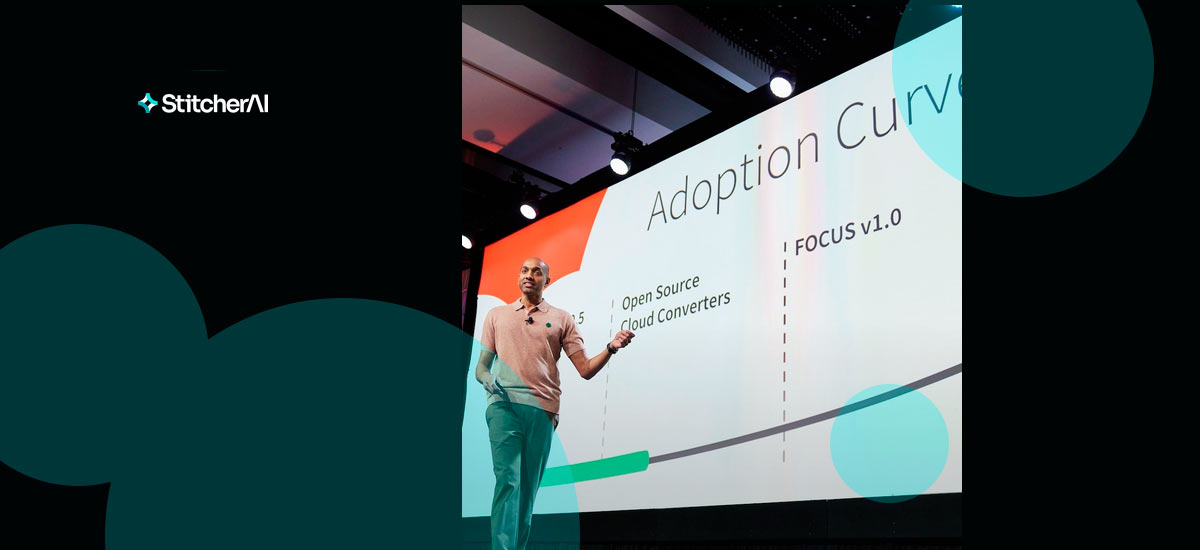
StitcherAI embeds business context into enterprise decision systems. Its semantic engine is built on FOCUS, the open billing standard adopted by AWS, Azure, and Google.
The company said its founder helped co-create FOCUS. The engine unifies cloud, AI, SaaS, vendor data, and cost models into business terms used by boards and finance teams. Those terms include products, customer segments, margins, unit economics, forecasts, and cost controls. The intelligence then flows into data lakes, BI platforms, JIRA, Slack, and ERP systems already used by customers.
StitcherAI also uses a reasoning engine made up of specialised agents. Those agents bring organization-specific financial context into agentic workflows and AI platforms such as Claude, Cursor, and Codex.
The company frames the shift as moving IT finance from invoice review to decision support. Instead of managing cost after spend occurs, the platform is designed to guide decisions as IT dollars are committed.
StitcherAI argues that engineers and agents now commit spend faster than finance teams can track. Agentic workflows can route to different tools, models, and vendors, each with separate pricing and token economics.
That makes unit cost variable from request to request. Older IT finance tools rely on engineers tagging spend, finance teams policing usage, and stakeholders checking dashboards.
Founder and CEO Udam Dewaraja said he saw the problem while leading global IT finance at Citi. He said humans and agents often did not check existing dashboards before committing spend, and they lacked access to relevant data.
Dewaraja said StitcherAI uses AI to automate low-impact decisions. It also gives business-aligned financial intelligence to people making higher-order IT investment decisions.
”I witnessed this problem firsthand while leading global IT Finance at Citi,” said Udam Dewaraja. “Humans and agents didn’t check the dashboards of existing tools when committing spend and often didn’t have access to all the relevant data. With StitcherAI, we reimagined how organizations manage modern IT spend using AI to automate low impact decisions while providing business-aligned financial intelligence for humans to make higher order IT investment decisions.”
During beta, StitcherAI worked with several customers spending nine figures on cloud and AI. One customer was a Fortune 500 employment marketplace with rapidly growing AI spend.
The company said beta customers reduced the cost of building and maintaining internal IT finance infrastructure by 80%. They also reached time-to-value 85% faster.
Founders Co-op Managing Partner Chris DeVore said AI ROI has become a board-level issue. He said IT finance tooling that can answer ROI questions with confidence is now mission critical.
IBM research cited by StitcherAI found that only 25% of AI initiatives have delivered expected ROI in recent years. It also found that only 16% have scaled across the enterprise.
The gap is widening as engineers and autonomous agents make architecture and infrastructure decisions in seconds. Existing IT finance governance often still works on weekly review cycles.
StitcherAI said this creates a pattern where AI and IT spend is committed without clear ROI context. Finance teams then have to react after invoices arrive.
The company also pointed to risks from agentic workflows taking unintended execution paths or producing unexpected outputs. Those failures can create cost exposure that older governance tools were not designed to catch.
Fortune 100 companies are spending 18 to 24 months and mn in labor costs to build internal IT spend controls, according to StitcherAI. The company says that approach is too slow and expensive for many enterprises now facing rising AI and IT investment.
Tim Crawford, CIO strategic advisor at AVOA and a member of The Wall Street Journal Technology Council, said CIOs and CFOs are shifting their questions. They are asking which AI investments produce returns, which ones should scale, and which ones should stop.
Crawford said enterprises need financial context inside workflows at the point of decision for both humans and agents. He said StitcherAI was built for that model.