- AI strengthens life insurance distribution and adviser productivity
- AI underwriting reduces friction at the point of sale
- Customer engagement becomes a competitive priority
- Digital distribution increases competition for customer relationships
- Human expertise remains essential in AI-driven life insurance
Artificial intelligence and digital technology are changing how life insurers distribute policies, assess risks and manage customer relationships. Insurers are using AI to support advisers, accelerate underwriting, simplify onboarding and maintain contact with policyholders after a sale.
Swiss Re Institute reviewed 197 publicly reported AI and technology initiatives undertaken by leading global life insurers and selected intermediaries between 2022 and 2026. The research examined applications across the insurance sales journey, including advice, quotation, underwriting, customer servicing and claims.
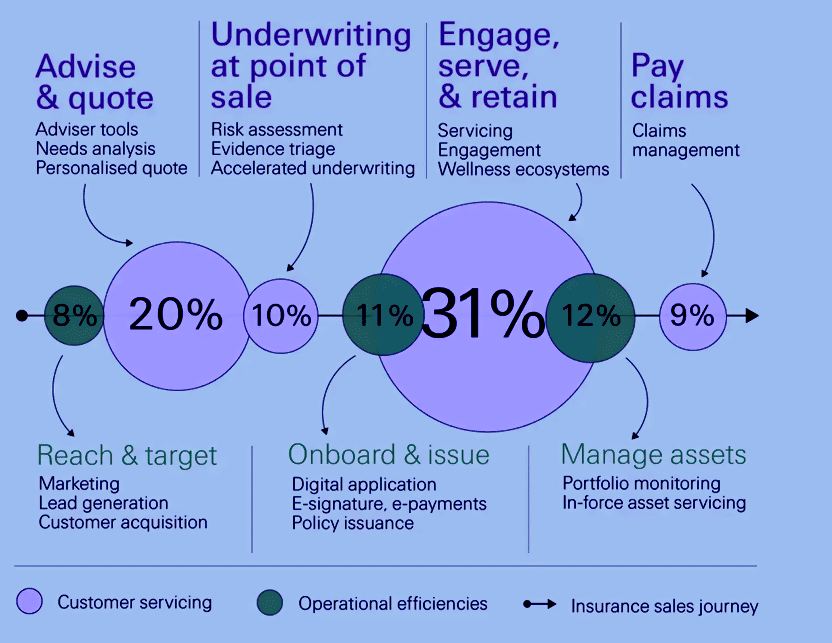
Customer engagement, servicing and retention accounted for 31% of reported initiatives, while advice and quotation represented another 20%.
The findings suggest that insurers are investing in technology to improve customer interactions throughout the policy lifecycle, rather than concentrating exclusively on sales automation.
AI strengthens life insurance distribution and adviser productivity

AI is increasingly being applied to established life insurance distribution channels, helping insurers and intermediaries identify prospective customers, prepare quotations and manage administrative requirements.
Technology can assist advisers in identifying consumers more likely to purchase coverage, researching products and providing relevant information during customer conversations.
Automating routine activities also allows advisers to spend more time working directly with clients.
AI-supported product research, comparison and administration can reduce operational demands on intermediaries, particularly those distributing products from multiple insurers.
Independent intermediaries may benefit significantly because they must compare coverage, prices and product features across several providers while managing compliance and documentation requirements.
AI can simplify these processes, allowing advisers to handle more customer enquiries without a proportional increase in administrative work.
For life insurers operating through independent distribution networks, ease of doing business is becoming an important competitive factor. 67% of US independent insurance agents use AI, while trust and innovation drive carrier partnerships and satisfaction diverges across P&C insurance lines.
Share of reported AI initiatives across the life insurance sales journey
Insurers compete on more than pricing and policy features. The speed and simplicity of obtaining quotations, completing underwriting and administering policies can influence which providers intermediaries recommend.
Insurers that make their products easier to research, quote and administer may improve their position in open distribution channels without changing the underlying insurance coverage.
AI underwriting reduces friction at the point of sale
Technology is also changing how underwriting fits into the life insurance purchasing process.
AI-supported systems can bring risk assessment and underwriting decisions closer to the initial customer interaction, potentially reducing the time between application and policy issuance.
Faster decisions can improve the customer experience and reduce the likelihood that applicants abandon the process before obtaining coverage.
Moving underwriting closer to the point of sale can help insurers shorten application timelines and reduce customer drop-off during the purchasing process (see about Agentic AI in Insurance).
Digital onboarding provides additional opportunities to simplify information collection and reduce manual administration.
These improvements can make life insurance more accessible to consumers who expect financial services to offer faster and less complicated digital processes.
AI can also support advisers with needs analysis, product explanations and scenario modelling, providing information that helps customers understand available protection options.
Technology can accelerate routine underwriting and improve decision support, but human oversight remains necessary when automated assessments affect insurance eligibility or customer outcomes.
For more complex financial decisions, advisers continue to provide interpretation and judgement that automated systems may not adequately replicate.
Customer engagement becomes a competitive priority

Swiss Re Institute’s research indicates that customer engagement, servicing and retention represent the largest category of AI and technology initiatives, accounting for 31% of the 197 cases reviewed.
Traditional engagement often focuses on promotional offers and product notifications. More developed approaches can provide information about customers’ financial or personal goals, while broader programmes connect insurance services with health, wellness and other aspects of financial wellbeing.
Digital engagement can extend beyond policy administration to wellness programmes, rewards and services that help insurers maintain relationships with customers throughout the policy lifecycle.
Digital platforms give insurers additional opportunities to communicate with policyholders after coverage has been issued.
These interactions may also help insurers identify changes in customers’ protection requirements.
As policyholders move through different life stages, their health, family circumstances and retirement needs can change. Continued engagement creates opportunities for insurers to offer relevant information and support.
Insurers that remain connected to policyholders after the initial sale may gain additional opportunities to address changing protection, health and retirement needs.
The ability to maintain these relationships could become particularly valuable as digital services make it easier for customers to interact with several financial providers.
Digital distribution increases competition for customer relationships
Digital technology gives life insurers greater opportunities to engage directly with consumers, including those who purchase products from multiple providers. This can alter relationships between insurers, independent intermediaries and other distribution partners.
Where intermediaries traditionally manage much of the customer relationship, digital platforms allow insurers to provide services, communicate directly and participate in subsequent financial decisions.
Greater direct engagement creates competition over which insurer, intermediary or digital platform maintains the primary customer relationship.
The implications extend beyond policy sales. Access to customer interactions can influence future product recommendations, servicing arrangements and opportunities to meet additional protection requirements.
Insurers must therefore consider how technology affects both their distribution partnerships and their ability to retain customers (see US Life Insurers Face Rising Investment Risks).
AI may improve the efficiency of traditional distribution while giving insurers additional ways to reach customers independently of established sales channels.
Swiss Re’s findings suggest that technology can strengthen existing intermediated channels while creating alternative routes for direct engagement.
Human expertise remains essential in AI-driven life insurance
Despite advances in automation, Swiss Re Institute expects AI to support rather than fully replace human expertise in life insurance distribution.
Automated systems can assist with product explanations, needs assessments, quotations and scenario analysis.
Advisers remain important where financial decisions involve complex circumstances, competing objectives or significant long-term commitments.
Human oversight is also necessary when AI influences underwriting decisions, insurance recommendations or customer outcomes.
AI can improve the speed and consistency of insurance processes, but complex financial advice and consequential underwriting decisions continue to require human judgement.
The research points to a distribution model in which insurers and intermediaries combine digital capabilities with professional advice.
For insurers, the practical challenge is to improve efficiency without weakening the service quality, regulatory controls and customer relationships on which life insurance distribution depends.
The competitive value of AI in life insurance lies in combining faster digital processes with effective advice, underwriting controls and sustained customer engagement.