Overview
- Alphabet trades at a discount to Microsoft, Apple and Meta
- Google Cloud revenue jumps 82% as enterprise AI demand accelerates
- Google Cloud backlog reaches $514 bn
- Alphabet’s AI strategy extends beyond Google Cloud
- Alphabet’s 17.3 P/E ratio requires closer examination
- Alphabet raises AI capital spending forecast to $205 bn
- Alphabet’s balance sheet provides financial flexibility
- GOOGL stock forecast for 2026 and 2027
- Alphabet’s next earnings report will test its AI investment strategy
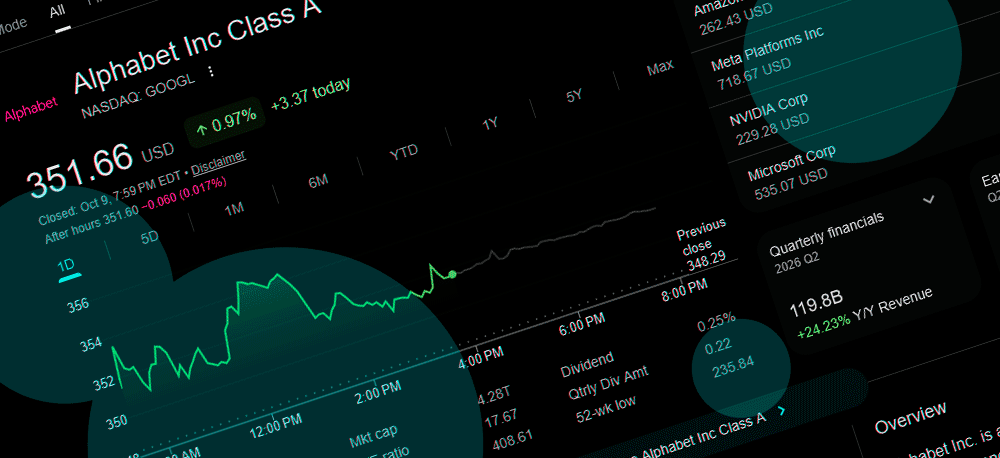
Alphabet (NASDAQ: GOOGL) shares ended the latest trading session at $351.66 on October 9, 2026, up $3.37, or 0.97%, as investors continued to assess the company’s accelerating cloud revenue, artificial intelligence investments and comparatively low earnings valuation.
Wall Street’s outlook remains predominantly positive. Among 62 analysts covering Alphabet, 57 have buy-equivalent ratings and five recommend holding the shares. The average 12-month price target stands at $429.47, implying potential appreciation of 22.13% from the latest close.
The median target is $430, while individual forecasts range from $340 to $515. These estimates represent analysts’ expectations rather than guaranteed future prices.
- Alphabet (NASDAQ: GOOGL) closed at $351.66 on October 9, 2026, gaining 0.97% for the session. Wall Street’s average 12-month price target of $429.47 implies 22.1% upside, with analyst estimates ranging from $340 to $515.
- Google Cloud revenue surged 82% to $24.8 bn in Q2 2026, while Alphabet’s total revenue increased 24% to $119.8 bn. Cloud backlog reached $513.9 bn, supporting future revenue visibility as enterprise demand for AI infrastructure accelerates.
- Alphabet’s reported trailing P/E of 17.3 is the lowest among six major technology peers, but unrealized investment gains inflate net earnings. Management’s $195 bn–$205 bn capital expenditure forecast and pressure on free cash flow remain major valuation risks.
Recent brokerage actions reinforce that relatively favorable assessment. BMO Capital reiterated its buy rating and $465 target on October 9, while RBC Capital maintained a $425 target. Needham has a $450 objective, and Wells Fargo increased its target from $411 to $417 on October 6. Yorkville Ives initiated coverage with a buy rating and $400 target on October 7.
Shorter-term technical forecasts are more restrained. StockInvest downgraded Alphabet from Buy to Hold/Accumulate in its October 9 assessment, assigning a technical score of 0.77 on a scale ranging from -10 to +10. Its three-month trend model projects a 1.54% decline, indicating a less favorable near-term outlook than Wall Street’s 12-month consensus.
The difference reflects the distinct methods and investment horizons involved. Brokerage targets generally incorporate assumptions about future earnings, revenue growth and valuation, whereas technical projections emphasize historical trading patterns and price momentum.
Alphabet’s latest results provide considerable support for the longer-term growth argument, but its rising infrastructure costs and unusually large investment gains complicate the valuation.
Alphabet trades at a discount to Microsoft, Apple and Meta
Alphabet’s reported valuation remains unusually low relative to several large technology companies with comparable growth characteristics.
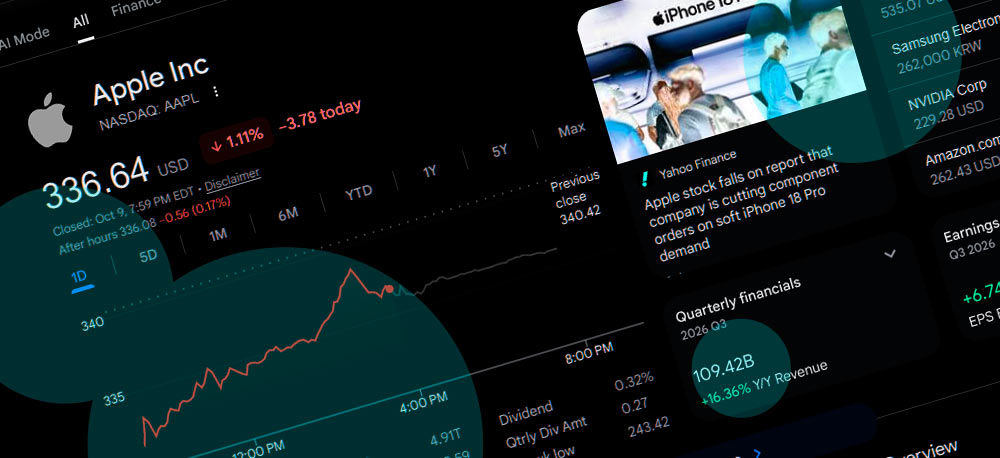
Alphabet generated 20.1% revenue growth over the trailing 12 months, compared with Apple’s 14.2%. Their operating profitability was nearly identical, with margins of 33.1% for Alphabet and 33.2% for Apple.
Microsoft recorded revenue growth of 17.8% and an operating margin of 46.8%, while Amazon generated 15.8% growth with a 12.1% margin. Netflix reported 16.0% revenue growth and a 29.7% operating margin.
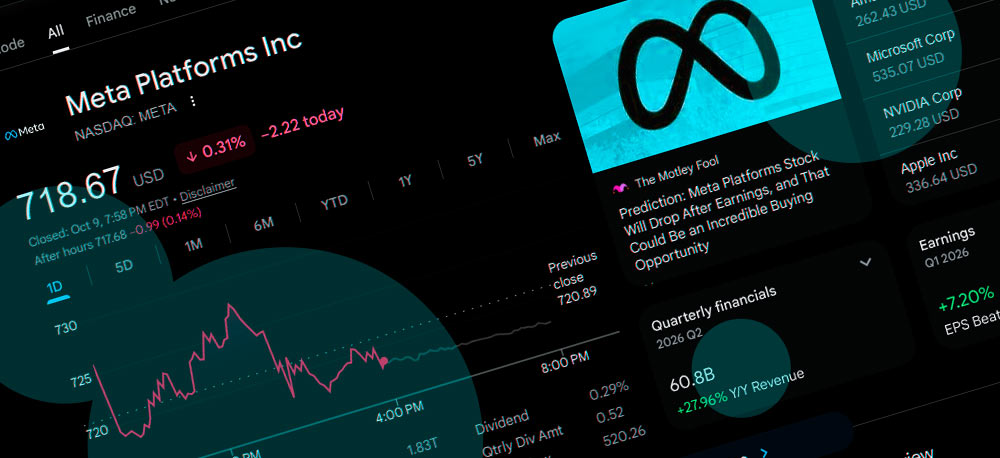
Meta was the only company in the comparison growing faster than Alphabet, with revenue increasing 27.7% and its operating margin reaching 38.1%.
Alphabet also delivered the strongest 12-month share price performance among the six companies. Its 42.1% gain compared with Apple’s 33.2%, Amazon’s 14.6%, Microsoft’s 0.6% and Meta’s 1.4%. Netflix shares declined 39.9% over the same period.
The figures suggest that Alphabet’s operating growth compares favorably with several more highly valued peers. They do not, however, establish that the stock is necessarily undervalued.
A significant portion of Alphabet’s reported earnings comes from investment gains rather than recurring income from its operating businesses.
Google Cloud revenue jumps 82% as enterprise AI demand accelerates
Alphabet reported consolidated revenue of $119.8 bn for the second quarter of 2026, an increase of 24% year over year, or 23% in constant currency. The company has now recorded 12 consecutive quarters of double-digit revenue growth.
Google Cloud was the principal growth driver, generating $24.768 bn in quarterly revenue, up 82% from $13.624 bn a year earlier.
Management attributed the acceleration to enterprise demand for AI infrastructure, AI solutions and traditional Google Cloud Platform services.
The cloud business also delivered substantial operating profit growth. Segment operating income reached $8.814 bn, compared with $2.826 bn in the corresponding quarter of 2025.
These results indicate that Google Cloud is increasing its contribution to Alphabet’s operating earnings, although its continuing expansion requires substantial investment in computing infrastructure.
Cloud revenue represented approximately 21% of Alphabet’s consolidated second-quarter sales, compared with roughly 15% of annual revenue in 2025.
- Google Services remained the company’s largest business, generating $94.5 bn in quarterly revenue, up 15% from a year earlier.
- Google Search and related advertising revenue increased 17% to $63.271 bn. YouTube advertising revenue rose 13% to $11.055 bn, while Google subscriptions, platforms and devices revenue grew 15% to $12.911 bn.
- Total Google advertising revenue reached $81.629 bn, demonstrating the continued financial importance of the company’s established search and advertising operations.
Alphabet’s combination of advertising, subscriptions, cloud services and AI products provides several independent sources of revenue. It also gives the company an existing customer base and distribution infrastructure through which new AI services can be introduced.
Google Cloud backlog reaches $514 bn
One of the most consequential figures in Alphabet’s second-quarter results was the expansion of its contracted revenue backlog.
Total remaining performance obligations reached $519.5 bn as of June 30, 2026, including $513.9 bn attributable to Google Cloud.
Alphabet expects to recognize just over 50% of its backlog as revenue within the next 24 months, with the remainder recognized over subsequent periods.
The timing depends on contract duration, service delivery and customer consumption. The backlog therefore provides visibility into future revenue without guaranteeing precisely when each commitment will appear in reported sales.
The scale of these agreements indicates considerable demand for Google’s computing capacity and enterprise services.
It also helps explain management’s decision to increase spending on data centers, networking equipment and specialized AI processors.
The company must expand infrastructure capacity to fulfill customer commitments, creating a direct connection between the growth opportunity and its rising capital requirements.
Alphabet’s AI strategy extends beyond Google Cloud
Google’s competitive position in artificial intelligence depends on more than its ability to sell cloud infrastructure. The company develops its Gemini model family, operates a global search and advertising network, and distributes consumer and enterprise software through established products.
During its second-quarter earnings announcement, Alphabet said the Gemini application had reached 950 mn monthly active users. Its models were processing approximately 22 bn API tokens per minute, and nearly 90% of Fortune 100 companies were using Gemini Enterprise.
On September 30, Google announced Gemini 4 Argon, a model developed for complex reasoning and extended workflows involving software engineering, professional services and cybersecurity.
The initial rollout is restricted to trusted cybersecurity organizations through Google’s Fairwind Program. Wider availability is expected to follow additional testing and safety evaluations.
The introduction expands Google’s AI capabilities, but its contribution to future earnings will depend on commercial adoption, pricing and operating costs.
Competition with OpenAI and Anthropic remains substantial. The three companies offer models with different performance characteristics, pricing structures and enterprise integration capabilities.
An August 2026 comparison published by the University of California, Berkeley’s School of Information found that selected Gemini, ChatGPT and Claude models could perform comparable data science tasks, although their strengths differed.
In the July 2026 pricing comparison, Gemini 3.0 Pro cost $2 per mn input tokens and $12 per mn output tokens, compared with $3 and $15 for Claude Sonnet 4.6 and $5 and $30 for GPT-5.5.
In a controlled data analysis exercise, Gemini produced particularly precise technical observations, including identifying a potential Python data-type issue. ChatGPT delivered the most extensive structured documentation, while Claude emphasized analytical explanation and practical interpretation.
For Alphabet, the financial significance lies in its ability to serve customers with different requirements for pricing, performance and integration.
Its existing search infrastructure, enterprise distribution channels and cloud business may help support AI adoption even if competition places pressure on individual model prices.
Alphabet’s 17.3 P/E ratio requires closer examination
The apparent valuation discount becomes less straightforward when Alphabet’s reported earnings are separated into operating and non-operating components. Its trailing net profit margin increased to approximately 55%, compared with 31% a year earlier. The operating margin changed far less, moving from around 33% to 33.1%.
In Q2 2026, Alphabet reported approximately $98.0 bn in net other income, primarily attributable to unrealized gains on equity securities.
Quarterly net income available to common stockholders consequently reached $112.107 bn, compared with operating income of $40.770 bn.
These investment gains are recognized in reported earnings even though they do not represent recurring advertising or cloud operating revenue. Their future contribution will depend on changes in the value of the underlying investments.
The reported trailing P/E therefore makes Alphabet appear less expensive than a valuation based exclusively on normalized operating earnings would suggest.
This distinction is relevant when comparing Alphabet with Apple, Microsoft and other peers whose earnings compositions differ.
Consensus adjusted earnings per share for 2026 stand at approximately $12.11, rising to $15.21 in 2027. At the October 9 closing price, the 2026 estimate implies a forward adjusted P/E of roughly 29.0.
The two measures should not be treated as interchangeable. One reflects reported historical earnings, including investment gains, while the other incorporates analysts’ expectations for adjusted future profitability.
Alphabet raises AI capital spending forecast to $205 bn
Infrastructure investment represents the principal financial constraint on Alphabet’s growth prospects.
Management increased its expected 2026 capital expenditure range to $195 bn–$205 bn, compared with the previous forecast of $180 bn–$190 bn.
The additional spending reflects demand for AI computing capacity and the need to accelerate infrastructure deployment.
Second-quarter capital expenditures reached $44.924 bn, exceeding operating cash flow of $39.069 bn. As a result, Alphabet reported negative quarterly free cash flow of $5.855 bn.
The result contrasts with the company’s positive free cash flow of $10.116 bn in the first quarter of 2026. Over the trailing 12 months, Alphabet nevertheless generated $53.273 bn in free cash flow.
Consolidated operating income rose 30% to $40.770 bn in Q2, with the operating margin reaching 34%, up two percentage points year over year.
That performance indicates that higher infrastructure spending had not prevented operating profitability from improving through June.
The longer-term issue is whether continued investment will increase depreciation and other operating costs faster than the resulting infrastructure generates revenue.
Assets such as servers and data centers create future depreciation expenses as they enter service. Those expenses can reduce reported operating earnings even after the initial cash expenditures have been made.
Analysts are consequently paying close attention to Alphabet’s prospective 2027 capital requirements and the eventual return on its AI investments.
Alphabet’s balance sheet provides financial flexibility
Although capital spending has increased sharply, Alphabet retains substantial liquidity. At June 30, 2026, the company reported $242.474 bn in cash, cash equivalents and marketable securities.
Current assets totaled $343.524 bn, compared with current liabilities of $126.111 bn, producing a current ratio of approximately 2.72.
Long-term debt stood at $98.165 bn, up from $46.547 bn at the end of 2025. The company has also raised capital through equity and debt transactions to support its infrastructure expansion.
During the second quarter, Alphabet received approximately $49.6 bn in net proceeds from offerings involving common shares and mandatory convertible preferred stock. It also issued senior unsecured notes generating approximately $20.3 bn in net proceeds.
Alphabet’s existing liquidity and operating cash generation reduce immediate funding concerns, although they do not eliminate the financial consequences of sustained infrastructure spending.
GOOGL stock forecast for 2026 and 2027
Analysts expect Alphabet’s revenue expansion to continue beyond the current quarter.
Consensus estimates place full-year 2026 revenue at approximately $498.95 bn, compared with $402.84 bn in 2025, representing expected growth of 23.9%.
Revenue is projected to reach $616.65 bn in 2027, an increase of approximately 23.6%. Adjusted earnings per share are forecast to rise from $12.11 in 2026 to $15.21 in 2027, representing projected growth of 25.6%.
These expectations depend on sustained demand for Google Cloud, continued advertising growth and the company’s ability to control expenses as infrastructure capacity expands.
At the stock level, the average analyst target of $429.47 suggests substantial potential appreciation, although individual estimates vary.
Some analysts assign considerably higher values. Citizens maintained a $515 target on October 9, while BMO Capital’s $465 forecast and Needham’s $450 target also imply significant gains from the latest closing price.
A discounted cash flow analysis published in October estimated Alphabet’s intrinsic value at $353.70 per share, only around 0.6% above its October 9 close. The accompanying investment assessment assigned the stock a Hold rating.
That estimate illustrates how differences in assumptions about long-term cash flow, growth and capital expenditure can produce substantially different valuations for the same business.
The consensus price target should therefore be interpreted as an aggregation of analyst expectations rather than a definitive measure of intrinsic value.
Alphabet’s next earnings report will test its AI investment strategy
Alphabet’s third-quarter earnings announcement is scheduled for October 28, 2026, after the U.S. market close. Wall Street expects approximately $127.4 bn in quarterly revenue and earnings of $3.04 per share.
Revenue growth will be an important indicator, but investors are also likely to examine Google Cloud profitability, contracted demand, operating expenses and the company’s capital spending outlook.
An operating margin substantially below the 34% reported in Q2 could indicate that infrastructure expenses and depreciation are beginning to absorb a larger share of revenue.
Conversely, sustained cloud growth combined with stable or improving operating margins would strengthen the case that Alphabet can expand its AI business without sacrificing operating profitability.
Search advertising performance will also matter. Google’s ability to maintain revenue growth as AI-based search products develop remains important because advertising continues to generate the majority of consolidated revenue.
Wall Street’s 12-month consensus indicates approximately 22% upside from $351.66, supported by projected revenue and earnings growth. Short-term technical analysis is more cautious, with a three-month forecast decline of 1.54%.
Alphabet’s balance sheet, established distribution network and expanding cloud operations provide substantial financial resources for AI development. Yet the reported earnings multiple understates the significance of non-operating investment gains, and the company’s capital expenditure program places increasing demands on cash flow.
The October 28 results will provide the next evidence of whether Alphabet can sustain its cloud growth and 34% operating margin while investing as much as $205 bn in infrastructure during 2026.