Overview
- September CPI could determine the next Dow Jones move
- Treasury yields remain a risk for U.S. stocks
- JPMorgan and Goldman Sachs begin Q3 earnings season
- Dow Jones stocks: Amazon, Cisco and Visa lead gains
- Technology and AI investment remain important market drivers
- Dow Jones forecast: what investors should watch next
The Dow Jones Industrial Average enters the week of October 12, 2026, near record levels after U.S. stocks rebounded on Friday, supported by gains in technology, healthcare and consumer-related shares. Investors are preparing for September inflation figures and the start of third-quarter bank earnings, two developments likely to influence the near-term direction of the U.S. stock market.
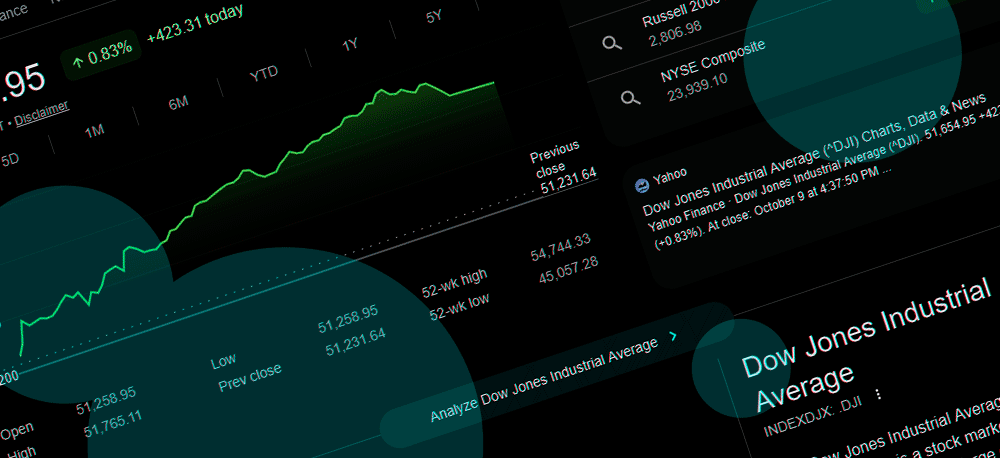
The Dow Jones closed Friday at 51,654.95, gaining 0.83%. The S&P 500 advanced 0.59% to 7,811.54, while the Nasdaq Composite increased 0.64% to 27,366.17.
For the week, the Dow gained approximately 0.93%, the S&P 500 rose 1.15%, and the Nasdaq added 0.64%. The advance reversed losses in the Dow and S&P 500 during the preceding week, when they declined 1.3% and 0.3%, respectively. The Nasdaq had gained 0.5% during that earlier period and extended its weekly winning streak to four.
- The Dow Jones Industrial Average closed at 51,654.95 on October 9, gaining 0.83%, while the S&P 500 advanced 0.59% and the Nasdaq Composite rose 0.64%. All three indexes finished the week higher.
- September inflation data, due October 14, could influence expectations for another Federal Reserve interest rate increase. Headline CPI is forecast to accelerate from 3.4% to approximately 3.6% year over year.
- JPMorgan Chase, Goldman Sachs and other major banks begin reporting third-quarter earnings on October 13. Strong corporate profits could support the Dow Jones rally, although elevated Treasury yields and inflation remain significant risks.
The market’s next direction will depend partly on whether economic data support expectations for a pause in Federal Reserve tightening and whether corporate earnings can justify elevated equity valuations.
The Federal Reserve increased interest rates in September for the first time since 2023. Its next policy meeting is scheduled for October 27–28, making the upcoming inflation report particularly relevant to investors.
September CPI could determine the next Dow Jones move
The U.S. Consumer Price Index for September is scheduled for release on Wednesday, October 14. Headline inflation is expected to accelerate to approximately 3.6% year over year from 3.4% in August, with some forecasts reaching 3.7%.
Monthly consumer prices are projected to increase 0.6%, compared with a 0.4% gain in August.
An inflation reading above expectations could revive speculation about another Federal Reserve rate increase in October. Higher interest rates generally raise financing costs for businesses and consumers and can weigh on equity valuations, particularly when bond yields are already elevated.
A report showing inflation at or below expectations could reduce immediate pressure on the Fed to tighten monetary policy further. That would provide some support for equities, although the central bank’s decision will also depend on employment conditions and other economic indicators.
The September employment report has already provided evidence of slowing labor demand.
Following the October 2 employment release, futures traders assigned a 23% probability to an interest rate increase at the October meeting, down from 28% before the report and 64% a week earlier, according to CME FedWatch figures available at the time.
U.S. employers added just 29,000 jobs during the month, substantially below economists’ expectations of 84,000 and the 162,000 jobs initially reported for August. The unemployment rate reached 4.2%, exceeding the expected 4.1%.
The weaker employment data reduced expectations for further monetary tightening, although persistent inflation has prevented investors from ruling out another increase.
“We are seeing the tension between the goods-producing sectors that support the AI boom and the services-producing sectors that are feeling the impact of technological change,” Jeffrey Roach, chief economist at LPL Financial, said in commentary following the employment report. “Given the overall softness of the labor market, the likelihood of two Fed hikes is getting lower.”
Treasury yields remain a risk for U.S. stocks
Government bond yields have become another major consideration for the Dow Jones forecast. The bond market remained volatile during the following week, with the 10-year yield reaching approximately 5.36% on October 7 before retreating. By the October 9 close, it stood near 5.24%.
The benchmark 10-year Treasury yield approached 5.35% during the first part of October, reaching its highest level in roughly 24 years. After briefly dropping toward 5.16% following the September employment report on October 2, the yield recovered to around 5.30% later that session.
The elevated yield increases competition for investor capital because government securities offer relatively high returns without the earnings uncertainty associated with stocks.
Higher borrowing costs can also affect consumer spending, corporate investment and credit demand. These pressures are particularly relevant as major financial institutions prepare to report quarterly results.
For the Dow Jones, a renewed increase in Treasury yields could offset the benefit of strong earnings. Conversely, stabilizing yields would remove one source of pressure on equity valuations.
JPMorgan and Goldman Sachs begin Q3 earnings season
Third-quarter corporate earnings will provide another important test of the stock market rally.
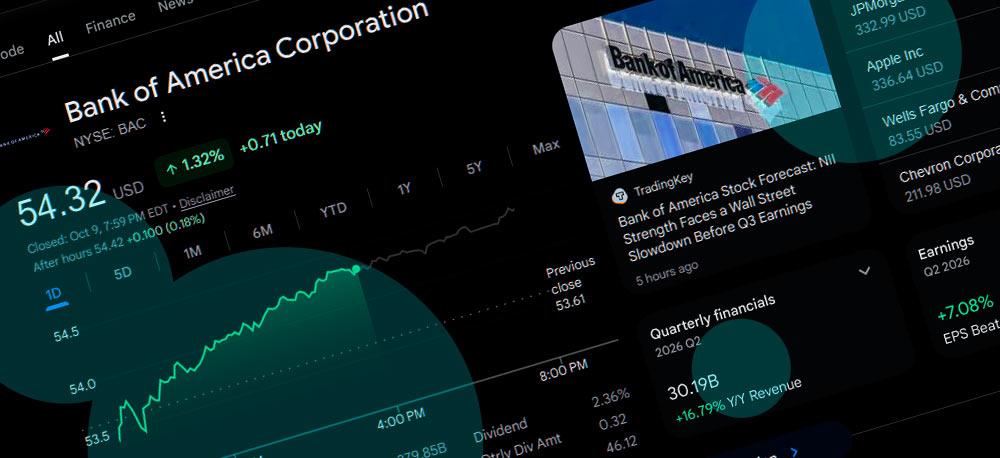
JPMorgan Chase, Goldman Sachs, Citigroup and Wells Fargo are scheduled to report on Tuesday, October 13. Bank of America and Morgan Stanley follow on Wednesday.
Earnings for S&P 500 companies are expected to increase by around 30% year over year during the third quarter, creating demanding expectations for corporate performance.
The bank reports will provide evidence of how higher interest rates and energy costs are affecting households, lending activity, corporate financing and capital markets.
Investors will examine net interest income, credit quality, loan demand, investment banking activity and management commentary on consumer financial conditions.
Stronger-than-expected results could support confidence in corporate profitability and help sustain the broader equity rally. Weaker earnings or more cautious guidance could encourage investors to reassess valuations, particularly after the market’s recent gains.
Dow Jones stocks: Amazon, Cisco and Visa lead gains
Friday’s advance included substantial gains among several Dow Jones components. The gains helped the Dow recover despite significant selling pressure in telecommunications stocks.
Amazon shares increased 3.29%, or $8.37, to close at $262.43. Cisco Systems gained 3.03%, or $3.48, finishing at $118.37, while Visa rose 2.76%, or $10.35, to $385.45.
Verizon Communications declined 8.75%, or $3.99, to $41.65. Industrial conglomerate 3M fell 2.21%, or $3.62, to $159.96, while Home Depot dropped 1.60%, or $4.73, to $290.74.
Telecommunications shares weakened as investors assessed the potential competitive implications of SpaceX’s expansion into mobile communications.
T-Mobile US declined 13.27% to $148.58, making it the weakest performer in the S&P 500. AT&T lost approximately 10%, closing near $22.18, while Verizon’s decline added to pressure on the sector.
The selling followed developments involving SpaceX’s acquisition of wireless spectrum intended to support its Starlink Mobile business.
Cell tower companies moved in the opposite direction. Crown Castle surged 15.60% to $79.64, leading the S&P 500, as investors evaluated the potential infrastructure requirements associated with expanded satellite-linked mobile services.
Healthcare stocks also recorded substantial gains. Moderna advanced 14.21% to $225.00, while health insurer Humana increased 11.56% to approximately $431.87.
Technology and AI investment remain important market drivers
Technology shares continue to influence the broader market, particularly as investors assess the scale of capital spending on artificial intelligence infrastructure.
During the preceding week’s trading, Tesla shares rose approximately 4.5% after third-quarter vehicle deliveries exceeded expectations. SpaceX gained 7.5%, while Nike declined about 3.5% after projecting a larger fiscal-year sales contraction than analysts had anticipated.
AI-related investment also remained in focus following reports about financing arrangements involving major technology companies.
A Financial Times report indicated that Amazon was considering transferring approximately $8 bn of advanced Nvidia chips to investors as part of an effort to strengthen its balance sheet.
Nvidia reached an intraday high during that earlier trading period, while the Roundhill Magnificent Seven ETF gained approximately 1.5%.
Broadcom advanced around 3.5% following a Bloomberg report that a financing syndicate was assembling approximately $60 bn to support AI chip purchases involving Anthropic and other companies. The iShares Semiconductor ETF rose about 2%.
The memory storage segment showed a different pattern. Roundhill’s Memory ETF declined 0.5%, pressured by double-digit losses in Seagate Technology and Western Digital after reports that Toshiba planned to double hard disk drive production capacity.
These developments illustrate the different pressures within the technology sector, where large-scale AI financing commitments coexist with competitive and supply-related risks.
Dow Jones forecast: what investors should watch next
The near-term outlook for the Dow Jones Industrial Average depends on the relationship between corporate earnings, inflation and Treasury yields.
The index enters the new week above 51,600 following a positive weekly performance, with the S&P 500 also trading close to record levels. Recent gains suggest investors remain willing to hold equities despite relatively high borrowing costs.
A September CPI reading in line with or below expectations, combined with strong bank earnings, could support further advances. Lower Treasury yields would strengthen that outcome by reducing pressure on stock valuations.
The opposite scenario would involve inflation exceeding forecasts, renewed increases in bond yields and weaker-than-expected corporate results. Such a combination could encourage profit-taking following the market’s recent rally.
The Dow’s performance will also depend on the participation of its individual components. Friday’s gains in Amazon, Cisco and Visa helped offset substantial losses in Verizon, demonstrating how sector-specific developments can influence the index even when the broader market advances.
For investors assessing the Dow Jones forecast for October 11, the immediate events are JPMorgan Chase and Goldman Sachs earnings on October 13, the September CPI report on October 14, and subsequent economic releases ahead of the Federal Reserve’s October 27–28 meeting.
The latest closing level of 51,654.95 provides the reference point for the next trading session. Whether the Dow extends its gains will depend on how incoming economic and corporate data affect interest rate expectations and the outlook for U.S. earnings.