Follow Beinsure
Severe convective storms and hail that swept across Queensland and New South Wales in late November are estimated to have caused A$2.663 bn in insured losses, roughly $1.78 bn, according to PERILS.
The storm sequence hit Australia’s east coast between 21 and 27 November 2025. Queensland and New South Wales took the brunt.
Claims built quickly, with hail emerging as the dominant loss driver, based on earlier figures published by the Insurance Council of Australia.
Primary insurers have already flagged pressure. Suncorp Group said it expects to rely on reinsurance protection to absorb part of the hit. Others may follow.
Excess-of-loss covers look set to trigger, and quota share structures will pass losses through automatically. That much feels inevitable.
PERILS based its estimate on loss data reported by insurers affected by the storms. The figure covers property and motor hull lines, no surprises there.
Late November delivered a textbook setup for destruction, with weather conditions lining up to produce extreme hail, damaging winds, and intense local rainfall across a wide corridor between Brisbane and Sydney.
Queensland and New South Wales Severe Convective Storms
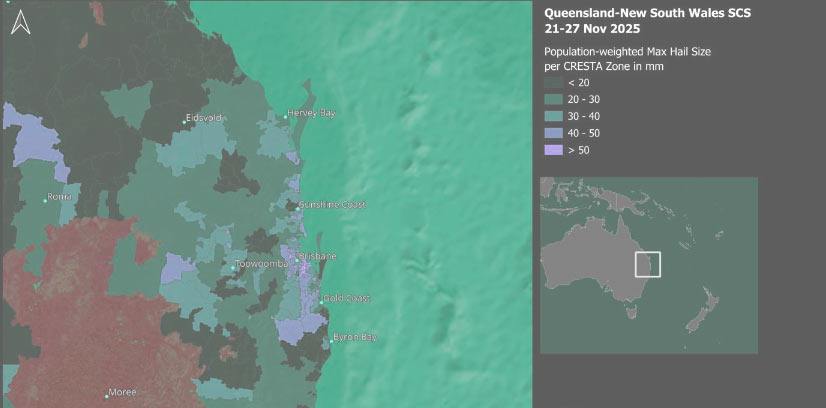
The most severe damage landed on 24 November in South East Queensland. PERILS reported hailstones up to 14 cm in diameter. Winds followed. Roofs failed. Facades suffered. Solar panels shattered. Vehicles took direct hits, often beyond repair.
Darryl Pidcock, head of Asia Pacific and cyber at PERILS, said the event marked the second billion-dollar severe convective storm within a single month. He said it now ranks among Australia’s five most costly SCS events over the past 60 years.
Compared with the October storms, this one caused materially greater destruction, especially in Brisbane suburbs where hailstones reached tennis-ball size or larger.
Pidcock added some context around frequency. Debate continues over whether multi-billion-dollar SCS events are becoming more common. On a normalised basis, Australia has already recorded five SCS events above A$1 bn this decade.
The previous decade saw three. Between 2000 and 2009, there were none. The 1990s logged two. The numbers don’t settle the argument, but they narrow it.
PERILS had earlier pegged insured losses from late October east coast storms at A$1.108 bn. November came harder. And it didn’t wait long.